

Christmas Day: History, Date, Traditions and Meaning
December 25 became Christmas in 4th-century Rome, but nobody actually knows when Jesus was born. Here's how one date conquered the calendar and what the world does with it every year.
Christmas Day is December 25, the date on which Christians celebrate the birth of Jesus Christ. It is the most widely observed holiday on the planet. Roughly 2 billion Christians recognize it as a religious feast, and hundreds of millions more celebrate it as a secular occasion involving gifts, meals, and family gatherings. It is a public holiday in more than 160 countries.
Contents
The date itself is fixed in the Western calendar. Unlike Easter, which shifts each year, Christmas always falls on December 25. Orthodox Christians who follow the Julian calendar celebrate on January 7, which corresponds to December 25 on their older calendar. The holiday's position near the winter solstice is not a coincidence, though scholars disagree about exactly why early Christians chose this date.
Why Is Christmas Day on December 25?
The earliest recorded Christmas celebration on December 25 appears in the Chronography of 354, a Roman document that lists feast days reflecting practice as early as 336 AD. Before that date, there was no consensus among Christians about when to celebrate Christ's birth. Some Eastern churches observed it on January 6 (Epiphany). Others didn't celebrate it at all.
Two competing theories explain why December 25 was chosen.
The Calculation Theory
By the 3rd century, many Latin Christians in Rome and North Africa had settled on March 25 as the date of Jesus's crucifixion. An early tradition held that great prophets died on the same date they were conceived. If Jesus was conceived on March 25, a nine-month pregnancy would place his birth on December 25. The theologian Sextus Julius Africanus made this calculation as early as 221 AD, over a century before the first Christmas feast was recorded in Rome.
This theory has strong scholarly support. It doesn't require any pagan influence. It relies entirely on internal Christian logic about sacred dates.
The Sol Invictus Theory
December 25 was also the traditional date of the winter solstice in the Roman calendar and the festival of Dies Natalis Solis Invicti (Birthday of the Unconquered Sun), established by Emperor Aurelian in 274 AD. The theory suggests that Christians chose December 25 to replace or compete with this pagan festival.
The idea is popular and often repeated, but the evidence is thin. The Chronography of 354 lists both the birth of Christ and the birthday of Sol Invictus on December 25, which could mean Christians borrowed the date, or that both traditions arrived at it independently. Most recent scholarship treats the relationship as unproven. The pagan-replacement narrative makes a better story than it does a historical argument.
Is December 25 Jesus's Birthday?
Almost certainly not, at least not in the historical sense. The Gospels of Matthew and Luke describe the nativity, but neither gives a date. Luke mentions shepherds "keeping watch over their flocks by night," which some scholars argue points to spring or autumn rather than midwinter, when flocks in the Judean hills would more likely have been sheltered. Others note that shepherding practices varied and the detail isn't definitive.
The year is also uncertain. Matthew places the birth during the reign of Herod the Great, who died in 4 BC. Luke connects it to a census under Quirinius, governor of Syria, which occurred around 6 AD. These two accounts are difficult to reconcile. Most historians place Jesus's birth somewhere between 6 BC and 4 BC, based primarily on Herod's death.
The early Church wasn't bothered by the gap between the historical date and the liturgical one. December 25 was chosen to mark the theological significance of the incarnation, not to record a historical birthday. The date celebrates what happened, not when it happened.
Christmas Day as a Public Holiday
In the United States, Christmas Day became a federal holiday on June 26, 1870, when President Ulysses S. Grant signed it into law alongside New Year's Day, Independence Day, and Thanksgiving. The legislation initially applied to federal employees in the District of Columbia, but the holiday's observance quickly spread. Today, December 25 is the only religious holiday on the U.S. federal calendar.
The constitutionality of this arrangement has been debated but never overturned. Courts have generally held that Christmas has both religious and secular dimensions and that recognizing it as a public holiday serves a legitimate secular purpose (giving workers a day off during a period when most businesses close anyway).
In the United Kingdom, Christmas Day has been a public holiday since long before the concept was formalized. The Christmas Day (Trading) Act 2004 restricts large shops in England and Wales from opening on December 25. Scotland and Northern Ireland have their own legislation. The result is that Christmas Day is one of the quietest days of the year in British public life.
Globally, Christmas Day is a public holiday in virtually every country with a significant Christian population. It is also a public holiday in several countries where Christians are a minority, including India, Indonesia, and Lebanon, reflecting the holiday's cultural reach beyond its religious origins.
Christmas Day Mass and Church Services
For practicing Christians, the religious centerpiece of Christmas is the church service. Catholic, Orthodox, Anglican, and many Protestant churches hold services on Christmas Day, though the most heavily attended service is typically on Christmas Eve rather than Christmas morning.
A 2024 survey by Lifeway Research found that 47% of Americans attend a religious service on Christmas Eve or Christmas Day, down 17 percentage points from 2010. Among Christian celebrants specifically, the figure is 61%, down from 73% in 2010. The decline tracks with broader trends in church attendance across Western countries.
Half of U.S. Protestant pastors identify Christmas Eve as their largest service of the holiday season. Only 7% say Christmas Day draws the biggest crowd. The pattern makes practical sense. Christmas Eve services end early enough for families to go home, put children to bed, and handle last-minute gift preparations. Christmas morning is for the living room, not the pew.
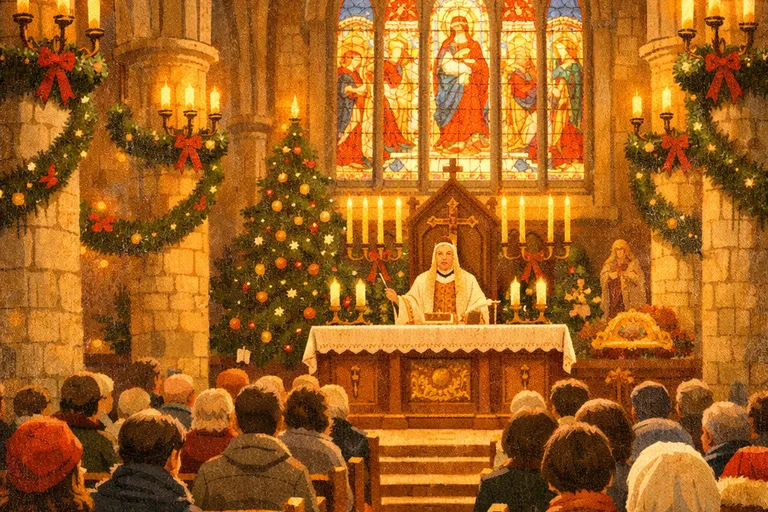
The Vatican's papal Christmas Mass at St. Peter's Basilica remains one of the most watched religious broadcasts in the world. In the Philippines, the tradition of Simbang Gabi (dawn Mass) runs for nine consecutive days starting December 16, culminating on Christmas Eve. Filipino churches open as early as 4 AM, and families fill the pews before sunrise. In Caracas, Venezuela, the tradition of roller-skating to Christmas morning Mass is so embedded in local culture that the government closes streets to car traffic to let worshippers glide to church.
Christmas Day Parades and Broadcasts
The Disney Parks Christmas Day Parade has aired on American television every year since 1983. Filmed at Walt Disney World and Disneyland, the two-hour broadcast features floats, musical performances, celebrity appearances, and Disney characters. It airs on ABC at 10:00 AM Eastern on December 25 and streams on Disney+ and Hulu. For many American families, turning on the Disney parade is as much a Christmas Day ritual as opening presents.
In the United Kingdom, the Royal Christmas Message is the day's defining broadcast. The tradition started in 1932, when King George V delivered a live radio address written by Rudyard Kipling. Queen Elizabeth II gave her first televised Christmas message in 1957. Unlike the King's Speech at the State Opening of Parliament, which is written by the government, the Christmas message is personal, written by the monarch with input from family and advisors. It airs at 3:00 PM GMT, and watching it (or pointedly not watching it) is a national tradition.
Australia's Adelaide Christmas Pageant, held since 1933, draws over 300,000 spectators to the streets of central Adelaide, making it one of the largest Christmas parades in the world. In Ireland, the tradition of the Wren's Day parade takes place on December 26 (St. Stephen's Day) rather than Christmas Day itself. Groups known as "Wren Boys" dress in straw costumes and masks and parade through towns, collecting money for charity.
What People Actually Do on Christmas Day
A 2024 Gallup survey found that 96% of Americans who celebrate Christmas exchange gifts, and 95% gather with family or friends. These numbers have barely changed in decades. The specific traditions vary by household, but the broad pattern is consistent: gifts in the morning, food in the afternoon, some combination of television and family time in between.
The Christmas dinner is where national identity takes over. In the United States, ham or turkey dominates the table. In the United Kingdom, roast turkey with all the trimmings (roast potatoes, Brussels sprouts, pigs in blankets, Christmas pudding) is the standard. In Australia, where December 25 falls in the middle of summer, barbecues and cold seafood platters are common. In the Philippines, families return to the table with lechon, queso de bola, and the same dishes that filled the Noche Buena feast the night before.
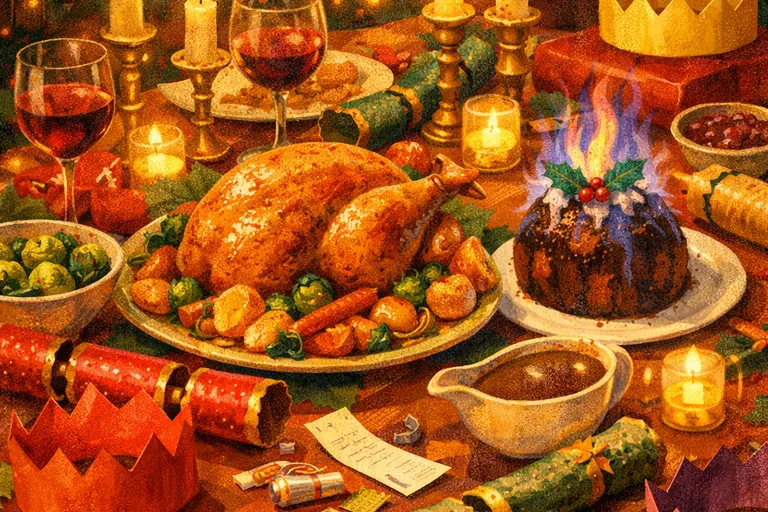
In the UK, Christmas crackers (cardboard tubes that pop when pulled apart, containing paper crowns, small toys, and terrible jokes) have been part of the meal since Tom Smith invented them in the 1840s. Wearing the paper crown from your cracker during dinner is not optional. It is understood that everyone looks ridiculous and that this is the point.
By evening, much of the English-speaking world settles into a similar pattern: leftover food, new toys and gadgets being tried out, and a collective sense of having eaten too much. In the UK, roughly 9 million viewers tune in to whatever special the BBC has scheduled for the evening slot. In the United States, the NBA has played games on Christmas Day since 1947, turning December 25 into one of the league's marquee broadcasting days.
Frequently Asked Questions
What day is Christmas Day?
Christmas Day is always December 25 in the Western (Gregorian) calendar. The date is fixed and does not change from year to year. Orthodox Christians who follow the Julian calendar celebrate Christmas on January 7, which corresponds to December 25 on the older Julian calendar.
Is December 25 really Jesus's birthday?
There is no historical evidence that Jesus was born on December 25. The Gospels do not specify a date. Most historians place his birth between 6 BC and 4 BC based on references to King Herod, but the month and day are unknown. December 25 was established as the liturgical celebration of his birth in 4th-century Rome.
When did Christmas Day become a federal holiday in the USA?
Christmas Day became a U.S. federal holiday on June 26, 1870, when President Ulysses S. Grant signed it into law. It was part of a package that also established New Year's Day, Independence Day, and Thanksgiving as federal holidays. It is the only religious holiday on the U.S. federal calendar.
Why is Christmas on December 25 and not another date?
Two main theories exist. The Calculation Theory holds that early Christians placed the Annunciation on March 25 (the date they believed Jesus was crucified), counted nine months forward, and arrived at December 25. The Sol Invictus Theory suggests Christians chose the date to compete with the Roman sun festival. Most recent scholarship favors the calculation theory or considers the evidence inconclusive.
What is the Royal Christmas Message?
The Royal Christmas Message is an annual broadcast by the British monarch to the Commonwealth, aired at 3:00 PM GMT on Christmas Day. The tradition began in 1932 with a radio address by King George V. Unlike parliamentary speeches written by the government, the Christmas message is personal content written by the monarch. It was first televised in 1957 by Queen Elizabeth II.
Do all countries celebrate Christmas on December 25?
Most countries that celebrate Christmas observe it on December 25, but Orthodox Christians in Russia, Ethiopia, Egypt, Serbia, and other countries celebrate on January 7 due to the Julian calendar. Armenia celebrates on January 6. Christmas Day is a public holiday in over 160 countries, including several where Christians are a minority.