
Holly at Christmas: History, Symbolism and Meaning
Long before anyone pinned holly to a Christmas wreath, the Druids wore it at solstice rituals and Romans tied sprigs to Saturnalia gifts. How a spiky evergreen became the most recognizable plant in Christianity.
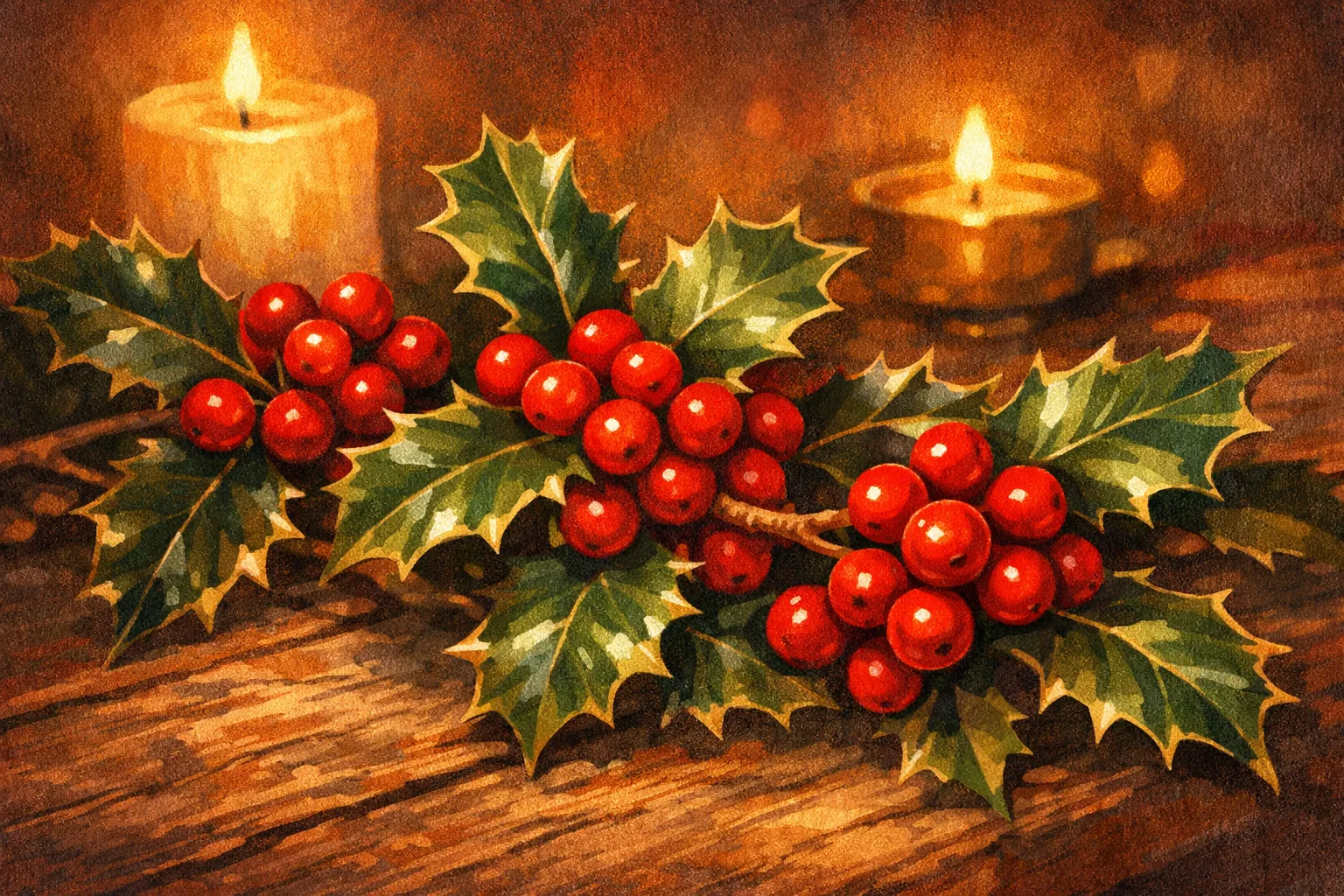
Holly is the single most recognizable plant in the Christmas visual vocabulary. Its glossy, spined leaves and bright red berries appear on greeting cards, wrapping paper, door wreaths, and mantelpiece garlands every December. But the reason holly became a Christmas symbol has almost nothing to do with Christianity. The plant's association with midwinter celebrations stretches back thousands of years, to a time when Druids credited it with magical powers and Roman citizens tied sprigs of it to gifts exchanged during the festival of Saturnalia.
Contents
The genus Ilex contains more than 480 species, but the one most associated with Christmas is Ilex aquifolium, the European or English holly. Native to western and southern Europe, northwest Africa, and southwest Asia, it can grow over 15 meters tall in the wild, though most garden specimens stay much smaller. Only female plants produce the red berries, and only when a male plant grows nearby for pollination. The berries ripen in autumn and persist through winter, which is precisely why ancient peoples paid attention to this particular tree when everything else had gone bare and brown.
Why Is Holly Associated with Christmas?
The short answer: because the Romans did it first, and Christians decided to keep doing it. During Saturnalia, the Roman festival honoring Saturn, the god of agriculture and time, citizens decked their homes with evergreen garlands. Holly sprigs were tied to each gift exchanged during the festivities. Pliny the Elder, writing in the first century, claimed holly planted near a house could repel poison, defend against lightning, and ward off witchcraft. He even asserted that holly wood thrown near an animal would compel it to return and lie down beside it. Pliny was wrong about most of this, but the superstitions stuck.
North of the Roman Empire, the Celtic Druids had their own ideas about holly. They considered it a symbol of eternal life because it stayed green through winter when deciduous trees stood skeletal. At the summer solstice, according to Celtic mythology, the Holly King defeated the Oak King and reigned through to winter. Druids wore holly during solstice rituals, believing it offered protection from evil spirits, witches, and (oddly specific) mad dogs.
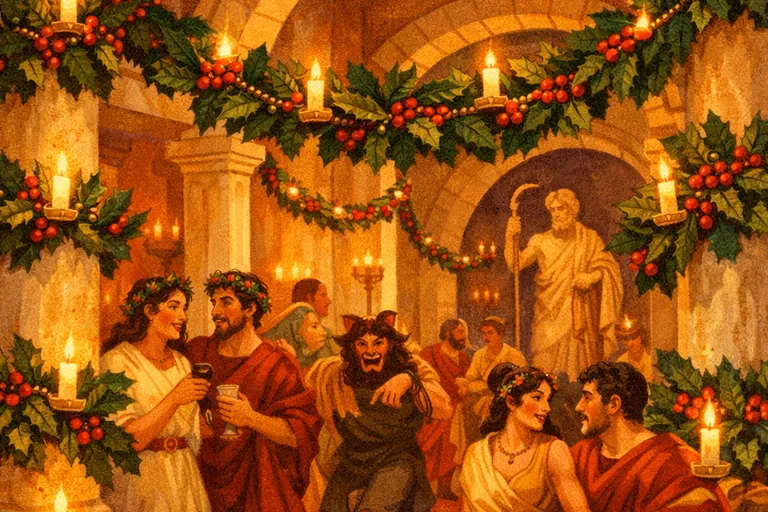
When Christianity expanded across Europe, early church leaders tried to stamp out these pagan decorating customs. They failed. The more pragmatic clergy took a different approach: they reassigned the symbolism. Instead of fighting holly, they baptized it.
Holly Christmas Meaning: Thorns, Blood, and Eternal Life
The Christian reinterpretation of holly is elegant in its directness. The spiny leaves became the crown of thorns pressed onto Christ's head before the crucifixion. The red berries became drops of his blood. The evergreen nature of the plant represented eternal life after death. Even the white flowers of the holly tree were conscripted into service, symbolizing purity.
This symbolism was taken seriously enough that holly acquired a new common name in parts of Europe: "Christ's thorn." One popular legend held that holly berries were originally white and turned permanently red after being stained by Christ's blood. Another claimed that the cross itself was made from holly wood. Neither story appears in any biblical text, but both circulated widely during the medieval period and helped cement the plant's place in Christian iconography.
The practical side mattered too. Holly's berries ripen in winter. It keeps its leaves year-round. It was available when very little else was. If you wanted to bring something green and alive into your home during the darkest weeks of the year, holly was one of your few options. Theology followed convenience, not the other way around.
The Holly and Ivy Christmas Tradition
Holly and ivy are so often paired at Christmas that it can be difficult to separate them. But their pairing predates Christianity by centuries. In pre-Christian Britain, holly was considered male and ivy female. This gendered reading created a ritual structure. A fifteenth-century collection of English carols preserves evidence of a contest between boys carrying holly branches and girls carrying ivy. The holly, symbolizing light and warmth, was meant to triumph over ivy, which represented darkness and cold. Ivy stayed outside the door. Holly was carried into the hall.
At the pagan festival of Beltane, holly and ivy branches were burned together. In the Midlands of England, an old tradition held that whichever plant was brought into the house first at winter determined who would rule the household for the coming year: the man (holly) or the woman (ivy).
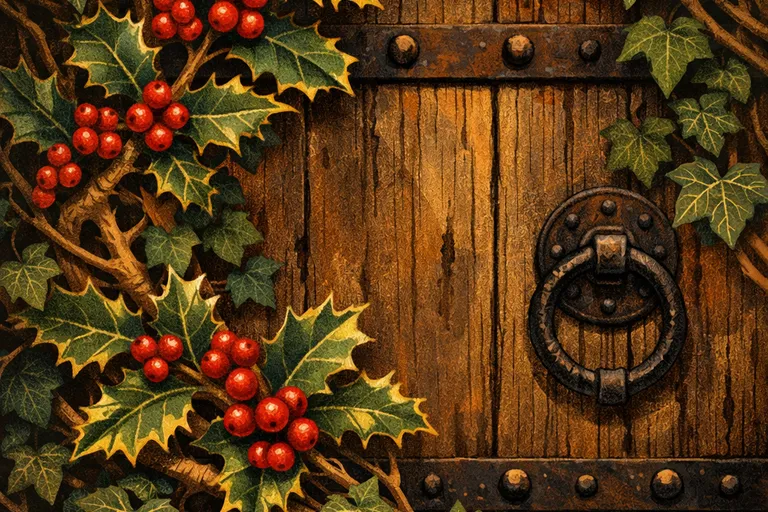
Christianity initially had trouble with ivy. Its ability to grow in shade gave it associations with secrecy and debauchery. For a period, ivy was banished from church decoration while holly remained welcome. But the two plants were eventually reunited under Christian symbolism: holly represented Jesus, ivy represented the Virgin Mary. This reading became the basis for one of the most enduring Christmas carols in the English language.
The Carol That Sealed It
The first known publication of "The Holly and the Ivy" appeared on broadsides printed in Birmingham in the early nineteenth century. But the lyrics carry older DNA. The version now sung in churches worldwide was collected in 1909 by the folk song collector Cecil Sharp, who heard it from a woman named Mary Clayton in the market town of Chipping Campden, Gloucestershire.
The carol is deceptively simple. Its opening line, "The holly and the ivy, when they are both full grown," sounds like a nature poem. But every subsequent verse layers Christian meaning onto the holly's physical features: the blossom represents Mary, the berry represents blood, the prickle is the crown of thorns, the bark is bitter as gall. Ivy barely appears after the first line. The song belongs to holly entirely.
Holly Berry Christmas Traditions and Folklore
Holly berries did more than look festive. In folk tradition, their abundance predicted the coming winter. A heavy crop of berries supposedly meant harsh weather ahead. The thinking was that nature produced extra food to sustain birds through a difficult season. This isn't botanically sound (berry production relates more to the previous spring's conditions), but it persisted as weather lore across Britain and northern Europe for centuries.
The berries also carried superstitions about luck. Cutting down an entire holly tree was considered spectacularly bad luck. In 1861, the Duke of Argyll rerouted a planned road to avoid felling a prominent old holly tree. Taking branches for decoration was acceptable. Destroying the whole tree was not.
After Christmas, the disposal of holly required care. In Ireland, throwing holly in the trash was considered disrespectful. Burning it was the proper method, as fire honored the plant's symbolic power. But in Shrewsbury, England, burning holly decorations was considered exceedingly unlucky. These contradictions are typical of folk tradition, where rules shift every 50 miles.
Holly's Pagan Origins and Thunder Gods
Before holly belonged to Christ, it belonged to the gods of thunder. In Norse mythology, holly was associated with Thor. In Celtic tradition, it was linked to Taranis, the thunder deity. The common thread was protection. Holly was hung over doorways as a barrier against demons. It was planted near houses to divert lightning strikes. The logic was sympathetic: holly's sharp spines resembled tiny weapons, so the plant itself was understood as combative, a natural guardian.
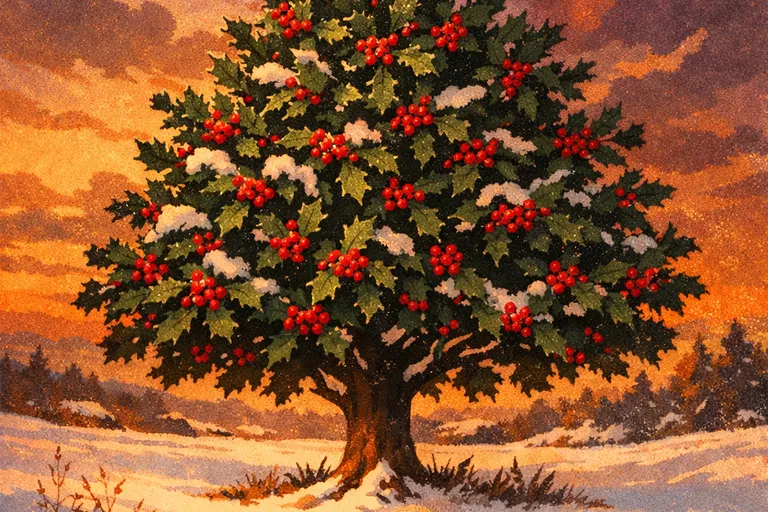
Modern science has added its own footnote. Researchers discovered that holly trees adjust their leaf spines through epigenetic modification. Leaves on lower branches, within reach of browsing animals, tend to be spikier. Leaves higher up, beyond the reach of deer, are often smooth-edged. The tree is, in a literal sense, arming itself where it needs to. The Druids who credited holly with defensive magic were responding to something real, even if their explanation was wrong.
Holly in the Modern Christmas
Holly's position in the modern Christmas is secure but largely decorative. Few people hanging a holly wreath on their front door are thinking about Saturnalia or the Holly King. The symbolism has been compressed into pure visual shorthand: saw-toothed green leaves plus red berries equals Christmas.
The plant itself has spread far beyond its European origins. Ilex aquifolium is now classified as an invasive species on the Pacific coast of North America, where it escapes from gardens and colonizes native forests. In its homeland, meanwhile, the Woodland Trust in Britain lists holly as an important native species, noting that its dense foliage provides critical winter shelter for birds. The mistle thrush is so protective of holly berry supplies that it will aggressively defend a single tree against all other birds throughout winter.
In a church in rural Gloucestershire in 1909, Mary Clayton sang Cecil Sharp a carol about holly that she had probably learned from her mother, who had learned it from hers. The words traced their lineage back through medieval ritual contests, past Christian reinterpretation, past Roman Saturnalia garlands, all the way to a Druid standing in a forest, looking at a tree that refused to die in winter, and deciding that it must mean something.
Frequently Asked Questions
Why is holly associated with Christmas?
Holly became a Christmas symbol because ancient Romans decorated with it during Saturnalia, their midwinter festival, and early Christians adopted the custom rather than fighting it. The church reassigned holly's meaning: spiny leaves represented Christ's crown of thorns, red berries symbolized his blood, and the evergreen leaves stood for eternal life. The plant's ability to stay green and produce bright berries in winter made it a natural choice for midwinter decoration long before Christianity existed.
What do holly berries symbolize at Christmas?
In Christian tradition, holly berries symbolize the blood Christ shed during the crucifixion. A popular medieval legend claimed that holly berries were originally white and turned permanently red after being stained by Christ's blood. Before Christianity, the berries were simply valued as one of the few bright spots of color available during the dark winter months.
Is holly a pagan symbol?
Holly was a significant pagan symbol before it became a Christian one. The Druids considered it sacred and associated it with eternal life because it stayed green through winter. The Celts connected it to the Holly King, who ruled from the summer solstice to the winter solstice. Romans used holly extensively during Saturnalia. Christianity later reinterpreted these existing traditions rather than eliminating them.
What is the tradition of the holly and the ivy?
Holly and ivy were traditionally paired as masculine and feminine symbols in pre-Christian Britain. Boys carried holly branches and girls carried ivy in ritual winter contests. The popular Christmas carol "The Holly and the Ivy" dates to at least the early nineteenth century and layers Christian symbolism onto the holly plant, with each physical feature representing an aspect of Christ's life and death. The carol was collected in its current form in 1909 by folk song collector Cecil Sharp in Gloucestershire, England.
Is it bad luck to cut down a holly tree?
In British and European folklore, cutting down an entire holly tree was considered very bad luck. In 1861, the Duke of Argyll rerouted a road rather than fell a prominent holly. Taking branches for Christmas decoration was acceptable, but destroying the whole tree was not. After Christmas, disposal traditions varied by region: in Ireland, burning holly was proper, while in Shrewsbury, England, burning it was considered unlucky.
How many species of holly exist?
The genus Ilex contains more than 480 species worldwide. The species most associated with Christmas is Ilex aquifolium, the European or English holly, which is native to western and southern Europe, northwest Africa, and southwest Asia. Only female holly plants produce the characteristic red berries, and they require a male plant nearby for pollination.