
Christmas
Markets
Glühwein, gingerbread, and glittering wooden stalls - your guide to the world's best Christmas markets, from the medieval Christkindlmärkte of Germany to festive holiday markets in New York City.
A Christmas market is one of the most magical experiences of the holiday season - rows of twinkling wooden chalets selling handmade ornaments, the scent of roasted chestnuts and cinnamon, a steaming mug of Glühwein warming your hands against the December chill. Born in medieval Germany and now embraced worldwide, Christmas markets transform city squares into festive wonderlands every Advent season. Whether you are planning a trip to the legendary Christkindlmärkte of Germany or exploring the growing holiday markets of New York City, this hub will help you find the perfect market for you.
Explore our five in-depth guides below - from the best Christmas markets in Europe ranked by atmosphere and tradition, to city-specific guides for Vienna and Prague. Then scroll on for the fascinating history of this centuries-old Christmas tradition, practical planning tips, and answers to every question you might have.
Christmas Market Guides
City-by-city guides to the world's best Christmas markets - dates, food, top stalls, and insider tips for each destination.
Best Christmas Markets in Europe
15+ marketsFrom Nuremberg to Strasbourg, Vienna to Zagreb - 15+ top European Christmas markets ranked by atmosphere, food, and tradition.
German Christmas Markets
10 ChristkindlmärkteThe birthplace of the Christkindlmarkt - Nuremberg, Dresden, Cologne, Munich, and beyond. History, Stollen, and Glühwein.
Vienna Christmas Markets
6 marketsRathausplatz, Schönbrunn Palace, Belvedere - Vienna's imperial Christmas markets set against Baroque architecture.
Prague Christmas Markets
5 marketsOld Town Square, Wenceslas Square, and the best of Czech Christmas - trdelník, svařák, and Gothic charm.
New York Christmas Markets
6 marketsBryant Park, Union Square, Columbus Circle - NYC's holiday markets plus Rockefeller tree, Saks windows, and Dyker Heights.
What to Expect at a Christmas Market
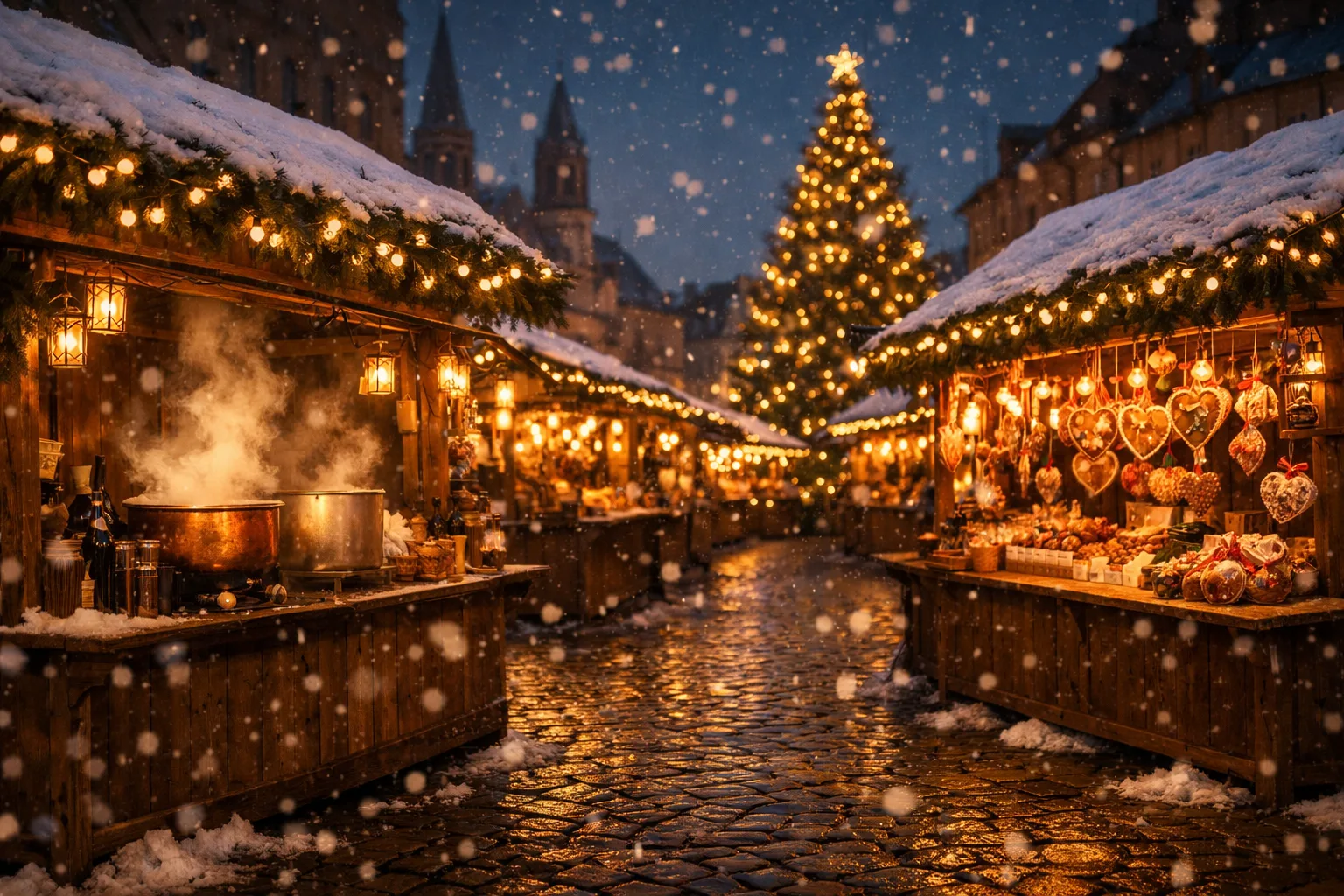
A typical Christmas market is an open-air affair set in a town square, park, or pedestrian street. Rows of wooden stalls - often styled as rustic alpine chalets with pitched roofs and twinkling lights - line walkways that wind through the market. Each stall specialises: one sells hand-carved wooden ornaments and nutcrackers, another offers beeswax candles and nativity scenes, a third displays hand-knitted scarves and felt decorations. At the heart of most markets stands a towering Christmas tree, often the centrepiece of the entire square.
Food and drink are inseparable from the Christmas market experience. Glühwein (hot mulled wine) is the signature drink, served in collectible ceramic mugs unique to each market - keeping the mug is a tradition in itself. German markets add Bratwurst, Lebkuchen (gingerbread), Stollen (fruit bread), and roasted chestnuts. In Vienna, look for Punsch (hot punch) and Kaiserschmarrn; in Prague, trdelník (chimney cake) and svařák (Czech mulled wine); in New York, artisan hot chocolate and gourmet doughnuts.
Beyond shopping and eating, Christmas markets are about atmosphere. Live carol performances, brass bands, and choir concerts are common. Many markets include an ice-skating rink, a carousel, or a small Ferris wheel. Children visit Santa's grotto or workshop. As evening falls and the lights come on, the market transforms into a scene straight from a storybook - the amber glow of lanterns, the hum of conversation, the crunch of snow underfoot. It is this sensory richness that draws millions of visitors to Christmas markets across Europe and beyond every year.
History & Origins of Christmas Markets
The Christmas market tradition stretches back to the late Middle Ages in the German-speaking world. The Dresden Striezelmarkt, first documented in 1434, is generally regarded as the oldest Christmas market in the world - it takes its name from Striezel, an early word for Stollen. Strasbourg's Christkindelsmärik, dating to 1570, is the oldest in France (Alsace was then part of the Holy Roman Empire). These early markets served a practical purpose: they were the last chance for townspeople to stock up on meat, winter supplies, and gifts before the Christmas season.
Over the centuries, the markets evolved from utilitarian trade fairs into festive celebrations. By the 18th century, German Christkindlmärkte had become destinations in their own right - places to buy handcrafted toys, decorations, and seasonal treats. The tradition spread across the German-speaking world to Austria, Switzerland, and the Alsace region. Nuremberg's Christkindlesmarkt, with its famous opening ceremony by the Christkind (Christ Child), became a symbol of German Christmas culture.
The 20th century brought Christmas markets to the wider world. After World War II, the tradition spread across Europe - to Scandinavia, the UK, the Low Countries, and Eastern Europe. Cities like Vienna, Prague, and Budapest developed their own distinctive market cultures. In the 1990s and 2000s, the concept crossed the Atlantic: Chicago opened a German-style Christkindlmarket in 1996, and cities like New York, Denver, and Baltimore followed. Today, Christmas markets operate on every continent except Antarctica, drawing an estimated 300 million visitors worldwide each season.
Planning Tips
Visit on weekday mornings
Christmas markets are busiest on Friday and Saturday evenings. For a more relaxed experience, visit on a Tuesday or Wednesday morning - you'll have space to browse and shorter queues at food stalls.
Bring cash
Many stalls - especially smaller craft vendors and food stands - accept only cash. In Germany and Austria, this is particularly true. Bring euros in small denominations (or Czech crowns for Prague).
Dress in warm layers
You will be outdoors for hours. Wear thermal layers, a warm coat, hat, gloves, and comfortable waterproof boots. Standing on cobblestones in December gets cold quickly.
Try the regional specialties
Every market has signature dishes. Don't just stick to Bratwurst - try Raclette in Strasbourg, trdelník in Prague, Kaiserschmarrn in Vienna, or Feuerzangenbowle (flaming rum punch) in Germany.
Collect Glühwein mugs
Each market has its own unique ceramic mug, changed annually. Pay the deposit (Pfand), keep the mug as a souvenir - it's one of the best free-with-purchase keepsakes in Europe.
Go after dark
Christmas markets are beautiful by day, but magical after dark - usually from 4pm onward. The lights, lanterns, and glowing stalls create the atmosphere that makes these markets unforgettable.
Frequently Asked Questions
What is a Christmas market?
A Christmas market (Weihnachtsmarkt or Christkindlmarkt in German) is an outdoor street market held during the Advent season, typically from late November to 23 December. Originating in medieval Germany, these markets feature rows of wooden stalls selling handcrafted ornaments, seasonal food like Bratwurst and Lebkuchen, and hot drinks like Glühwein (mulled wine). Today, Christmas markets operate in cities across Europe, North America, and beyond.
Where are the best Christmas markets in Europe?
The most celebrated Christmas markets in Europe include Vienna's Rathausplatz, Strasbourg's Christkindelsmärik (one of the oldest, since 1570), Prague's Old Town Square, and Germany's big four - Nuremberg, Dresden, Cologne, and Munich. Other standouts include Budapest, Brussels, Zagreb, and Copenhagen. Each market has its own character, signature foods, and traditions.
Are there Christmas markets in the USA?
Yes - Christmas markets have become a growing tradition in the United States. New York City leads with Bryant Park Winter Village, Union Square Holiday Market, and Columbus Circle. Chicago's Christkindlmarket in Daley Plaza is modelled directly on Nuremberg's. Other notable US markets include Denver's Christkindlmarket, Seattle's Holiday Market, and Atlanta's Christmas market at Atlantic Station.
When do Christmas markets open?
Most European Christmas markets open in late November, often on the Friday before the first Sunday of Advent, and close on 23 December (Christmas Eve in much of Europe). Some markets - particularly in larger cities like Vienna and Prague - extend into late December or early January. Opening hours are typically 10am to 9pm, with some markets staying open later on weekends.
What do you buy at a Christmas market?
Popular purchases include handmade Christmas ornaments, wooden toys, candles, nativity figurines, and Glühwein mugs (a collectible from each market). Food is a major draw - Bratwurst, roasted chestnuts, Stollen, Lebkuchen, trdelník (in Prague), and Punsch (in Vienna). Many visitors go primarily for the atmosphere, food, and drinks rather than shopping.
Are Christmas markets free to enter?
Almost all Christmas markets are free to enter - you simply walk in and browse. You pay only for what you eat, drink, or buy from individual stalls. A few exceptions exist: some markets charge a small entry fee for special areas or evening events, and Glühwein mugs typically require a deposit (Pfand) of 2–4 euros, refunded when you return the mug.