

Christmas Stockings: History, Origins and Tradition
The story of how a bishop's gold coins, wet laundry, and Victorian sentimentality turned a simple sock into one of Christmas's most enduring rituals.
Every December, millions of families pin oversized socks to their mantels and wait for them to fill with small gifts overnight. The Christmas stocking is so familiar that most people never stop to ask why. Why a sock? Why the fireplace? And how did a piece of hosiery become one of the most recognizable symbols of Christmas?
Contents
- 1. The Legend of Saint Nicholas and the Three Daughters
- 2. Why Do We Hang Christmas Stockings by the Fireplace?
- 3. A Short History of the Christmas Stocking
- 4. What Goes in a Christmas Stocking?
- 5. Christmas Stocking Traditions Around the World
- 6. The Meaning Behind the Christmas Stocking
- 7. Who Started the Tradition of Christmas Stockings?
- 8. Frequently Asked Questions
The tradition of hanging Christmas stockings traces back to legends about Saint Nicholas of Myra, a fourth-century bishop in what is now Turkey. According to the most widely told version, Nicholas secretly tossed bags of gold coins through the window of a poor man's house to provide dowries for his three daughters. The gold reportedly landed in stockings that had been hung by the fire to dry. That single act of anonymous charity became the origin story for a custom now practiced across the English-speaking world and beyond.
The Legend of Saint Nicholas and the Three Daughters
The Saint Nicholas stocking legend first appeared in written form during the medieval period, though the oral tradition is almost certainly older. The details vary depending on the source. In some versions, Nicholas drops the gold down the chimney. In others, he throws it through an open window. A few accounts say the coins landed in shoes left by the door rather than stockings by the fire.
The core story stays consistent: a nobleman in Myra had fallen into poverty and could not afford dowries for his three daughters. Without dowries, the young women faced lives of destitution or worse. Nicholas, then a young man who had recently inherited wealth, decided to help anonymously. He visited the house on three separate nights, each time leaving a bag of gold.
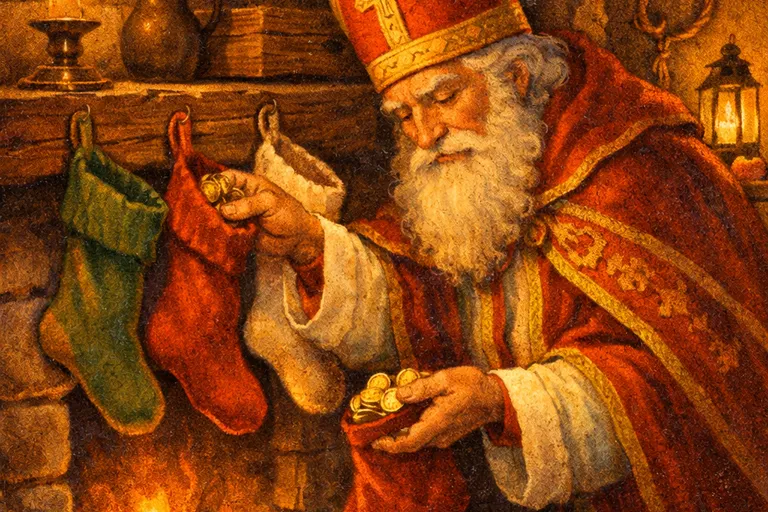
The detail about stockings drying by the fire is a later addition, likely grafted on to explain an already existing custom. Historians at the Saint Nicholas Center note that the legend was well established across Europe by the 12th century, though the stocking-specific version gained traction mainly in English-speaking countries. In much of continental Europe, children left shoes by the door or window instead, a tradition that persists in the Netherlands, Germany, and France to this day.
Why Do We Hang Christmas Stockings by the Fireplace?
The fireplace connection makes more practical sense than you might expect. Before central heating, the hearth was the warmest spot in the house. Wet clothes and socks were routinely hung near the fire to dry. If you're a saint trying to deliver gifts discreetly through a chimney, freshly laundered stockings are conveniently placed targets.
But the real answer has less to do with Saint Nicholas and more to do with 19th-century literature. The 1823 poem "A Visit from St. Nicholas" (better known as "'Twas the Night Before Christmas") cemented the stocking-by-the-fireplace image in the American imagination. The famous lines, "The stockings were hung by the chimney with care, in hopes that St. Nicholas soon would be there," gave the custom a specific visual template that families have followed ever since.
Before that poem, stocking practices were informal and regional. After it, they became standardized. That's the power of a good piece of writing at the right moment.
A Short History of the Christmas Stocking
The Christmas stocking as we know it evolved in distinct phases. In the early 1800s, American and British families used actual everyday stockings. Children hung their regular socks or knitted hose, and the gifts inside were modest: an orange, some nuts, a few coins, maybe a small toy.
The Victorians changed everything. By the 1850s and 1860s, Christmas had been transformed from a relatively minor holiday into a major domestic celebration, largely thanks to Queen Victoria and Prince Albert's influence in Britain, and the booming consumer culture in the United States. Stockings grew larger. Decorative stockings made specifically for Christmas appeared. The tradition of filling them became more elaborate.
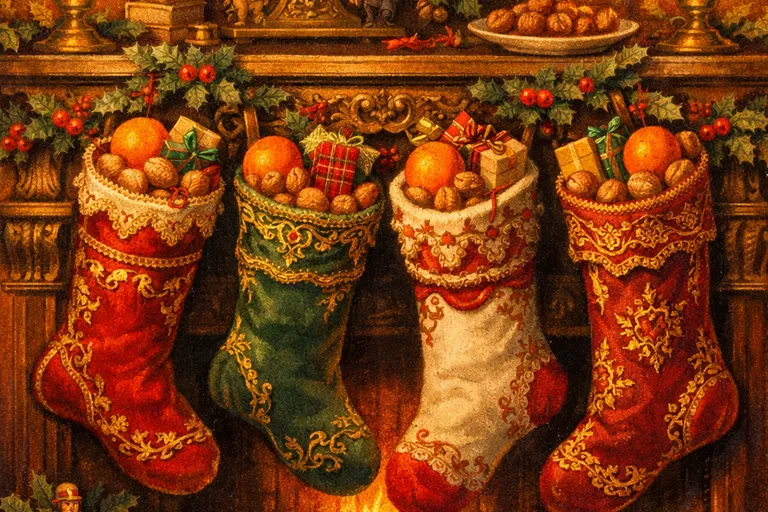
Thomas Nast, the cartoonist who shaped so much of American Christmas imagery, drew Santa Claus filling stockings in his illustrations for Harper's Weekly throughout the 1860s and 1870s. His images showed stockings of various sizes pinned to mantels, establishing a visual standard that manufacturers were happy to turn into products.
By the early 1900s, commercially produced Christmas stockings were widely available. Department stores sold pre-filled mesh stockings loaded with candy and cheap toys. The stocking had completed its transformation from practical garment to purpose-built Christmas vessel.
What Goes in a Christmas Stocking?
Stocking contents have always reflected the era's economy and values. In the 18th and 19th centuries, an orange at the toe was standard. This wasn't arbitrary. Citrus fruit was expensive, imported, and rare enough in northern climates during winter that a single orange qualified as a genuine treat. Some historians connect the orange to the gold coins in the Saint Nicholas legend, a round golden object standing in for what most families couldn't actually afford.
Nuts, particularly walnuts and hazelnuts, were another staple. A few hard candies. Perhaps a coin. The contents were small and practical because the stocking itself was small and practical.
Modern stockings bear little resemblance to this. Today's oversized, purpose-built Christmas stockings can hold gift cards, electronics, cosmetics, books, socks (actual ones, which creates a satisfying recursion), and specialty foods. The National Retail Federation doesn't break out stocking-specific spending, but the "stocking stuffer" category has become a retail segment of its own, with stores dedicating entire displays to small gifts priced for stocking inclusion.
The traditional toe orange has survived, though. Many families still place one at the bottom of each stocking, sometimes without knowing why.
Christmas Stocking Traditions Around the World
The stocking custom is strongest in the United States, United Kingdom, Canada, Australia, and Ireland. But the underlying idea, leaving a receptacle out for a gift-bringing figure to fill, is nearly universal.
In the Netherlands and Belgium, children set out shoes on the evening of December 5 (Sinterklaas Eve) and find them filled with treats the next morning. Dutch children sometimes leave a carrot or hay in the shoe for Sinterklaas's horse. Italian children hang stockings for La Befana, a gift-bringing old woman who visits on Epiphany Eve (January 5). In France, children traditionally place shoes by the fireplace for Pere Noel.
The Japanese have no indigenous stocking tradition, but the custom has been adopted in some households as part of the broader commercial Christmas celebration. In Scandinavia, gifts are more commonly placed under the tree or delivered by hand, and the stocking tradition is less prominent.
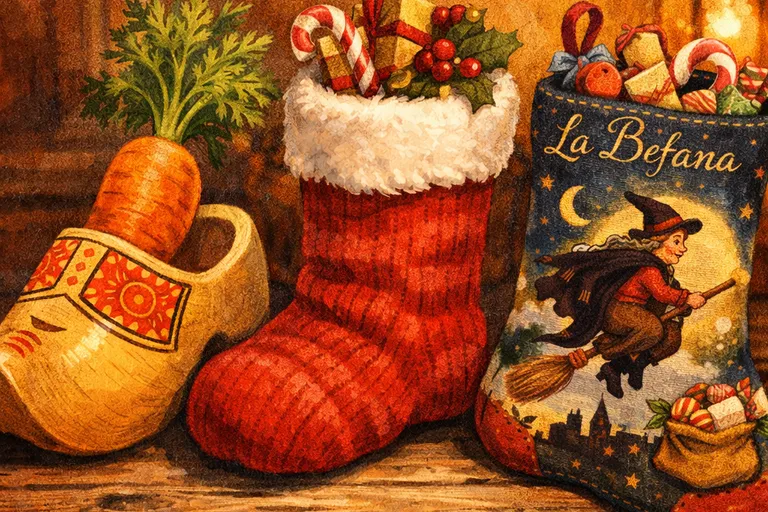
What's notable is how the specific vessel changes but the ritual stays the same: leave something out at night, wake up to find it filled. The stocking is the English-speaking world's answer to a question every Christmas culture has asked.
The Meaning Behind the Christmas Stocking
The Christmas stocking carries a specific emotional function that's different from the gifts under the tree. Tree presents are chosen, wrapped, and labeled. They're deliberate. Stockings are supposed to feel spontaneous, almost magical, as if filled by an unseen hand overnight.
For children, the stocking is often the first thing they check on Christmas morning. It serves as a signal that Santa has visited. The small, personal nature of stocking gifts creates a different kind of pleasure than opening larger presents. There's a treasure-hunt quality to pulling items out one by one.
For adults, the stocking tradition often persists long after belief in Santa has faded. Many couples and families fill stockings for each other, treating them as a space for thoughtful, personal, or humorous small gifts. A 2019 YouGov survey found that 66% of Americans hang Christmas stockings, making it one of the most widely practiced Christmas customs in the country.
Who Started the Tradition of Christmas Stockings?
No single person "started" it. The tradition assembled itself over centuries from multiple sources. The Saint Nicholas legend provided the origin story. European shoe-filling customs provided the basic ritual. The 1823 poem provided the specific imagery. Victorian consumer culture provided the commercial infrastructure. And Thomas Nast's illustrations provided the visual blueprint.
If you had to pick one moment when the tradition solidified, it would be the mid-1800s in the United States and Britain. That's when the stocking shifted from a regional folk practice to a mainstream Christmas custom with a standardized form: decorative stockings, hung by the chimney, filled overnight with small gifts and treats.
The tradition has barely changed since. Which is unusual for Christmas customs. Many holiday practices have been dramatically reinvented or abandoned over the past 150 years, but the stocking has stayed remarkably stable. You could transport a family from 1880 into a modern living room on Christmas morning, and the stockings on the mantel would be instantly recognizable to them. The gifts inside would be different. The socks would be bigger. But the ritual would be exactly the same.
Frequently Asked Questions
Why do we hang Christmas stockings by the fireplace?
The tradition connects to the legend of Saint Nicholas, who reportedly dropped gold coins down a chimney, where they landed in stockings hung to dry by the fire. The 1823 poem "A Visit from St. Nicholas" cemented this image with the famous line about stockings hung by the chimney with care. Before central heating, the fireplace was the natural place to dry laundry, making stockings a convenient target for gift delivery.
What is the origin of the Christmas stocking tradition?
The custom originates from legends about Saint Nicholas of Myra, a fourth-century bishop who secretly gave gold to a poor man's three daughters. The gold reportedly landed in their stockings drying by the hearth. The tradition evolved through European folk customs, was popularized by 19th-century literature and illustrations, and became a mainstream Christmas practice in the Victorian era.
What traditionally goes in a Christmas stocking?
Traditional stocking contents included an orange at the toe (representing the gold coins from the Saint Nicholas legend), nuts, hard candy, and small coins. Modern stockings typically contain a wider range of small gifts: candy, toiletries, gift cards, small toys, books, and novelty items. Many families still place an orange at the bottom as a nod to the older custom.
Do all countries hang Christmas stockings?
No. Christmas stockings are primarily an English-speaking tradition popular in the United States, United Kingdom, Canada, Australia, and Ireland. Other cultures have equivalent customs using different vessels. Dutch and Belgian children leave shoes out for Sinterklaas. Italian children hang stockings for La Befana on Epiphany Eve. French children place shoes by the fireplace for Pere Noel.
When did Christmas stockings become a common tradition?
Christmas stockings became widespread in the mid-1800s, driven by the 1823 poem "A Visit from St. Nicholas," Thomas Nast's illustrations in Harper's Weekly during the 1860s-1870s, and Victorian-era enthusiasm for elaborate Christmas celebrations. By the early 1900s, commercially produced Christmas stockings were widely available in stores across the United States and Britain.
What does a Christmas stocking symbolize?
The Christmas stocking symbolizes generosity and anonymous giving, rooted in the Saint Nicholas legend of secretly helping those in need. It represents the surprise and spontaneity of Christmas, with gifts meant to feel as though they appeared magically overnight. For many families, filling stockings is one of the most personal and intimate parts of the holiday gift-giving tradition.