
Saint Nicholas: The Real Man Behind Santa Claus
A 4th-century Greek bishop who punched a heretic, secretly threw gold through windows, and somehow became the world's most beloved gift-giver. The real story of the man behind the red suit.
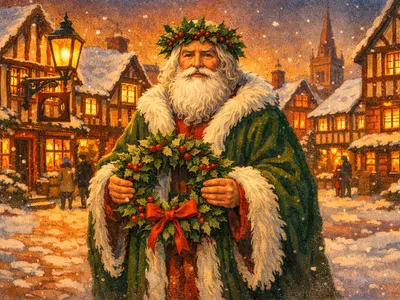
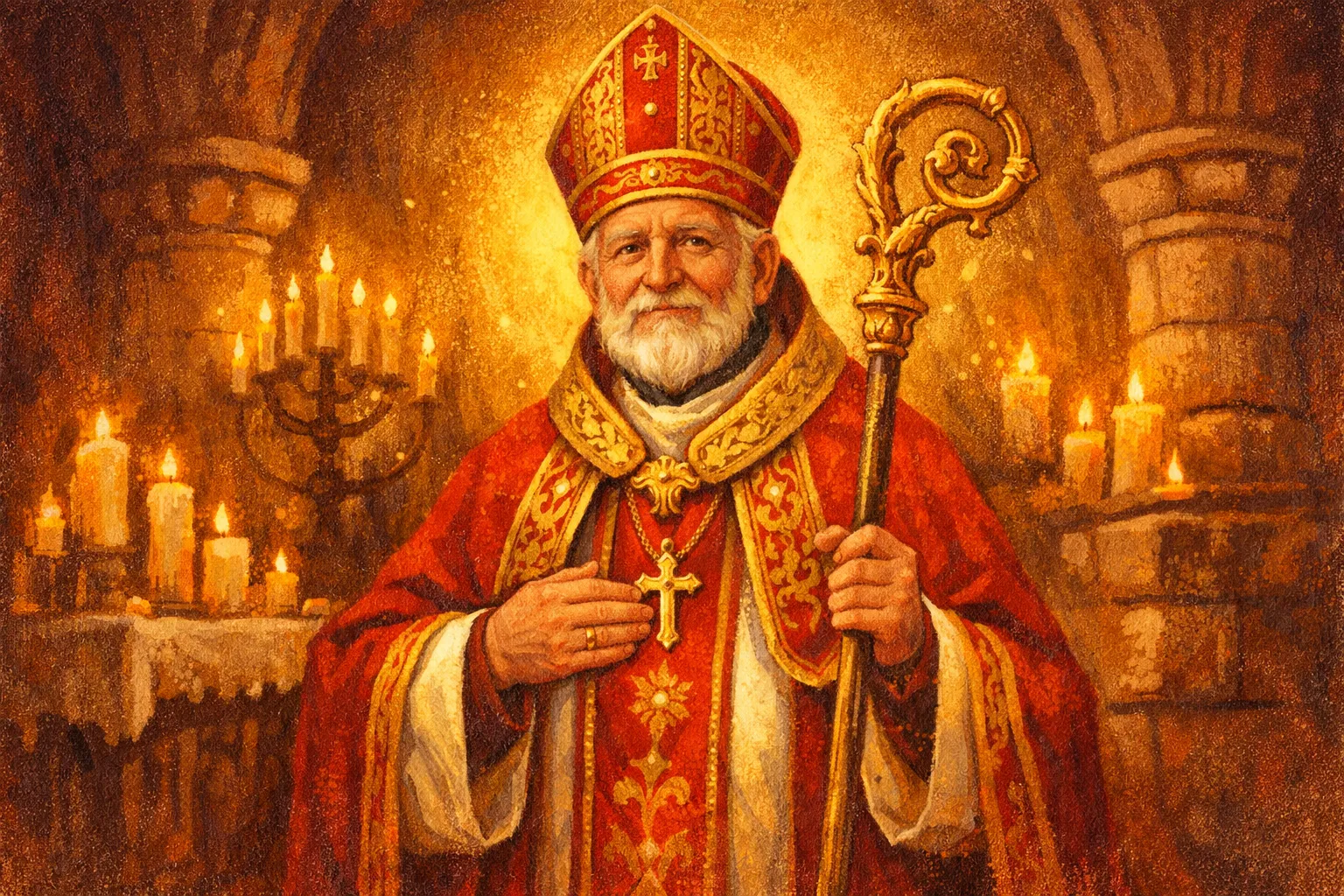
Saint Nicholas was a Christian bishop who lived in the 4th century in the city of Myra, on the Mediterranean coast of what is now Turkey. He was born around 270 AD in the nearby port town of Patara and died on December 6, 343 AD. That date became his feast day, and it's the reason children across Europe still put boots by the door on the night of December 5. He is the historical person behind Santa Claus, Sinterklaas, and every red-suited gift-bringer who shows up each December.
Contents
- 1. Who Was Saint Nicholas?
- 2. Why Is Saint Nicholas the Patron Saint of So Many Things?
- 3. The Legend of the Three Bags of Gold
- 4. When Is Saint Nicholas Day?
- 5. How Did Saint Nicholas Become Santa Claus?
- 6. What Happened to His Relics?
- 7. What Is "Jolly Old Saint Nicholas"?
- 8. Frequently Asked Questions
Almost everything about Saint Nicholas blurs the line between history and legend. Very few verified facts about his life survive. What does survive is a collection of stories so compelling that they built one of the most widespread cults of any Christian saint, spawned gift-giving traditions on two continents, and eventually produced the most commercially successful fictional character in human history.
Who Was Saint Nicholas?
Nicholas was born to wealthy Greek Christian parents in Patara, a port city in the Roman province of Lycia (modern-day Antalya Province, Turkey). Both parents reportedly died during an epidemic while Nicholas was young, leaving him with a substantial inheritance. He was raised by his uncle, also named Nicholas, who was the bishop of Patara.
He became Bishop of Myra while still relatively young, though exact dates are disputed. Early records suggest he was imprisoned during the persecution of Christians under Emperor Diocletian, which began in 303 AD, and released after Constantine legalized Christianity in 313 AD. Some early lists place him at the First Council of Nicaea in 325 AD, the gathering where Christian bishops debated the nature of Christ and produced the Nicene Creed.
A popular legend claims Nicholas punched the heretic Arius at Nicaea for denying Christ's divinity. The story is almost certainly apocryphal. It doesn't appear in any contemporary account of the council. But it has been repeated for centuries because people enjoy the image of a saint throwing a punch at a theological debate. The Orthodox Church treats the story with caution but hasn't suppressed it.
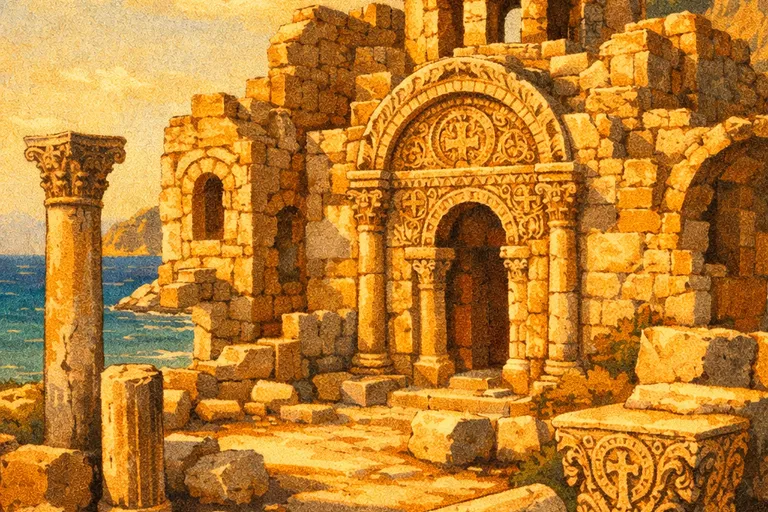
Nicholas died on December 6, 343 AD, in Myra. He was buried in the cathedral church there, and his tomb quickly became a pilgrimage site.
Why Is Saint Nicholas the Patron Saint of So Many Things?
The list of groups who claim Saint Nicholas as their patron saint is absurdly long. Children. Sailors. Merchants. Pawnbrokers. Unmarried women. Students. Brewers. Repentant thieves. The entire countries of Greece and Russia. The city of Amsterdam. It's easier to list who he isn't the patron saint of.
Each patronage traces back to a specific legend. The connection to sailors comes from a story in which Nicholas calmed a deadly storm at sea, saving a group of sailors who prayed to him. The connection to pawnbrokers comes from his most famous legend: the three bags of gold (more on that below). The three golden balls on pawnshop signs represent the three purses Nicholas threw through a window. The connection to children solidified over centuries of gift-giving traditions built around his feast day.
His association with so many groups made him one of the most widely venerated saints in both Eastern and Western Christianity. By the medieval period, more churches in Europe were named after Saint Nicholas than after any apostle except Peter.
The Legend of the Three Bags of Gold
The most important Saint Nicholas story, the one that connects him directly to gift-giving and eventually to Santa Claus, involves a poor man with three daughters. The father couldn't afford dowries, and without dowries, his daughters faced a life of slavery or prostitution. Nicholas heard about the family's situation and acted.
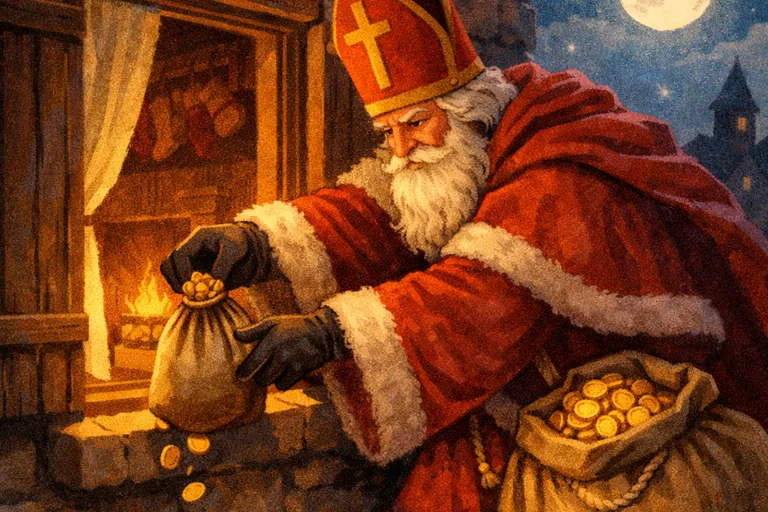
On three consecutive nights, Nicholas threw a bag of gold coins through the family's window. Each bag provided a dowry for one daughter. In some versions, he threw the gold down the chimney, and it landed in stockings hanging by the fire to dry. In other versions, he dropped it through an open window into shoes left near the hearth.
This single story explains an extraordinary amount of Christmas tradition. Stockings hung by the fireplace. Gifts appearing overnight. Shoes and boots left out to be filled. The secrecy of the giving. Even the three golden balls on pawnbroker signs trace directly to this one legend from the 4th century.
When Is Saint Nicholas Day?
Saint Nicholas Day is celebrated on December 6, the anniversary of Nicholas's death in 343 AD. In countries that observe the tradition, the evening of December 5 (Saint Nicholas Eve) is when the action happens. Children clean their boots or shoes and place them by the door, on the windowsill, or by the fireplace before going to bed. By morning, good children find their boots filled with chocolate, fruit, nuts, coins, and small gifts. Naughty children get coal or birch switches.
The holiday is a major event in the Netherlands, Belgium, Germany, Austria, Switzerland, the Czech Republic, Slovakia, Poland, and parts of France. It is separate from Christmas and predates modern Christmas gift-giving by centuries. In the Netherlands and Belgium, Saint Nicholas (Sinterklaas) is arguably more important to children than Christmas itself.
How different countries celebrate
In the Netherlands, Sinterklaas arrives by steamboat from Spain (yes, Spain, not the North Pole) in mid-November, an event broadcast live on national television. On the evening of December 5, families exchange gifts, read humorous poems about each other, and eat pepernoten (small spiced cookies). Sinterklaas wears a red bishop's robe and a mitre. He looks nothing like the American Santa Claus.
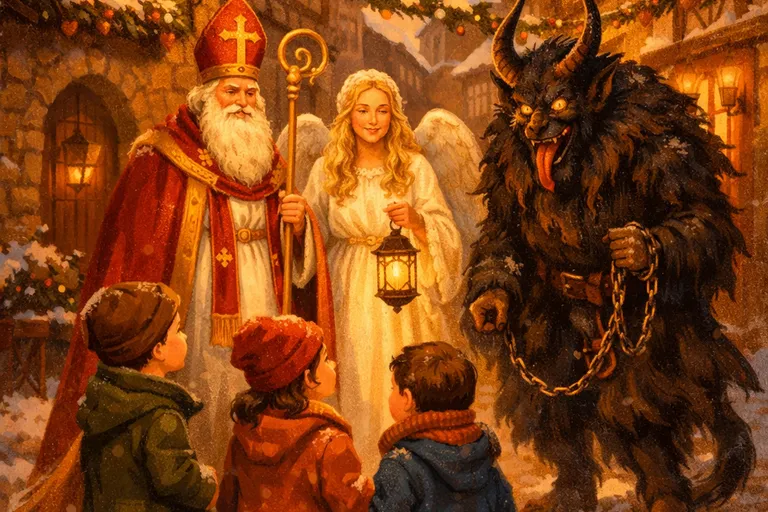
In Germany and Austria, children polish their boots and leave them outside their bedroom doors on the evening of December 5. Sankt Nikolaus fills them with sweets and small gifts. In parts of Austria and Bavaria, he travels with Krampus, a horned, chain-rattling demon who punishes badly behaved children. The contrast between the gentle bishop and his terrifying companion is intentional: reward and punishment, delivered as a pair.
In the Czech Republic and Slovakia, groups of young people dress up as Mikulas (Nicholas), an angel, and a devil, and walk the streets on the evening of December 5. They visit homes and stop children on the street. The angel rewards good behavior with sweets. The devil threatens bad children with a sack or a piece of coal. Children sometimes have to recite a poem or sing a song to prove they deserve their treats.
In Poland, traditions vary by region. In some areas, children find gifts in their shoes or under their pillow on the morning of December 6. In Poznan and the Wielkopolska region, Saint Nicholas Day is celebrated with particular enthusiasm, including parades and public events.
How Did Saint Nicholas Become Santa Claus?
The transformation happened in stages, across several centuries and at least three countries.
Dutch settlers brought Sinterklaas traditions to New Amsterdam (later New York) in the 17th century. The Dutch name "Sinterklaas" gradually morphed into "Santa Claus" in English. But the Dutch Sinterklaas was still a thin bishop in religious vestments, not the plump, fur-trimmed figure Americans recognize today.
In 1809, Washington Irving's satirical book A History of New York depicted Saint Nicholas as a rotund Dutchman who flew over rooftops in a wagon and dropped gifts down chimneys. Irving was writing comedy, not theology, but his version stuck. In 1823, the poem "A Visit from St. Nicholas" (commonly known as "Twas the Night Before Christmas") gave Santa a sleigh, eight reindeer, and a round belly that shook "like a bowl full of jelly." The poem's authorship is disputed, traditionally attributed to Clement Clarke Moore, though some scholars credit Henry Livingston Jr.
The visual image solidified through Thomas Nast's illustrations for Harper's Weekly, published from the 1860s through the 1880s. Nast drew Santa as a large, bearded man in a fur-trimmed suit, living at the North Pole, keeping a list of naughty and nice children. Almost every detail Americans associate with Santa Claus comes from Nast's pen.
By the early 20th century, the transformation was complete. The 4th-century bishop of Myra had become a secular, commercial figure with no visible connection to Christianity. December 6 gave way to December 25. The mitre became a floppy red hat. The pastoral staff became a bag of toys. The only thing that survived intact was the core idea: a figure who rewards good children with secret gifts.
What Happened to His Relics?
In 1087, a group of merchants and sailors from the Italian port city of Bari broke into Nicholas's tomb in Myra and took most of his skeletal remains. The historian Adam C. English has described the event as "essentially a holy robbery." The men were motivated partly by piety and partly by the economic benefits a major saint's relics would bring to their city.
The context matters. By 1087, Myra was under Seljuk Turkish control, and the Christian population was declining. The Bari merchants saw both an opportunity and a justification. They loaded the bones onto a ship, arrived in Bari on May 9, 1087, and the remains were initially stored in a Benedictine abbey. Two years later, Pope Urban II personally placed the relics in the crypt of the newly built Basilica di San Nicola.
The Basilica in Bari remains the primary site of Nicholas's relics today. It draws pilgrims from both Western and Eastern Christianity. The relics reportedly produce a clear liquid known as "manna" or "myrrh," which the church collects annually in a ceremony on May 9. Scientists have studied the liquid; it appears to be water that seeps into the tomb through the porous marble.
Venice holds a secondary collection of bone fragments, taken from Myra during the First Crusade. And in 2017, an archaeological survey in Demre (the modern Turkish town built over ancient Myra) suggested that an undisturbed tomb beneath the church might still contain remains that the Bari merchants missed.
What Is "Jolly Old Saint Nicholas"?
"Jolly Old Saint Nicholas" is one of the most recognized Christmas songs in the English-speaking world. The lyrics originated with a poem called "Lilly's Secret" by Emily Huntington Miller, published in The Little Corporal Magazine in December 1865. The poem was written from a child's perspective, whispering Christmas wishes into Saint Nicholas's ear.
The song has also been attributed to Benjamin Hanby (who wrote "Up on the Housetop") and to John Piersol McCaskey, a Pennsylvania educator and song editor. McCaskey's family claimed he wrote it in 1867, but his own published songbook from 1881 doesn't list him as the author. The most supported attribution remains Miller.
Ray Conniff's 1962 recording on We Wish You a Merry Christmas turned the song into a mid-century standard. The album went platinum. The song remains a staple of children's Christmas performances, school concerts, and holiday playlists, keeping the name "Saint Nicholas" in popular culture even as "Santa Claus" dominates everywhere else.
Frequently Asked Questions
Who was the real Saint Nicholas?
Saint Nicholas was a Christian bishop who lived in Myra (modern-day Demre, Turkey) in the 4th century. He was born around 270 AD in the port city of Patara and died on December 6, 343 AD. He became famous for his generosity, particularly the legend of secretly providing dowries for three poor girls, and is the historical figure behind the Santa Claus tradition.
When is Saint Nicholas Day?
Saint Nicholas Day is December 6. The main celebrations happen on the evening of December 5 (Saint Nicholas Eve), when children in the Netherlands, Germany, Austria, Czech Republic, Slovakia, Poland, and other European countries place their boots or shoes out to be filled with treats and small gifts overnight.
How did Saint Nicholas become Santa Claus?
Dutch settlers brought "Sinterklaas" traditions to New York in the 17th century. The name evolved into "Santa Claus" in English. Washington Irving's 1809 book, the 1823 poem "A Visit from St. Nicholas," and Thomas Nast's illustrations in Harper's Weekly during the 1860s-1880s gradually transformed the thin bishop into the plump, fur-suited figure known today.
What is Saint Nicholas the patron saint of?
Saint Nicholas is the patron saint of children, sailors, merchants, pawnbrokers, unmarried women, students, brewers, and repentant thieves, among others. He is also the patron saint of Greece, Russia, and numerous cities. Each patronage connects to a specific legend from his life or the centuries of veneration that followed.
Is Saint Nicholas the same as Santa Claus?
Saint Nicholas is the historical person who inspired the Santa Claus character, but the two are quite different. Nicholas was a 4th-century Greek bishop in religious vestments. Santa Claus is a 19th-century American creation: a secular, fur-suited figure who lives at the North Pole. The connection runs through the Dutch Sinterklaas tradition, which Dutch settlers brought to New York.
Where are Saint Nicholas's remains?
Most of Saint Nicholas's remains are in the Basilica di San Nicola in Bari, Italy. They were taken from his original tomb in Myra (now Demre, Turkey) by Italian merchants in 1087. Additional bone fragments are held in Venice. A 2017 archaeological survey suggested some remains may still exist beneath the church in Demre.