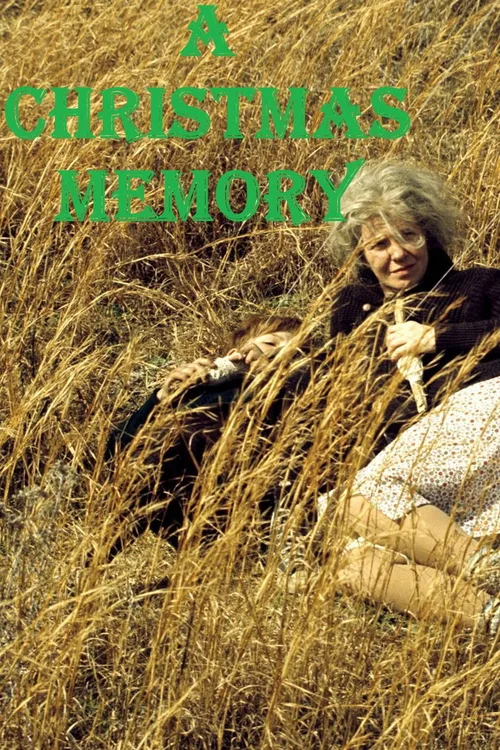
A Christmas Memory (1966)
As Christmastime approaches in rural, Depression-era Alabama, a young boy and his best friend, an elderly woman distantly related to him, prepare for the impending holiday by gathering ingredients for their annual batch of fruitcakes for "people who've struck our fancy." On Christmas Eve, they talk with great anticipation of the next day, but underneath is the sad, almost unspoken knowledge that the boy is growing up and his cousin is getting older and frailer. Based on Truman Capote's autobiographical short story.
 rating 9/10 User rating 1 votes 60%
 ❄ Christmas Connection
A Christmas Memory is built entirely around the ritual of Christmas preparation in a small Alabama town. The entire story follows elderly Sook and young Buddy as they make fruitcakes and kites to give away each December, a tradition that defines their relationship and their world. Christmas here is not backdrop but the whole point.
Our Review
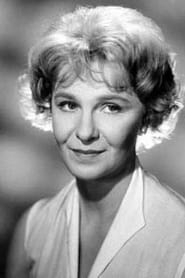
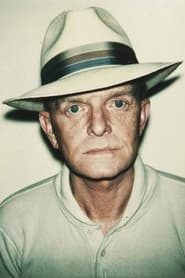
Truman Capote wrote "A Christmas Memory" in 1956 as a short story for Mademoiselle magazine. He described it as "a true story," and meant it literally. The elderly woman at its center, called Sook, was his distant cousin and childhood companion, Nanny Rumbley Faulk. The boy called Buddy was Capote himself, seven years old, living in rural Alabama while his parents sorted out their lives elsewhere. When ABC aired the television adaptation in December 1966, it had Geraldine Page playing Sook and eleven-year-old Donnie Melvin as Buddy. The result won an Emmy and a Peabody Award, and it deserved both.
What the Story Actually Is
Every year, when the first cold snap arrives in November, Sook announces: "It's fruitcake weather." She and Buddy gather pecans, scrape together their savings from a small tin, and make thirty-one fruitcakes to give to people they barely know. The President of the United States gets one. A knife-grinder who passed through once gets one. Neighbors do not get one, because Sook finds neighbors complicated.
After the fruitcakes come the kites. They build them from scraps of paper and wood, and on Christmas morning they fly them in a cold field instead of sitting inside with presents. The film ends in the way the story ends, which is not happily. Capote did not write happy endings. He wrote true ones.
The plot, such as it is, fits on a napkin. What fills the hour is observation: the texture of a Depression-era household, the specific logic of a woman who is child-like in some ways and ancient in others, and the tenderness between two people who are each other's best friend despite being separated by about sixty years.
Geraldine Page Carries This Film
Page was forty-one when she played Sook, which required her to move and think like someone much older. She does not play elderly as weakness. Sook is stubborn, excitable, occasionally mischievous, and deeply principled about small things. Page makes every choice land without making it look like a choice. The performance feels less like acting than like memory caught on film.
Donnie Melvin is a natural counterweight. He was a real child rather than a trained performer, and it shows in the best possible way. His reactions to Page have the quality of genuine surprise, genuine listening. The film was directed by Frank Perry, who understood that nothing should upstage that central relationship.
The cinematography by Jordan Cronenweth, who would later shoot Blade Runner, gives the Alabama countryside a specific look: not picturesque poverty but actual poverty, which is a different thing. The light is winter light. The fields are real fields. Nothing is made to look charming for the audience's comfort.
The Fruitcake as Organizing Principle
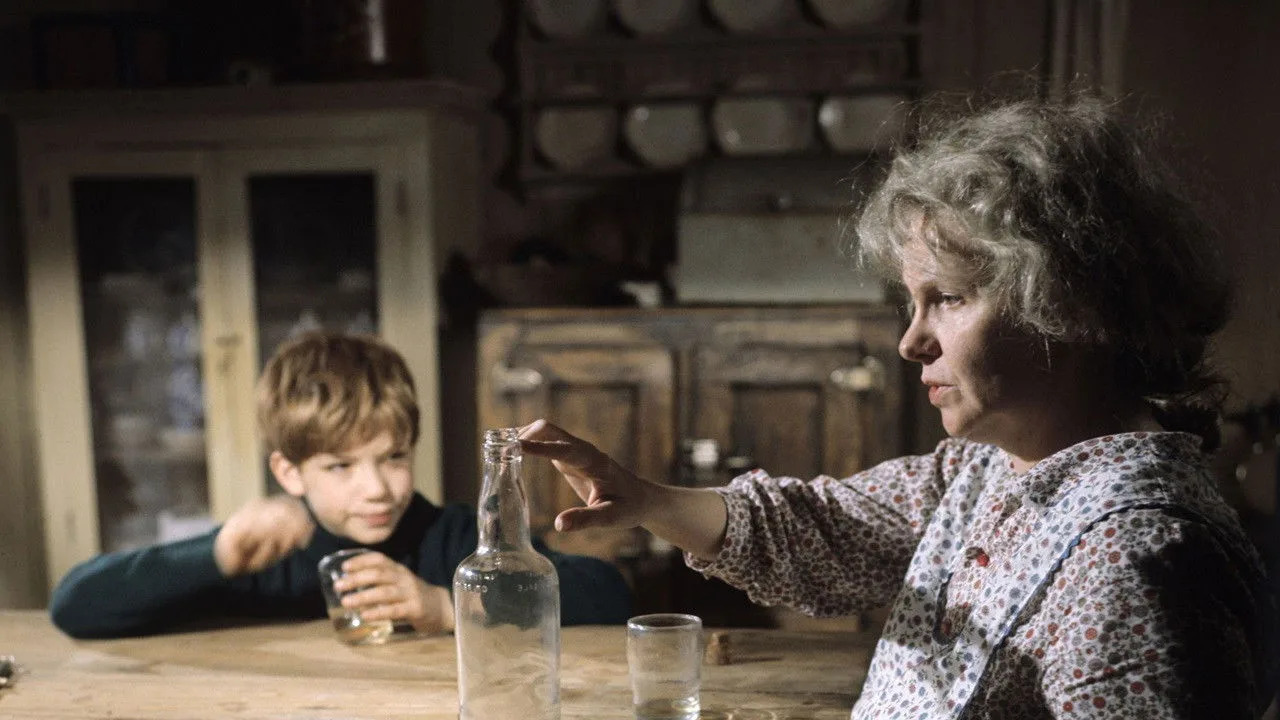
The fruitcake-making sequence is the film's emotional center. Sook and Buddy spend their entire savings, less than thirteen dollars in the story, on whiskey for the cakes, which requires a trip to the local bootlegger. The scene is played for gentle comedy but also for its real strangeness: an elderly woman and a small boy conducting business with a criminal because they need bourbon for Christmas baking.
Capote was specific about fruitcake in his story, listing ingredients with the care of someone who had made them. The film honors that specificity. These are not symbolic fruitcakes. They are real ones, made from real effort, given to people who will probably be surprised to receive them. The act of giving them away to strangers rather than family is the point. Sook and Buddy make their own rules about what Christmas means.
What 1966 Television Did Right
The 1966 CBS Playhouse production ran fifty minutes without commercials. That format no longer exists in American television, which partly explains why this kind of film no longer gets made. There was no pressure to extend the material or simplify it for broader audiences. The film trusts that viewers can watch two people make fruitcakes and find it interesting.
ABC aired it during the holiday season, and it found an audience that returned to it year after year when it was rebroadcast. Capote wrote a sequel story, "The Thanksgiving Visitor," which was also adapted for television in 1967 with the same leads. But the original stands on its own, complete and whole.
The ending does not deliver Christmas comfort. Capote's narrator, older now, recalls what became of Sook after Buddy was sent away to military school. Page plays the film's final moments without dialogue, and they are not easy to watch. The film earns that difficulty because everything before it has been honest.
Fun Facts
Truman Capote originally published "A Christmas Memory" in the December 1956 issue of Mademoiselle magazine. The story was later collected in Breakfast at Tiffany's and Three Stories (1958), where it has remained in print ever since.
The real-life Sook, Nanny Rumbley Faulk, died in 1938 when Capote was a teenager. He dedicated the original story to her memory by name.
Geraldine Page received an Emmy Award nomination for her performance as Sook. She had previously been nominated for an Academy Award for Hondo (1953) and would go on to win the Academy Award for Best Actress in 1986 for The Trip to Bountiful.
Cinematographer Jordan Cronenweth, who shot the film's Alabama landscapes, later became famous for his work on Blade Runner (1982) and Peggy Sue Got Married (1986).
The film won both an Emmy Award and a Peabody Award for Excellence in Broadcasting in 1967, making it one of the few television holiday specials to earn both distinctions in the same year.
ABC rebroadcast the film multiple times through the late 1960s and 1970s, and it was later released on home video. The Library of Congress has not formally preserved it in the National Film Registry, unlike some contemporaneous television productions.
Capote wrote a direct companion piece, "The Thanksgiving Visitor" (1967), also set in the same Alabama household with the same characters. A television adaptation followed in 1967 using Geraldine Page and Donnie Melvin again, making it one of the earliest holiday television sequels.
The bootlegger scene in the film reflects a real aspect of Capote's Alabama childhood. Monroe County, Alabama, where Capote grew up in Monroeville, was a dry county during Prohibition and remained restrictive about alcohol sales for decades afterward.
Cast