
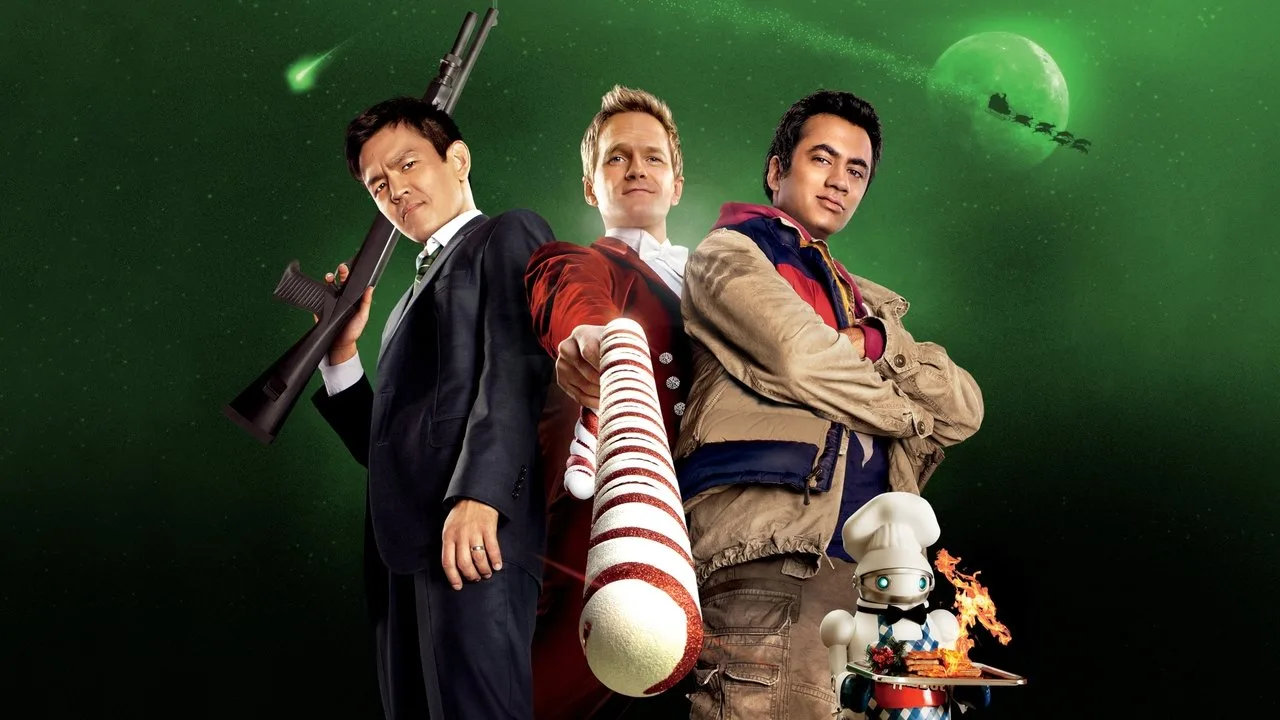
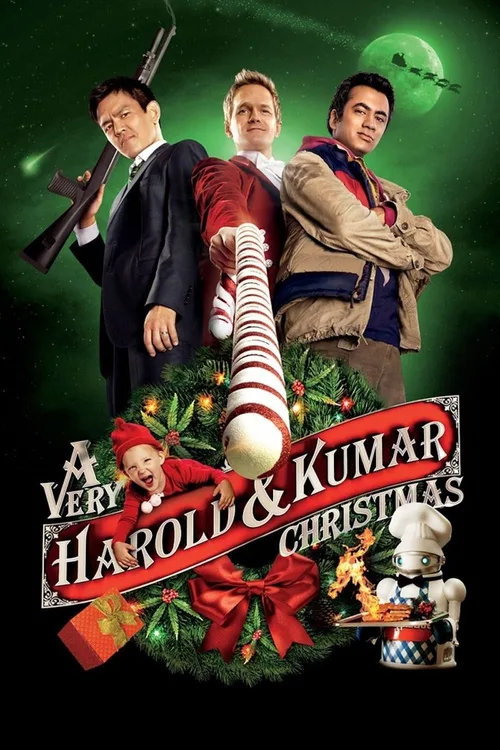
Christmas comes prematurely.
A Very Harold & Kumar Christmas (2011)
Six years have elapsed since Guantanamo Bay, leaving Harold and Kumar estranged from one another with very different families, friends and lives. But when Kumar arrives on Harold's doorstep during the holiday season with a mysterious package in hand, he inadvertently burns down Harold's father-in-law's beloved Christmas tree. To fix the problem, Harold and Kumar embark on a mission through New York City to find the perfect Christmas tree, once again stumbling into trouble at every single turn.
 rating 6/10 User rating 1,036 votes 60%
 ❄ Christmas Connection
The entire plot revolves around replacing a destroyed Christmas tree before Harold's father-in-law notices. Christmas decorations, a holiday party, a Ukrainian mob Santa ring, and a Christmas Eve setting make the holiday inseparable from the story.
Where to Watch


Our Review
A Very Harold & Kumar Christmas opens with a burnt Christmas tree and a friendship in ashes, then spends 90 minutes throwing everything at the screen to fix both problems. Released on November 4, 2011, the third film in the Harold & Kumar franchise takes the duo's signature blend of stoner absurdity and sharp cultural commentary and wraps it in tinsel, eggnog, and an alarming amount of 3D projectiles.
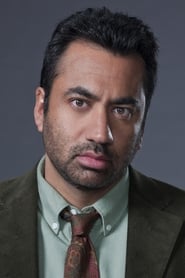
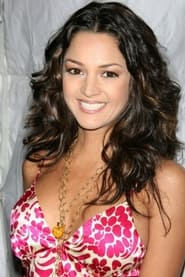
The setup is straightforward. Harold (John Cho) has grown up. He's married to Maria (Paula Garces), living in a nice suburban home, and desperately trying to impress his intimidating father-in-law, Mr. Perez (Danny Trejo). Kumar (Kal Penn) is still Kumar. He's dumped his girlfriend, lost his job, and lives in filth. When a mysterious package brings them back together and Kumar accidentally incinerates Mr. Perez's prized Fraser fir, they have one Christmas Eve to find a replacement tree before the family returns from midnight mass.
The Harold and Kumar Christmas Formula
Director Todd Strauss-Schulson, making his feature debut, understood something essential about the franchise: it works because the leads are genuinely likable people trapped in escalating nightmare scenarios. The comedy comes from contrast. Harold is an uptight Korean-American investment banker navigating in-law politics. Kumar is an Indian-American slacker who can't stop sabotaging his own life. Together, they stumble through a New York City that apparently contains Ukrainian mobsters, a drugged toddler, a shotgun-wielding Santa, and a WaffleBot that dispenses breakfast pastries while on fire.
The film doesn't pretend to be subtle. It was designed for 3D exhibition (the tagline was "Christmas comes prematurely"), and Strauss-Schulson leans into the gimmick with shameless enthusiasm. Eggs, joints, candy canes, and bodily fluids fly directly at the camera. One scene launches a baby through the air in slow motion. It's the kind of movie that knows exactly what it is and refuses to apologize.
Neil Patrick Harris and the Art of Playing Yourself
Neil Patrick Harris returns as the fictionalized version of himself, and his subplot is the movie's most committed bit of lunacy. Having been shot and killed at the end of Harold & Kumar Escape from Guantanamo Bay, NPH appears alive and well with no coherent explanation. He's involved in a strip club scene that would take four paragraphs to describe and is best experienced without spoilers.
Harris commits to the role with the same intensity he brought to the previous films. The fictionalized NPH is a womanizing, drug-fueled maniac who bears no resemblance to the actual actor. It's a performance built entirely on the gap between persona and reality, and Harris plays it with a wink that keeps it from ever feeling mean-spirited.
Christmas as Structural Necessity
Unlike many comedies that use the holidays as background decoration, A Very Harold & Kumar Christmas builds its entire plot around Christmas. The tree is the MacGuffin. The deadline is midnight mass. Harold's anxiety about being accepted by his new family ties directly into themes of belonging that Christmas movies trade in. Danny Trejo playing a strict but loving father-in-law who grows the perfect Christmas tree as his pride and joy is inspired casting.
The film also uses its holiday setting to take shots at Christmas commercialism. A visit to a shopping mall descends into chaos. A Christmas party at a hedge fund manager's penthouse reveals grotesque excess. Even the tree hunt itself becomes a commentary on how absurd the annual ritual of buying a dead conifer can get.
Where It Falls Short
The 3D gimmick dates the movie. Watched on a standard screen in 2026, the constant "flying at camera" shots feel like artifacts from a brief Hollywood trend that peaked around 2011. Several jokes land with the subtlety of a thrown eggnog, and a few set pieces run about two minutes longer than they should.
The subplot involving Harold's new friend Todd (Thomas Lennon) and Kumar's new friend Adrian never generates the same energy as the main duo. The film is at its weakest when Harold and Kumar are separated, which happens more often than it should in a buddy comedy. But when Cho and Penn share the screen, their chemistry remains the franchise's most reliable asset.
Cast and Performances
John Cho gives Harold a genuinely affecting arc. His anxiety about fitting into his wife's family is played for laughs but also rings true. Kal Penn's Kumar is broader, but Penn finds real emotion in the character's refusal to grow up and its consequences. Danny Trejo brings quiet menace to a role that could have been one-dimensional. The ensemble works because everyone treats the absurd material seriously enough to sell it.
The film made $36 million against a $19 million budget, respectable but not spectacular. It was the last Harold & Kumar theatrical release, and Cho and Penn have both spoken warmly about the franchise in interviews since. For a series that started with a quest for White Castle hamburgers, ending on a Christmas movie feels oddly fitting.
Fun Facts
Director Todd Strauss-Schulson was 27 years old when he was hired, making this one of the youngest directorial debuts for a major studio Christmas comedy.
Kal Penn left the franchise temporarily to work in the White House as Associate Director of Public Engagement under President Obama. He returned specifically for this sequel.
Danny Trejo's casting as Harold's father-in-law was suggested by John Cho, who thought the contrast between Trejo's tough-guy image and a Christmas tree obsession would be funny.
Neil Patrick Harris filmed his scenes in just five days. His "resurrection" after dying in the second film is never explained in the script, treated as a running joke with no punchline.
The WaffleBot, a robot that makes and serves waffles, was a fully functional practical prop built by the special effects team. It actually dispensed real waffles on set.
The film was one of the first R-rated comedies released in 3D. Warner Bros. initially hesitated, but test audiences responded so enthusiastically to the 3D gag sequences that the studio greenlit the format.
The movie's Christmas tree quest through New York City was primarily filmed in Detroit, Michigan, which doubled for Manhattan due to tax incentives.
Cast