
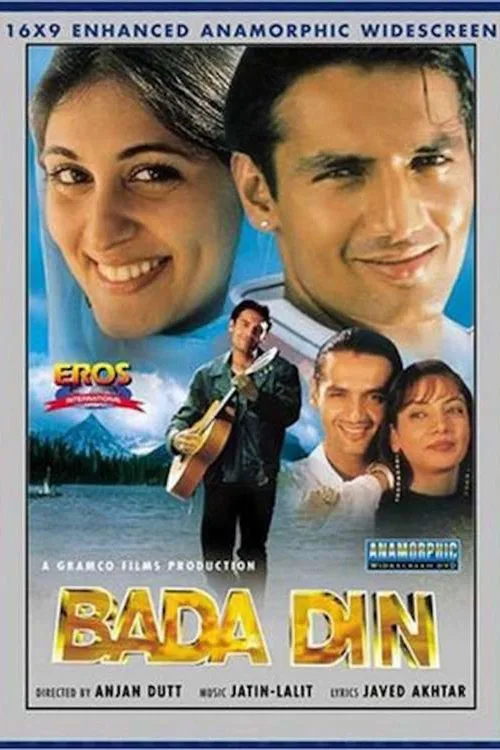
Bada Din (1998)
It is Christmas Day in Calcutta and David Dawson is off to celebrate it with his sweetheart, Nandini Shom. The meeting does not go well as Nandini wants him to start working so that they can get married and start a family, while David wants a career as a musician. She tells him that she will never see him again. Despondent, he returns to his rented apartment and is chided by his landlady, Lillian, who threatens to have him evicted as he has been delinquent in paying his rent for over a year...
 rating 7/10 0
 ❄ Christmas Connection
The entire film unfolds on Christmas Day in Calcutta, making the holiday not a backdrop but the film's structural spine. "Bada Din" is the Hindi phrase for Christmas Day, and the title is a direct declaration of the film's subject. The holiday atmosphere of Park Street, the Anglo-Indian community's celebrations, and the themes of goodwill toward strangers all make this an unambiguous Christmas film.
Our Review
Bollywood has given the world thousands of films set during Holi, Diwali, and Eid. Christmas, by contrast, has mostly appeared as scenery: a foreign holiday glimpsed through the windows of a five-star hotel, or a winter wonderland backdrop for a song sequence shot in Switzerland. Bada Din is one of the very few Hindi films to make Christmas the actual subject. The title itself means "Christmas Day" in Hindi, and director Anjan Dutt meant that literally: the entire film unfolds over a single December 25 in Calcutta.
Released in January 1998, the film did not find a large audience. It played on limited screens, earned mixed reviews, and quietly disappeared. That is a shame, because Bada Din has things in it worth seeing.
What Bada Din Is Actually About
David Dawson is a struggling Anglo-Indian musician living in a Calcutta apartment he can't afford. On Christmas morning, he meets his girlfriend Nandini, who gives him an ultimatum: find steady work or the relationship is over. She ends it. He walks home broke and heartbroken to face eviction threats from his landlady, Lilian.
Then a mute boy named Raka arrives. Raka witnessed a murder at a barbershop and is now being hunted by the killer's associates, who want him silenced. David, with nowhere useful to be on Christmas Day, becomes the boy's protector. A corrupt police inspector played by Irrfan Khan complicates everything.
The plot is a crime thriller wearing the coat of a holiday film. Dutt is less interested in suspense mechanics than in what happens when ordinary people, with no obvious reason to act decently, choose to anyway. Christmas serves as his moral backdrop: the season of goodwill tested against a city's indifference and corruption.
Anjan Dutt and Why Calcutta Makes Sense
Dutt is a Bengali filmmaker, actor, and musician, deeply embedded in Kolkata's cultural life. He had acted in Mrinal Sen's Chaalchitra and built a career in Bengali alternative music before turning to directing. Bada Din was his Hindi directorial debut, and the decision to set it in Calcutta rather than Mumbai or a generic city was intentional.
Calcutta's Anglo-Indian community has celebrated Christmas with particular intensity for generations. Park Street, the city's colonial-era entertainment strip, transforms each December into one of India's most photographed Christmas displays, with lights strung for blocks and Flurys, the iconic Swiss bakery founded in 1927, selling plum cake to long queues. Dutt shot on these actual streets during December 1996, and the footage captures something specific and real about how Christmas lives in that city.
The choice to center the story on an Anglo-Indian protagonist, David Dawson, is also deliberate. Anglo-Indians are a small, often overlooked community with their own traditions, their own relationship to Christmas, and their own complicated place in Indian society. Dutt gives them a film that treats their world as the main event, not as exotic local color.
Shabana Azmi as Lilian
Shabana Azmi plays Lilian, David's landlady, and she is the reason to watch. Azmi is one of the great Indian actresses, a five-time National Film Award winner who has worked with directors including Shyam Benegal, Mrinal Sen, and Govind Nihalani. In Bada Din, she plays a woman of a certain age, practical, unsentimental, with a past she doesn't discuss, who chooses to help a stranger's child on a day when she could have minded her own business.
Azmi does not soften Lilian or sentimentalize her. She plays the kindness as a decision made by someone who has seen enough of the world to know it requires occasional intervention. It's a quiet performance and considerably more interesting than the film around it.
The Irrfan Khan Factor
Irrfan Khan appears as the corrupt police inspector, and this was his first significant role in mainstream Bollywood cinema. He had previously worked in parallel cinema and art-house productions, but commercial Hindi films had not yet discovered what to do with him. Here, his menace is controlled and specific. He plays corrupt authority the way a good actor plays it: not as a cartoon villain but as a man who has decided the rules apply to other people.
Khan's career arc from here is one of Indian cinema's most satisfying stories. He went on to The Namesake, Life of Pi, The Lunchbox, and a dozen other films that proved his range. Watching Bada Din now, you can see the instrument already fully formed.
Where the Film Falls Short
Marc Robinson, playing David Dawson, is a fashion model making his acting debut. The gap between Azmi and Khan on one side and Robinson on the other is visible. He manages the physical scenes fine and has the right look for the part, but he can't carry the film's emotional weight in the quieter scenes. Tara Deshpande as Nandini has limited screen time and not much to do with it.
The music, composed by Jatin-Lalit with lyrics by Javed Akhtar, is competent Bollywood work of the period. The songs are professionally made but sit awkwardly against the film's more grounded tone. One track, "Suno Zara," borrows its melody closely from Anne Murray's 1978 song "You Needed Me," a detail that landed differently once the film reached wider awareness.
The pacing in the second half becomes uneven. The thriller elements and the character drama pull in slightly different directions, and Dutt doesn't quite resolve the tension between them.
Why It Matters Anyway
The Indian Christmas film barely exists as a genre. Bollywood has produced thousands of movies, but films that treat December 25 as something more than set dressing are genuinely rare. Bada Din takes the holiday seriously in a way that most mainstream Hindi cinema does not, and it does so without condescending to its subject or its audience.
The cinematographer was Sudeep Chatterjee, making his feature film debut. He later shot Chak De India, Bajirao Mastani, and Padmaavat, winning two National Film Awards for cinematography along the way. The Calcutta street footage in Bada Din is his earliest surviving work at feature length, and you can see the eye already developing.
Flurys bakery on Park Street, where some of the film's atmosphere was built, still serves plum cake every December. The Christmas lights still go up on Park Street each year. The Anglo-Indian community David Dawson represents is much smaller now than it was in 1998. Bada Din caught something of that world before it changed further.
Fun Facts
"Bada Din" literally translates to "big day" in Hindi, and it is the common Hindi term for Christmas Day. The title works as both a literal description of the holiday and a reflection of the significance the day carries for the film's characters.
Director Anjan Dutt was born on 19 January 1953 in Calcutta and had established himself as a Bengali actor and singer-songwriter before making this, his debut as a Hindi film director. He acted in Mrinal Sen's 1981 film Chaalchitra, earning the best newcomer award at the Venice Film Festival.
Irrfan Khan's role as the corrupt police inspector was his first significant appearance in mainstream commercial Bollywood cinema. His earlier work had been confined to Indian parallel cinema and art-house productions that reached limited audiences.
The soundtrack was produced by Gramco Films, a division of HMV (Gramophone Company of India). The film was essentially produced by the record label, which was unusual for a mainstream Hindi film of the period.
Marc Robinson, who plays the lead David Dawson, was one of India's leading male supermodels and a television presenter for Channel V before taking this role. Bada Din was his acting debut.
Cinematographer Sudeep Chatterjee, who shot the film in Calcutta in late 1996, went on to win the National Film Award for Best Cinematography twice, for Chotushkone (2014) and Bajirao Mastani (2015). Bada Din was his first feature film.
Park Street in Calcutta, where key exterior scenes were filmed, has hosted elaborate Christmas light displays since at least the 1960s. The street is sometimes called "Merry Christmas Street" during December and draws large crowds each year regardless of religious background.
Flurys, the Swiss-style bakery on Park Street that appears in the film's atmosphere, was founded in 1927 by a Swiss couple, Joseph and Frida Flury. It remains one of Calcutta's most recognized institutions and still sells plum cake every Christmas season.
Cast