

It's only a state of mind.
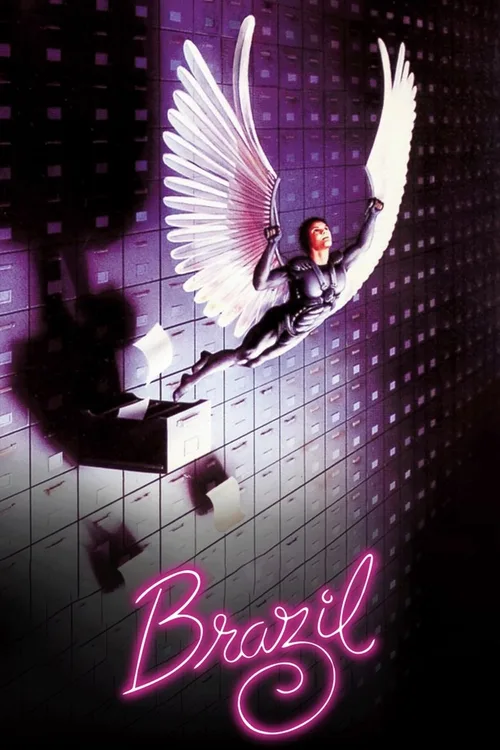
Brazil (1985)
Low-level bureaucrat Sam Lowry escapes the monotony of his day-to-day life through a recurring daydream of himself as a virtuous hero saving a beautiful damsel. Investigating a case that led to the wrongful arrest and eventual death of an innocent man instead of wanted terrorist Harry Tuttle, he meets the woman from his daydream, and in trying to help her gets caught in a web of mistaken identities, mindless bureaucracy and lies.
 rating 9/10 User rating 3,613 votes 77%
 ❄ Christmas Connection
Brazil uses Christmas not as decoration but as indictment. The film is set during the holiday season, and festive tinsel, carol-piping muzak, and frantic consumer shopping run throughout as evidence of a society numbing itself to its own horror. The holiday cheer is the point: it makes the totalitarian nightmare more unbearable, not less.
Where to Watch


Our Review
Terry Gilliam's Brazil opens with a Christmas shopping mob surging through a department store as "Jingle Bells" plays over the intercom, and a clerical error sends a government death squad to the wrong address. The family inside gets a bill for the interrogation. This is 1985, and nobody had made a movie quite like this before.
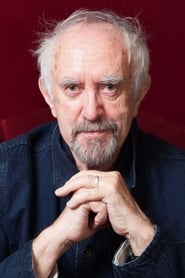
The film follows Sam Lowry (Jonathan Pryce), a low-level bureaucrat in a retro-futuristic surveillance state so drowning in paperwork that it can't function, let alone oppress people efficiently. He dreams, literally, of flying free as a winged warrior. Then a woman from his dreams turns up in real life and he does what any reasonable person would do: falsifies government documents, joins a terrorist cell, and destroys his career. The plot is almost secondary. What Gilliam builds around it is a complete world.
A Christmas Film That Hates Christmas (in the Best Way)
The holiday setting in Brazil is not incidental. Gilliam places his story squarely in December, and Christmas is everywhere: in the shopping queues, the piped carols, the wrapped packages under surveillance camera feeds, the desperate retail cheer on faces that have given up. It functions as the film's central irony. A population terrorized by its own government still decorates its windows and exchanges gifts on schedule.
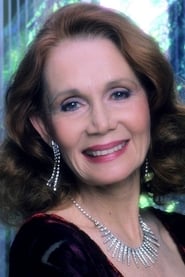
The most pointed Christmas scene involves Sam's mother, Ida (Katherine Helmond), surrounded by her wealthy friends at a holiday lunch. They eat, they gossip, they get cosmetic surgery between courses, they ignore a terrorist bomb that goes off in the restaurant and keeps eating amid the rubble. Gilliam shoots it straight, which makes it much funnier and much worse than any satirical flourish would.
This is what separates Brazil from simpler dystopias. The horror isn't that Christmas has been abolished. It's that Christmas survives perfectly intact, pressed right up against the torture chambers, and nobody finds this strange.
The Bureaucracy Is the Joke, and the Joke Is Real
The script, written by Gilliam, Tom Stoppard, and Charles McKeown, drew directly from Orwell's Nineteen Eighty-Four but bent it toward black comedy. The film's central catastrophe, Archibald Buttle arrested instead of Archibald Tuttle, happens because a fly falls into a printer and corrupts a single letter on a form. The state then processes this error with complete procedural correctness, killing the wrong man while generating immaculate paperwork.
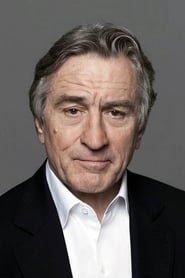
Robert De Niro appears as Archibald Tuttle, the rogue heating engineer who works without a permit, in what amounts to a cameo that De Niro reportedly begged Gilliam for the chance to play. He wanted the part because it was tiny, eccentric, and had nothing to do with his then-typecasting as dangerous men. Tuttle is essentially a plumber who became a revolutionary because he couldn't stand the forms. In Brazil, this makes perfect sense.
Michael Palin plays Jack Lint, Sam's childhood friend who now runs an interrogation department. Palin brings his characteristic cheerful decency to a man who tortures people between family commitments, which is the film's most quietly devastating performance. Jack Lint is not a monster. He's worse: he's a good person who has made reasonable accommodations.
The Battle Over the Ending
Universal Pictures acquired Brazil for North American distribution and then spent roughly a year refusing to release it. Studio head Sid Sheinberg demanded a new cut running 94 minutes (Gilliam's was 142) with an unambiguously happy ending, which Gilliam refused to deliver. Sheinberg's version, nicknamed "the Love Conquers All cut," added new footage and restructured the film so that Sam escapes with the girl and lives happily.
Gilliam screened his version for the Los Angeles Film Critics Association without Universal's permission, in December 1985. They awarded it Best Picture, Best Director, and Best Screenplay. Universal released the real film in January 1986. The "Love Conquers All" cut has occasionally surfaced as a curiosity, and watching it is genuinely disturbing, not because it's badly made but because it works as a completely different movie, one that says the opposite of everything Gilliam intended.
The actual ending, which you should not read if you haven't seen the film, is one of the bleakest in mainstream cinema. It arrives with such precision that it feels inevitable in retrospect, even though you spend the entire film hoping you've misread the signs.
What Gilliam Built
The production design by Norman Garwood created a world assembled from salvage: giant ducts run through every building for no clear reason, tubes and pipes crowd every ceiling, consumer goods are simultaneously futuristic and outdated. The aesthetic was influenced by Orwell but also by the Italian Futurists, early Fritz Lang, and the visual grammar of post-war British bureaucracy. Gilliam has said he wanted it to feel like the 1940s never ended, that society had kept going in the same direction without improvement.
The cinematography by Roger Pratt uses extreme wide-angle lenses that compress and distort spaces, making ordinary offices look grotesque and Sam's fantasy sequences look genuinely sublime. The contrast is deliberate. The dream world is beautiful. The real world is slightly, persistently wrong.
Brazil cost roughly $15 million and made back around $9 million theatrically. It has since been placed on the BFI's list of the 100 greatest British films, appeared on countless critical lists of the best science fiction ever made, and been credited as a direct influence on films including The Matrix, Dark City, and Children of Men. What Gilliam made in his fight with Universal was not just a film but a test case for whether studios could be forced to release art they didn't understand.
The Christmas setting makes this point sharper than Gilliam probably intended. The film arrives every December, dressed in tinsel, playing carols, asking if you're enjoying the holiday.
Fun Facts
The film's working title was "1984 1/2," a deliberate nod to both George Orwell and Federico Fellini's 8 1/2. Gilliam dropped it when he worried audiences would think it was an Orwell sequel.
Tom Stoppard, one of the three credited screenwriters, worked on the script for several weeks but has said he isn't entirely sure which lines he wrote, since Gilliam rewrote continuously throughout production.
Sid Sheinberg's re-edit, "the Love Conquers All cut," ran 94 minutes and was screened for test audiences without Gilliam's knowledge. Gilliam only found out when a friend in the audience called him.
Robert De Niro took his role as Archibald Tuttle for a fee far below his standard rate. He later said he wanted to do something small and strange as a break from playing Al Capone in The Untouchables, which he filmed around the same period.
The enormous heating ducts that cover almost every set were fully functional on location. The film used a real cooling plant in London as its primary shooting location, and the ducts were already there.
Jonathan Pryce prepared for Sam Lowry's daydream sequences by studying silent film acting, specifically Buster Keaton, to find a physical grammar for fantasy that would contrast with his clerkish stillness in the real-world scenes.
The Los Angeles Film Critics Association, after giving Brazil its awards in December 1985, issued a public statement criticizing Universal for refusing to release the film. This was one of the first times a major critics' organization publicly opposed a studio's distribution decision.
The song "Brazil," the Brazilian samba from 1939 written by Ary Barroso, was chosen as the recurring musical theme because Gilliam heard it on the radio while writing and found it absurdly at odds with the grim material. He licensed it for a few hundred dollars and built much of the film's score around Michael Kamen's variations on it.
Cast