
The year 2027: the last days of the human race. No child has been born for 18 years. He must protect our only hope.
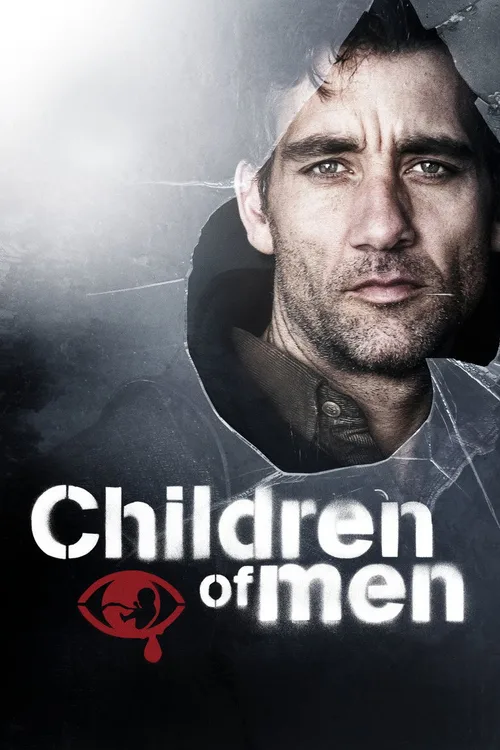
Children of Men (2006)
In 2027, in a chaotic world in which humans can no longer procreate, a former activist agrees to help transport a miraculously pregnant woman to a sanctuary at sea, where her child's birth may help scientists save the future of humankind.
 rating 9/10 User rating 7,686 votes 76%
 ❄ Christmas Connection
Children of Men is set in November and December 2027, with its climax arriving on Christmas Day. The entire plot is a stripped-down retelling of the Nativity: a pregnant woman of miraculous significance, a reluctant protector, a desperate journey through a world that has no room for them, and soldiers stopping mid-battle when they hear a newborn cry.
Where to Watch


Our Review
Children of Men opens with a news broadcast: Diego Ricardo, the youngest person on Earth, has just been stabbed to death in a bar fight in Buenos Aires. He was 18. The world mourns him the way it used to mourn celebrities, because in 2027, after 18 years of total human infertility, the youngest person alive was also the last proof that humanity had a future. That's the premise. Within five minutes, Alfonso Cuaron has blown up a coffee shop and set the tone for the next 109 minutes.
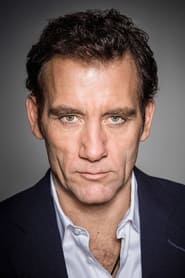
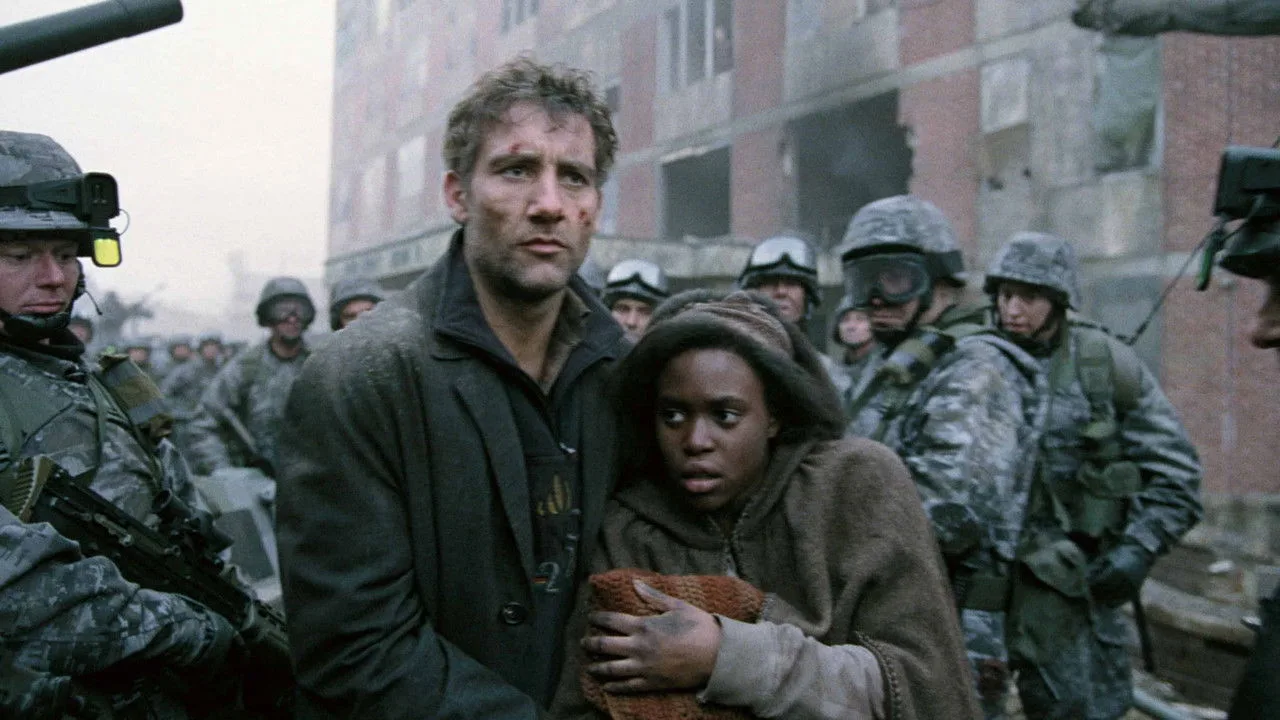
This is a Christmas movie. It earns that classification more honestly than most films marketed with that label. The action arrives at Christmas 2027. The central figure is a young woman named Kee, pregnant in a world that has forgotten what pregnancy looks like, carrying a child the whole world needs. She travels through Britain's militarized refugee camps with a reluctant, grief-worn protector named Theo (Clive Owen). The parallels to the Nativity aren't subtle, but Cuaron doesn't play them for sentiment. He plays them for gut-punch weight.
What "Children of Men" Gets Right That Other Christmas Films Don't
The Nativity story, at its core, is about the most important birth in history happening in the worst possible circumstances. No room at the inn. A stable. Shepherds and soldiers and kings converging on an unremarkable infant. Most Christmas films give you the warm version of that. Children of Men gives you the version where the inn is a detention camp, the stable is a bombed-out tenement, and the soldiers are pointing guns at each other until they hear the baby cry.
That scene, when Kee's baby is born and she carries it through an active firefight while soldiers on both sides fall silent, is one of the most affecting moments in 21st century cinema. Men who were trying to kill each other thirty seconds earlier reach out to touch the child. It doesn't fix anything. The shooting resumes almost immediately. Cuaron refuses you the easy catharsis. But for forty seconds, you understand exactly what the Nativity story is actually about, and you understand it in a way that no Christmas special has managed.
The Long Takes and How They Were Made
The film's technical signature is its extended single-take sequences. A car chase in the first act runs over four minutes without a cut, the camera moving through the vehicle, tracking action outside and inside simultaneously. The finale takes place in what appears to be one continuous shot lasting twelve or more minutes, through a collapsing building and a warzone. These aren't camera tricks for their own sake. The unbroken takes mean you cannot look away. There's no cut to signal that something difficult is coming. You're in the scene the same way Theo is in the scene.
Cinematographer Emmanuel Lubezki achieved the car chase shot using a custom-built camera rig inside the vehicle. The crew had the location for twelve days, spent ten of them rigging and testing, and had two days to actually shoot. Cuaron attempted only three total takes because each one required a complete reset. The blood that splashes onto the lens during that sequence was not scripted. It's real fake blood from a squib that hit the camera, and Cuaron kept it because it worked.
The Cast: Clive Owen and Everyone Surrounding Him
Clive Owen's Theo is a man who has already given up. His marriage to Julian (Julianne Moore, killed off earlier than most audiences expect) ended when their infant son died in the 1988 flu pandemic. He drinks too much. He moves through London's breakdown with the affect of someone who has already processed the worst and decided it doesn't matter. Owen plays this without self-pity, which is the only way it works.
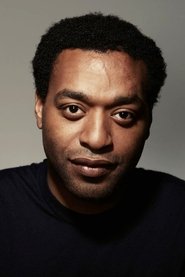
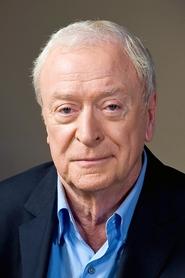
Michael Caine shows up as Jasper, Theo's old friend, a retired political cartoonist who grows marijuana in a forest cottage and listens to jazz. Caine plays him with the specific warmth of someone who has chosen joy as a deliberate act in the face of everything. The character could tip into whimsy; Caine never lets it. Chiwetel Ejiofor plays Luke, the leader of the Fishes resistance movement, and handles the film's most ambiguous arc with the kind of precision that makes you reconsider every scene he's in retrospectively.
Clive Owen made uncredited contributions to the screenplay. He spent several weeks working with Cuaron on his role before filming began, and his instincts about the character fed back into the script. Cuaron confirmed this publicly, telling Variety that Owen "was a big help" in developing the scenes.
Is It Too Grim for Christmas?
The honest answer is: yes, for some people. Children of Men is classified as a thriller and it earns that rating. Britain in 2027 looks like wartime London filmed through Lubezki's handheld lens, piled with abandoned cars and street graffiti and refugee cages. It is not a comfortable film to watch.
But Christmas itself has a darker history than its modern packaging suggests. The original Nativity involves a king ordering the massacre of infant boys. Medieval Christmas included "misrule," a deliberate inversion of social order. Victorian England's Christmas revival, driven largely by Charles Dickens, was explicitly a response to industrial poverty and child labor. The holiday's warmth has always existed alongside the awareness of what makes warmth necessary. Children of Men is operating in that tradition, not subverting it.
The film's 92% Rotten Tomatoes score is justified. It lost money on its initial run, earning roughly $70 million against a $76 million budget, and received three Academy Award nominations (Cinematography, Film Editing, Adapted Screenplay) without winning any. It is now regularly listed among the greatest films of the 2000s, which tells you something about how its reputation was built: slowly, by repeated viewings, by people who couldn't stop thinking about it.
Fun Facts
The car chase sequence took 12 days to prepare and could only be attempted three times total, because each attempt required a full reset of the location and camera rig. The blood that splatters the lens during the shot was from an unscripted squib accident that Cuaron decided to keep.
Children of Men opened in the UK on September 22, 2006, and in the US on December 25, 2006 — Christmas Day. The Christmas Day release date was deliberate, timed to align with the film's climactic setting and Nativity themes.
The screenplay lists five credited writers, but Clive Owen made uncredited contributions after spending several weeks developing the character of Theo with Cuaron before production began.
The film was adapted from P.D. James's 1992 novel "The Children of Men," but Cuaron's adaptation makes significant changes. In the novel, the protagonist is an Oxford academic named Theo Faron. The film strips out much of the novel's theological discourse and puts the camera on the street instead.
Emmanuel Lubezki, the cinematographer, used available light as much as possible throughout filming, often supplementing with handheld natural-light setups. This approach contributed to the film's documentary texture and earned Lubezki an Academy Award nomination, though he lost to Pan's Labyrinth's Guillermo Navarro that year.
The scene in which Kee reveals her pregnancy to Theo takes place in a barn, surrounded by farm animals. The staging is a direct visual echo of the Nativity, placed there by Cuaron with no dialogue to point it out.
Michael Caine based his performance as Jasper partially on John Lennon. The character's cottage, his political past, his relationship with a catatonic wife, and his defiant humor all reflect aspects of Lennon's public persona in the 1970s.
The battle sequence at Bexhill was shot over multiple days using hundreds of extras, with the long unbroken take assembled from several segments joined by digital stitching at points where the camera passed through smoke or darkness. Cuaron and Lubezki rehearsed it for weeks to make the joins undetectable.
Cast