

Christmas Comes But Once a Year (1936)
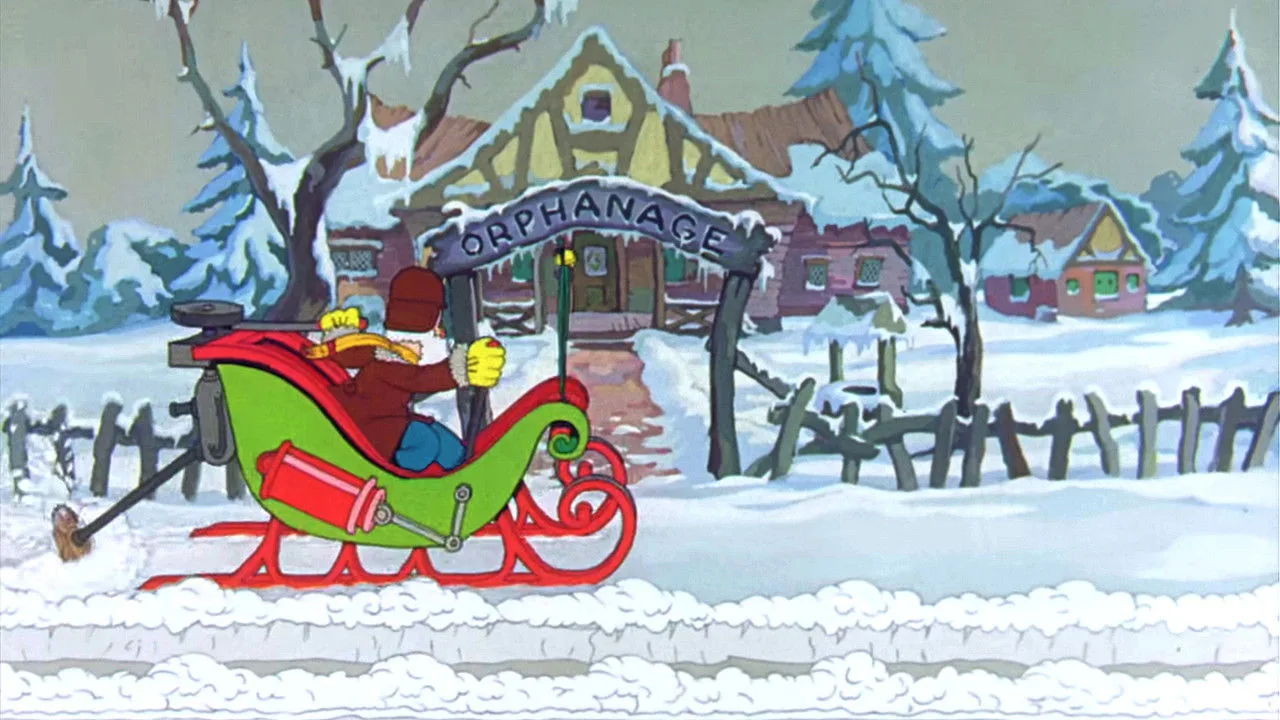
At an orphanage, the children are sad because they received used defective toys as gifts. Professor Grampy sees the children while passing by in his sled and has an idea on how to give them a merry Christmas.
 rating 7/10 User rating 26 votes 70%
 ❄ Christmas Connection
Christmas Comes But Once a Year is set entirely on Christmas morning at an orphanage, where a kindly inventor creates improvised toys for children whose gifts have been ruined. The short builds its entire story around the act of giving and the spirit of Christmas generosity, making it inseparable from the holiday.
Where to Watch

Our Review
"Christmas Comes But Once a Year" runs just over eight minutes and tells you everything you need to know about what Fleischer Studios could do when they were firing on all cylinders. Released in 1936 as part of the Color Classics series, it is a two-strip Technicolor short about an inventor who salvages a ruined Christmas morning for a group of orphans using nothing but junk and ingenuity. It received an Academy Award nomination for Best Animated Short Film. Ninety years later, it's still worth watching.
What Actually Happens in Those Eight Minutes
The setup is tight. A group of children at an orphanage wake up on Christmas morning to discover the toys Santa left them are already broken. They're devastated. Enter Professor Grampy, a recurring Fleischer character who appears in several Color Classics shorts, who is passing by on a sled packed with scrap parts and tools. He hears the crying, assesses the situation, and gets to work.
What follows is essentially a one-man contraption montage. Grampy builds new toys out of whatever's on hand: bicycle pumps, lamp bases, wire, springs. The film runs through his improvisations at a cheerful clip. None of the devices make physical sense, which is the point. The logic here is cartoon logic, where a broken phonograph horn can become a toy trumpet if you believe it hard enough.
The children go from miserable to delighted. That's the entire arc.
Simple as it sounds, the film earns its runtime. The Fleischer animators understood pacing. They don't linger on the sadness long enough to make it uncomfortable, and they don't cut the joy short just because the plot is technically resolved. The last few minutes are pure celebration, and the film lets it breathe.
The Color Classics Series and Why It Mattered
Fleischer Studios launched the Color Classics series in 1934 specifically to compete with Disney's Silly Symphonies, which were already using Technicolor to stunning effect. The studio had fallen behind on color production, and the Silly Symphonies were winning awards and audiences. "Christmas Comes But Once a Year" came in the third year of the Color Classics run, by which point Fleischer had developed a confident hand with the two-strip process.
Two-strip Technicolor is a different animal from three-strip. It renders reds and greens well but struggles with blues, giving the whole palette a warm, slightly unreal quality. For a Christmas short set in winter, that warmth is an odd fit that somehow works. The snow looks almost golden. The orphanage interior glows like a lamp left on too long.
The Color Classics shorts are less celebrated than the Silly Symphonies, and that's partly fair. Some of them are thin. But the best ones, including this short, show a studio with its own sensibility: looser than Disney, more comfortable with absurdity, less interested in sentiment for its own sake.
Professor Grampy as a Character
Grampy is not one of Fleischer's marquee characters. He doesn't have Betty Boop's fame or Popeye's staying power. But he's a genuinely useful type: the cheerful problem-solver whose enthusiasm outpaces any concern about how the solution is supposed to work. He doesn't fret. He builds.
There's a version of this character who exists to make children feel small by being competent. Grampy is not that version. He builds with children around him, not to impress them, and the film treats their wonder as the correct response rather than as naive ignorance. That's a small but real distinction in how the character is written.
His design is pure Fleischer: round and rubbery, slightly odd around the eyes, with the kind of fluid movement that the studio's rotoscoping-influenced technique produced better than almost anyone else in the 1930s.
The Oscar Nomination
The Academy Award nomination for Best Animated Short Film in 1937 put "Christmas Comes But Once a Year" in competition with Disney's "Country Cousin," which won. That result was predictable. Disney dominated the animated short categories throughout the late 1930s, and "Country Cousin" was a well-crafted film. But the nomination itself was not charity. The Academy recognized that Fleischer had made something genuinely good, which it had.
The nomination also reflects how seriously the short film category was taken in that era. Animation was not yet walled off into its own cultural category. A short that ran before a feature film in 1936 could be nominated alongside live-action work and discussed by serious critics. "Christmas Comes But Once a Year" is among the better-preserved artifacts of the studio's middle period, before the expensive features "Gulliver's Travels" and "Mr. Bug Goes to Town" stretched Fleischer beyond what it could sustain.
Is It Worth Watching?
The film is in the public domain and is freely available online. It costs eight minutes. The animation holds up better than most 1930s non-Disney work, the pacing is clean, and the central idea, that broken things can be fixed with enough resourcefulness and goodwill, is stated without being belabored. It doesn't overstay its welcome.
For anyone with children who are tired of watching the same handful of Christmas specials, "Christmas Comes But Once a Year" is a genuine discovery. The children in the orphanage who go from tears to shrieking delight are animated with enough specificity that even a modern eight-year-old will recognize something true in them.
The final shot holds on the Professor, tools in hand, grinning at the chaos he's created. It's the right note to end on.
Fun Facts
The film was released on November 27, 1936, timed to open before Thanksgiving so it could run through the Christmas season in theaters.
Fleischer Studios launched the Color Classics series in 1934 as a direct response to Disney's Silly Symphonies, which had been using Technicolor since 1932 and were pulling audiences and critics away from other studios.
The short was made using two-strip Technicolor rather than three-strip, which means the color palette is missing accurate blue reproduction. Three-strip Technicolor, which renders all colors accurately, was significantly more expensive and logistically demanding for smaller studios.
Professor Grampy appeared in at least five Color Classics shorts between 1935 and 1937, making him one of Fleischer's few recurring non-Popeye, non-Betty Boop characters in that series.
The Academy Award for Best Animated Short Film that year went to Disney's "The Country Cousin," continuing a streak in which Disney won the category every year from 1932 through 1942 except for 1938 and 1939.
Fleischer Studios was based in New York City, not Hollywood, which gave its animation a different cultural flavor from the Disney output. The studio remained in New York until it relocated to Miami in 1938.
The studio was formally dissolved in 1942 when Paramount Pictures, which had been distributing and financing Fleischer films, took control and renamed it Famous Studios. Max Fleischer, the studio's founder, never worked in animation at that scale again.
The film entered the public domain decades ago and has been included in numerous public domain Christmas DVD collections, making it one of the more widely distributed Fleischer shorts even though it is rarely discussed in histories of the studio.
Cast