
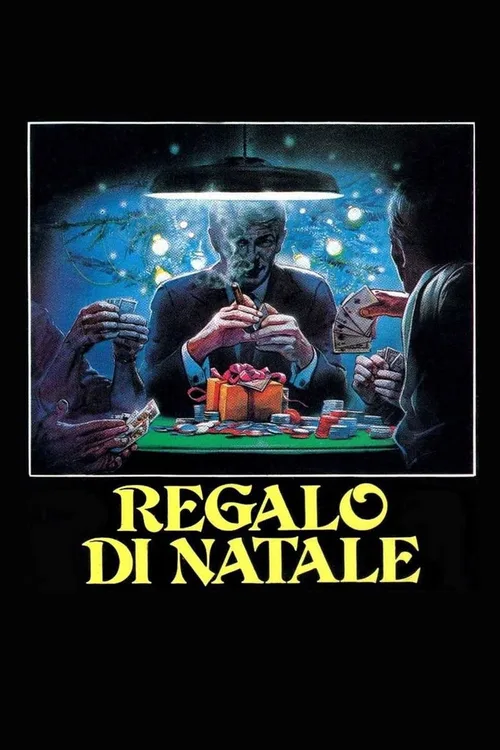
Christmas Present (1986)
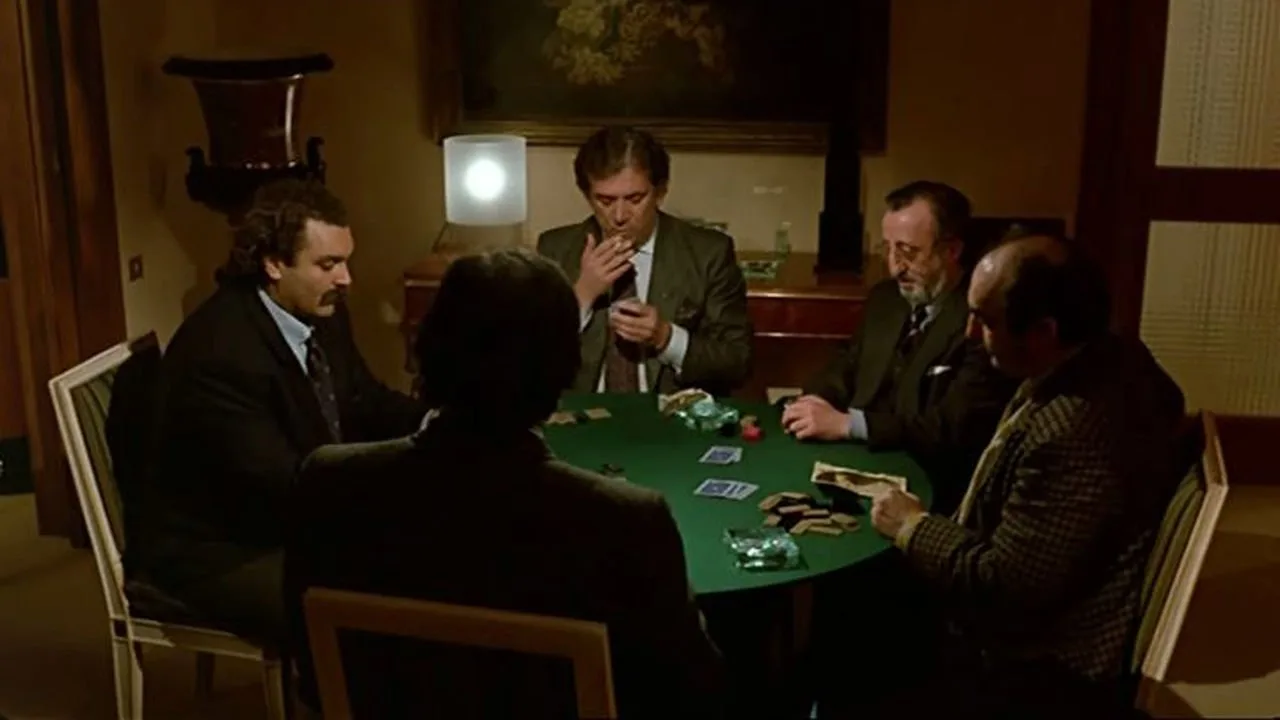
On Christmas night, four estranged friends reunite to rip off a wealthy businessman in a game of poker, but old grudges get in the way.
 rating 7/10 User rating 172 votes 73%
 ❄ Christmas Connection
Christmas Present uses the holiday purely as a pressure cooker. The entire plot is set in motion by a Victorian-era bank tradition of delivering a Christmas turkey to a deserving poor family, and the film unfolds on Christmas itself. But the holiday spirit is conspicuously absent. Christmas here is a mirror held up to class guilt, not a source of warmth.
Our Review
There is a British tradition, entirely real, of wealthy institutions dispatching a representative to deliver a token gift to the deserving poor at Christmas. A hamper, a turkey, a few coins. The gesture acknowledges inequality while ensuring nothing has to change. Tony Bicat's Christmas Present, broadcast by Channel 4 on December 19, 1985, is a 75-minute black comedy built entirely around that tradition. It is one of the more honest British Christmas films ever made.
Peter Chelsom plays Nigel Playfayre, an investment manager at Hammond's Bank, tasked with performing the firm's annual ritual: delivering a Christmas turkey and sixpence to an impoverished London family. It is the kind of duty that gets passed down the hierarchy like a bad smell. Nigel doesn't want to be there. The family doesn't particularly want him there either. What follows is the kind of comedy that makes you laugh and then feel bad about laughing.
A Sharply Specific Satire of Class and Charity
Bicat wrote and directed Christmas Present himself, and the script has the confidence of someone who has been thinking about British class dynamics for a long time. He should know the territory: in 1968, he co-founded Portable Theatre with David Hare, the company that launched the careers of Howard Brenton and Snoo Wilson and made it their business to confront the establishment on its own terms. By 1985, Bicat had moved into television, but his instinct for political provocation hadn't softened.
The film's central joke is that a bank's "charitable" Christmas gesture is patronising, absurd, and utterly useless to the people it claims to help. Bicat earns it by keeping the human detail precise. The family is not a symbol. They have their own dynamics, their own irritations with each other, their own ambivalence about the strange man standing in their hallway holding a turkey. The film resists making the poor family saintly and the banker simply villainous. Everyone is a bit ridiculous. That's the point.
Bill Fraser plays Sir Percy Hammond, the bank patriarch who dispatches Nigel on his mission. Fraser spent decades playing irascible authority figures: judges, generals, stuffed shirts. By 1985 he had the form down to an art. He would win the Laurence Olivier Award for Best Comedy Performance in 1986 for his stage role in When We Are Married, and Christmas Present sits in that same vein: comedy that draws its power from how seriously the pompous take themselves.
The Cast That Makes It Work
Chelsom was still a stage actor in 1985, not yet the film director he would become. He had appeared opposite Patrick Stewart at the Royal Shakespeare Company and alongside Anthony Hopkins at the National Theatre. Here, playing Nigel, he brings a quality the role needs: genuine discomfort. Nigel isn't a cartoon villain. He's a man who has internalised his class position so thoroughly that being confronted with real poverty registers as a social inconvenience rather than a moral challenge.
Lesley Manville plays Judy Tall, and Karen Meagher plays Anne. Both were in the thick of the most serious British television drama of the mid-1980s. Meagher had starred in Threads just a year earlier, the BBC's harrowing nuclear war film that remains one of the most disturbing pieces of television ever broadcast. Coming from that to a Christmas black comedy about class is a significant gear change, but it reflects how British television of this period moved freely between registers.
The cinematography is by Gabriel Beristain, a Mexican-born DP who had studied at the National Film and Television School in Beaconsfield and was just beginning to build his British career. In the same year, 1985, he also shot The Good Father. The following year, his work on Derek Jarman's Caravaggio won a Special Silver Bear at the Berlin International Film Festival.
What It Actually Looks Like as a Christmas Film
Anyone expecting festive warmth should be warned: Christmas Present delivers Christmas vibes approximately the way a cold radiator delivers heat. Christmas is the occasion, not the atmosphere. The decorations are there. The turkey is there. The sense that this particular holiday has arrived not to comfort but to expose is very much there.
What Bicat understood, and what makes the film worth watching now, is that Christmas in Britain in 1985 was politically loaded in a way that is easy to forget. The miners' strike had ended that March after a year that broke communities across the north and in Wales. Unemployment stood above three million. The image of Christmas as a time of shared national warmth existed in uncomfortable tension with what was actually happening outside the frame. Bicat put that tension inside the frame.
The music is by Nick Bicat, Tony's brother, who collaborated with him across many of his television films. Nick had already composed the score for David Hare's Wetherby earlier in 1985 and would go on to score The Scarlet Pimpernel for television. His contributions to Tony's work give the films a consistent register: thoughtful, slightly melancholy, not trying to tip the audience toward easy emotion.
The film aired and was largely forgotten by the wider public, which is the fate of most quality British television from this period. It did not spawn sequels or get remade or become a Christmas cult. It aired, it did what it intended to do, and it moved on. That is, in a way, very much in keeping with its own subject matter.
Fun Facts
Tony Bicat co-founded Portable Theatre in 1968 with David Hare. The company, which also launched Howard Brenton and Snoo Wilson, was dedicated to taking confrontational political theatre out of conventional venues and into found spaces across Britain.
The score was composed by Nick Bicat, Tony's brother. Nick and Tony had been writing together since adolescence and collaborated on several of Tony's television films, including Cotswold Death and Exchange of Fire.
Bill Fraser, who plays the pompous bank patriarch Sir Percy Hammond, died in September 1987, just two years after this film aired. He was 79. In 1986, the year after Christmas Present broadcast, he won the Laurence Olivier Award for Best Comedy Performance for his stage work in When We Are Married.
Peter Chelsom, who plays the hapless banker Nigel Playfayre, would go on to direct the 1991 film Hear My Song, which earned a BAFTA nomination and launched his career as a feature director. In 1985, he was primarily known as a stage actor who had worked at the RSC, the National Theatre, and the Royal Court.
Karen Meagher, who plays Anne, had starred just a year earlier in Threads (1984), the BBC's graphic nuclear war drama. Threads won four BAFTA Awards in 1985 and is still considered one of the most disturbing television films ever made. The contrast with a Christmas black comedy about a banker and a turkey is considerable.
Cinematographer Gabriel Beristain shot Christmas Present the same year he shot The Good Father. In 1986, his work on Derek Jarman's Caravaggio won a Special Silver Bear at the Berlin International Film Festival, establishing him as one of the most distinctive British DPs of his generation.
The film's premise, a bank employee delivering a charity turkey and sixpence to a poor family, is based on a real category of Victorian philanthropic tradition in which wealthy institutions performed token charitable acts at Christmas, more for the giver's sense of noblesse oblige than for any practical benefit to the recipient.
Cast