
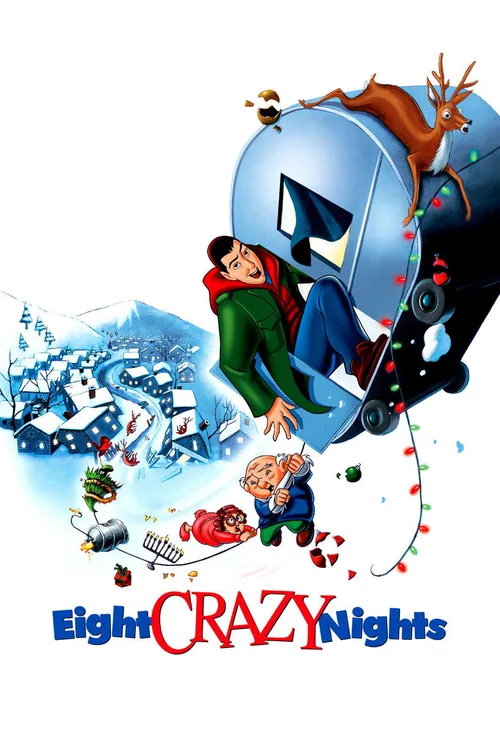
The ultimate battle between Naughty and Nice.
Eight Crazy Nights (2002)
Davey Stone, a 33-year old party animal, finds himself in trouble with the law after his wild ways go too far.
 rating 5/10 User rating 362 votes 52%
 ❄ Christmas Connection
Eight Crazy Nights is set during the eight nights of Hanukkah in a small New England town decorated for the holidays. While technically a Hanukkah film, its winter setting, holiday themes of redemption, and frequent Christmas imagery make it a December staple.
Where to Watch


Our Review
Adam Sandler's "The Chanukah Song" became a pop culture phenomenon in the mid-1990s, giving Jewish kids a holiday anthem to counter the wall-to-wall Christmas music. In 2002, Sandler tried to expand that energy into a full animated feature. Eight Crazy Nights is what happened. The result is a film that can't quite decide if it wants to be a raunchy adult comedy or a heartfelt holiday redemption story, and that internal conflict is both its biggest flaw and its strange appeal.
Adam Sandler Voices Nearly Everyone
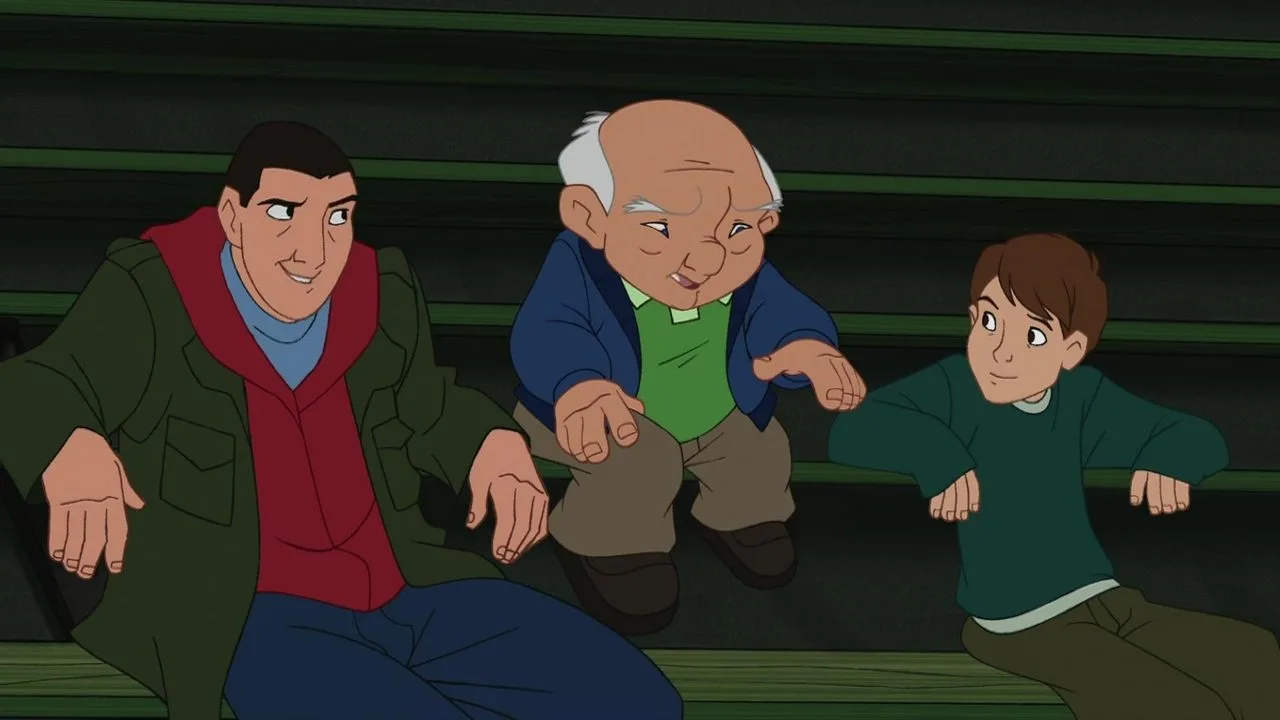
Sandler voices three characters: Davey Stone, a 33-year-old alcoholic with a rap sheet longer than his bar tab; Whitey Duvall, a squeaky-voiced elderly volunteer referee; and Whitey's twin sister Eleanore. The voice work for Whitey is genuinely impressive. Sandler pitches his voice into a nasal whine that somehow conveys both pathos and comedy, and the character lands as the emotional core of the film.
Davey, on the other hand, is one of Sandler's least likeable protagonists. He trashes a restaurant, assaults a mall Santa, and spends most of the film being cruel to the one person trying to help him. The movie asks you to root for his redemption, but it takes its time earning that turn.
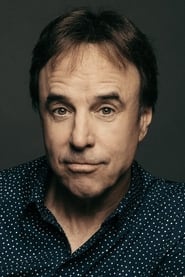
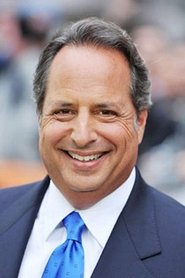
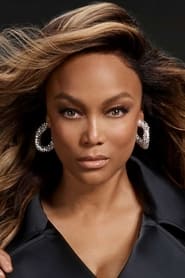
The supporting cast includes Rob Schneider as a Chinese waiter (a choice that has aged poorly), Kevin Nealon as the town mayor, Jon Lovitz as a rival, and Tyra Banks voicing a Victoria's Secret gown that comes to life. Yes, really.
Is Eight Crazy Nights a Christmas Movie?
Technically, no. The film follows the eight nights of Hanukkah, and Sandler wrote it specifically as a Hanukkah story. But the fictional town of Dukesberry is draped in Christmas decorations, carolers sing in the background, and the holiday basketball league serves as a unifying community event that crosses religious lines. The film exists in that overlap zone between Christmas and the broader "holiday season."
For a site about Christmas, Eight Crazy Nights earns its place because it engages with the December holiday atmosphere directly. Davey's backstory involves losing his parents on the first night of Hanukkah when he was twelve, and the film uses the holiday setting to explore grief, isolation, and the possibility of reconnecting with community. Those themes resonate across traditions.
The Animation That Nobody Expected
The most surprising thing about Eight Crazy Nights is how good it looks. Produced by Sony Pictures Imageworks, the animation blends traditional hand-drawn characters with digitally rendered backgrounds. The winter landscapes of small-town New England are genuinely beautiful, with soft snowfall and warm lighting that would feel at home in a much more prestigious film.
Then a deer eats a jockstrap.
That whiplash is constant. A tender scene about Davey visiting his parents' grave cuts to a porta-potty gag. A lovely musical number about community gives way to bodily function humor. Director Seth Kearsley clearly had cinematic ambitions, but the script by Sandler, Allen Covert, Brad Isaacs, and Brooks Arthur keeps yanking the tone back toward gross-out comedy.
The Musical Numbers Actually Work
Eight Crazy Nights is technically a musical, and this is where it punches above its weight. The original songs, composed with contributions from Sandler and Ray Ellis, range from genuinely catchy to surprisingly emotional. "Davey's Song," performed during a flashback to his childhood, is a legitimately affecting piece of animation and music.
The film also stuffs in references to real commercial products. Brand logos appear everywhere, from Foot Locker to Dunkin' Donuts, in what the filmmakers have called "product displacement" rather than placement. Animated brand mascots and store signs populate the town, giving it a hyperspecific American commercial landscape that feels like a commentary on holiday consumerism, whether intended or not.
A Cult Following Built on Nostalgia
Eight Crazy Nights made $23.8 million against a $3.4 million budget, so it turned a profit. Critics hated it. Audiences were split. But over two decades later, it has developed a genuine cult following, particularly among people who grew up watching it on cable TV during the holidays.
The film's reputation has shifted. What seemed like just another crude Sandler comedy in 2002 now reads as a rare animated film made explicitly for adults during the holiday season. There aren't many of those. For Jewish viewers especially, it remains one of the only mainstream animated films to center Hanukkah rather than treating it as a footnote to Christmas.
The final scene, where the town rallies around Whitey at the basketball awards ceremony, still works. Sandler commits fully to the sentiment, and the animation rises to meet it. For about five minutes, Eight Crazy Nights becomes the genuinely warm holiday film it always wanted to be. Then the credits roll with a reprise of "The Chanukah Song," and you remember what kind of movie you just watched.
Fun Facts
Adam Sandler voices four characters in the film: Davey Stone, Whitey Duvall, Eleanore Duvall, and a deer. He recorded each character's lines separately to differentiate the voices.
The film was produced on a budget of just $3.4 million, making it one of the cheapest wide-release animated films of the early 2000s. It grossed $23.8 million at the box office.
Director Seth Kearsley had previously worked as an animator on shows like Dexter's Laboratory and The Powerpuff Girls at Cartoon Network before taking on his first feature film.
The movie contains references to over 30 real-world brand names and products, including Foot Locker, Dunkin' Donuts, and Victoria's Secret. The filmmakers secured permission from each brand.
Eight Crazy Nights is the first theatrically released animated film to be centered entirely around Hanukkah rather than Christmas.
The animation was produced by Sony Pictures Imageworks, the same studio that would later create the visuals for Spider-Man: Into the Spider-Verse (2018).
Sandler co-wrote "The Chanukah Song" for Saturday Night Live in 1994. The song's popularity directly inspired the creation of Eight Crazy Nights eight years later.
Cast