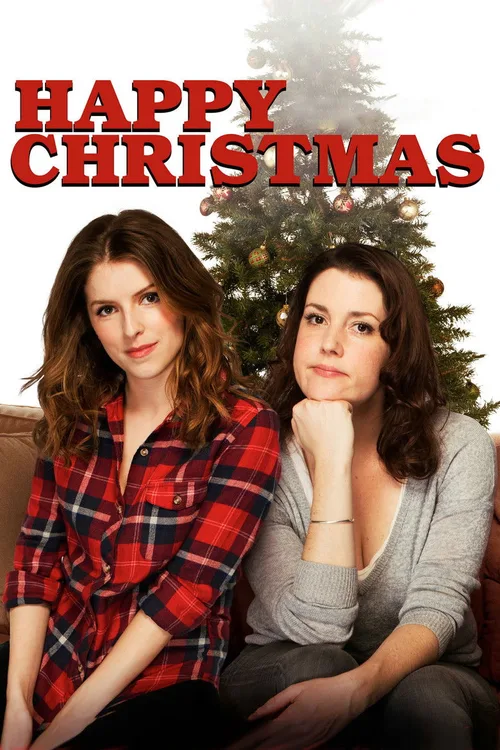
Family is the gift that keeps on taking.
Happy Christmas (2014)
After a breakup with her boyfriend, a young woman moves in with her older brother, his wife, and their 2-year-old son.
 rating 6/10 User rating 176 votes 51%
 ❄ Christmas Connection
Christmas serves as the background season rather than the story's engine. The holiday provides a reason for Jenny to crash with her brother's family, and a few decorations dot the Chicago bungalow, but the film is really about the messy personal reckonings that happen when people are stuck under one roof during the holidays.
Where to Watch


Our Review
Happy Christmas is the kind of movie that makes you wonder whether the people on screen know they're being filmed. Joe Swanberg's 2014 film gathers Anna Kendrick, Melanie Lynskey, Lena Dunham, and Mark Webber in a Chicago bungalow during the holiday season and lets them talk. No script. No written dialogue. Just a 15-page outline and a cast talented enough to make it work.
The result is 82 minutes of something that feels less like a Christmas movie and more like eavesdropping on a family you sort of recognize.
What Happy Christmas Is Actually About
The setup is simple. Jenny (Kendrick) has just been dumped and moves into the basement of her older brother Jeff's (Swanberg) house in Chicago. Jeff and his wife Kelly (Lynskey) have a toddler son and the kind of quiet domestic routine that looks stable from the outside but is slowly suffocating Kelly's identity as a writer.
Jenny's arrival disrupts everything. On her first night, she gets blackout drunk at a party, forcing Jeff to drag himself out of bed to pick her up. She starts seeing Kevin (Webber), who doubles as the family's babysitter and pot dealer. She is, by most measures, a mess.
But the movie's real interest isn't Jenny's self-destruction. It's Kelly. Lynskey plays a woman who has given up her writing career entirely to raise her child while her husband continues making films. She doesn't complain about it in dramatic speeches. She just looks tired. The frustration lives in the spaces between conversations, in the way she watches other people still doing the things she used to do.
The Happy Christmas Cast Makes Improvisation Look Easy
The entire film was improvised. Swanberg, a central figure in the mumblecore movement, gave his actors an outline of scenes and let them find the words themselves. This approach lives or dies on casting, and the Happy Christmas cast is precisely right for it.
Kendrick plays Jenny as charismatic but genuinely irresponsible, not in a cute rom-com way but in the way that actually exhausts the people around her. There's a scene where she and Lena Dunham's character Carson pitch Kelly on writing an erotic novel as a money-making shortcut so she can afford to keep writing serious fiction. The conversation is loose, funny, and a little uncomfortable. You can feel the actors discovering the scene in real time.
Lynskey is the film's quiet anchor. She does more with a hesitant smile than most actors do with a monologue. Her Kelly is a woman slowly realizing that the compromises she made for motherhood don't have to be permanent, and watching that realization take shape through improvised dialogue gives it a texture that scripted scenes rarely achieve.
Swanberg himself plays Jeff as a well-meaning husband who genuinely doesn't notice the imbalance in his marriage. He's not a villain. He's just oblivious, which is arguably worse.
How Christmassy Is Happy Christmas?
Barely. The holiday season provides the setting and the reason Jenny needs a place to stay, but this is not a movie about Christmas. There are no tree-trimming montages, no gift-exchange revelations, no snow-covered reconciliations set to a swelling score. A few decorations appear in the background. The Chicago winter is visible through windows. That's about it.
If you're looking for a film that will put you in a festive mood, this is not the one. If you're looking for a film that captures the specific emotional claustrophobia of spending the holidays with family when your life is falling apart, Swanberg nails it.
A Mumblecore Christmas Worth Finding
Happy Christmas premiered at the 2014 Sundance Film Festival, where it was nominated for the Grand Jury Prize in the U.S. Dramatic Competition. It holds a 75% approval rating on Rotten Tomatoes from 79 reviews. Critics generally praised its naturalism and performances while acknowledging that the thin plot isn't for everyone.
That's a fair assessment. The film doesn't build toward a climax. It accumulates. Small moments of friction, connection, and honesty pile up until you realize these characters have changed, even if nobody made a big speech about it. The erotic novel subplot sounds absurd in summary but plays as one of the most genuine depictions of creative collaboration on screen. Two women, a little tipsy, giggling over bad prose, accidentally stumbling into real artistic encouragement.
Swanberg shot the entire movie in his actual home. His real toddler son Jude plays the couple's child, which means several scenes feature a genuine two-year-old doing whatever two-year-olds do while professional actors try to maintain a conversation around him. The result is a film that feels lived-in because it literally was.
Fun Facts
Joe Swanberg directed Happy Christmas using only a 15-page outline with no written dialogue. Every line spoken in the film was improvised by the cast.
The film was shot entirely in Swanberg's real home in Chicago. The basement where Jenny crashes was his actual basement.
Swanberg's toddler son Jude plays the couple's child in the film. His unpredictable behavior in scenes forced the adult actors to adapt in real time.
Happy Christmas premiered at the Sundance Film Festival on January 19, 2014, and was nominated for the Grand Jury Prize in the U.S. Dramatic Competition.
Magnolia Pictures and Paramount Pictures jointly acquired the distribution rights before the film's Sundance premiere screening had even finished.
The movie's entire runtime is just 82 minutes, making it one of the shorter feature films to screen at Sundance that year.
Swanberg is considered a founding figure of the mumblecore movement, and Happy Christmas is often cited as his most accessible film despite having no traditional script.
Cast