

It's Christmas time in the city.
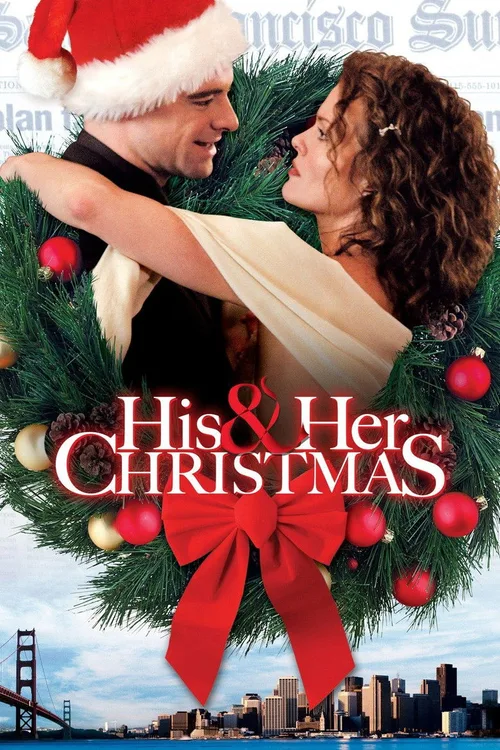
His and Her Christmas (2005)
Tom Lane is the star columnist for the media conglomerate owned San Francisco Sun newspaper. The company is thinking about increasing Tom's exposure by producing a new television show around him. Liz Madison is the advice columnist for the little read community newspaper, the Marin County Voice, which is a throwback to gentler times. Besides their journalistic occupations, one other similar aspect between Tom and Liz is that they are both currently single, with their friends and family doing whatever they can to find that special someone for their personal life. On November 2, the staff at the Voice learn that the Sun ownership has bought their newspaper, with the probable goal of folding it into the operations of the Sun. If this move does happen, the staff at the Voice will lose their jobs. To fight back, Liz decides to change her column to an editorial espousing the meaning of Christmas and the newspaper to the community...
 rating 6/10 User rating 19 votes 48%
 ❄ Christmas Connection
Christmas is the ideological battleground -- one columnist champions its sentimental spirit while the other argues for practicality, making the holiday the engine of both the plot and the central romance.
Where to Watch


Our Review
Ink, Rivalry, and Tinsel: His and Her Christmas Reviewed
Some Christmas movies want you to believe in miracles. His and Her Christmas (2005) wants you to believe that two journalists who despise each other in print will, inevitably, fall madly in love by December 25. It is a premise borrowed from the golden age of screwball comedy, updated with a Lifetime sheen and a Vancouver winter standing in for San Francisco. The result is warmer than its critics claim and sharper than its modest reputation suggests.
The setup is clean. Tom Lane (David Sutcliffe) writes a prestige column for the fictional San Francisco Sun, a corporate-owned daily that treats Christmas like a quarterly earnings report. Liz Madison (Dina Meyer) pens the advice column for the Marin County Voice, a small community paper that still believes in handwritten letters and hot cocoa. When the Sun's parent company buys the Voice, the power dynamic shifts -- and both writers, each freshly single, are suddenly competing for readers, relevance, and something neither of them planned for.
The Newsroom Conceit Actually Works
What makes the film more interesting than a standard holiday meet-cute is its thematic architecture. The Christmas debate is not just a plot device -- it is a genuine argument. Liz writes a column defending the emotional and communal value of the season; Tom fires back with a piece about sentimentality being a commercial construction. Their editors egg them on, their readers take sides, and the film uses this battle of op-eds as a proxy war for two very different philosophies of life.
It is a structure with real pedigree. The Front Page, His Girl Friday, and a hundred romantic comedies have used professional rivalry as romantic foreplay. Director Farhad Mann, a filmmaker with Emmy-winning television credentials stretching back to the groundbreaking Max Headroom pilot, understands the rhythm of this kind of story. He keeps the pace brisk and never lets the sentiment curdle into saccharine. The Vancouver locations provide an effective backdrop, standing in cheerfully for Bay Area winter.
Two Leads Who Deserve More Credit
Dina Meyer carries the film on instinct and timing. By 2005 she had already proven her range across wildly different genres -- from the cult science-fiction of Starship Troopers to DC television in Birds of Prey to genuine horror in the Saw franchise. Here she plays warmth without playing naive, which is harder than it looks in a holiday TV movie. Her Liz is someone with convictions, not just a love interest waiting to be thawed.
David Sutcliffe brings a rueful charm to Tom that prevents him from becoming a simple villain of the piece. Audiences who knew him as the complicated Christopher Hayden on Gilmore Girls would have recognized that quality immediately -- his gift for playing men who are wrong about something important but sympathetic enough to root for anyway. The chemistry between the two leads is genuine if never electric, which is probably the honest verdict most viewers would land on.
The supporting cast adds texture without overwhelming the central romance. The friends-who-push-the-plot characters are handled with enough efficiency that they feel like humans rather than plot mechanics. The film runs 86 minutes and wastes very few of them.
Where the Tinsel Gets Tangled
The screenplay by Peter Sullivan -- who would go on to write some of the highest-rated Christmas films in Lifetime history -- is functional rather than inspired. Some of the dialogue in the early rivalry scenes crackles, but the third-act reconciliation is rushed in a way that the buildup does not quite earn. A film that spends its first hour making a genuine case for why these two people grate on each other needs more than a single vulnerable conversation and a snowfall to seal the deal.
The Christmas-spirit message, while earnest, leans slightly heavy. By the final reel the film has largely abandoned Tom's counterargument -- that the holiday's commercial layer deserves scrutiny -- in favor of a total conversion that feels unearned. Real debates do not end with one side simply capitulating. A braver script might have let both columnists keep part of their view and still find each other.
The Verdict
His and Her Christmas is a better film than its 5.1 IMDB score implies and a more honest one than its feel-good genre packaging might suggest. It asks a real question -- what does Christmas actually mean, and to whom -- and it asks it with two leads capable of making the argument interesting. The romance is charming without being transformative, and the holiday atmosphere is present without being oppressive.
For a Lifetime original that premiered on December 19, 2005, it has aged gracefully. It sits comfortably in that specific tradition of American television Christmas films that borrow their structure from 1940s newspaper comedies and their emotional logic from classic romantic fiction. If you come to it knowing that, you will spend 86 minutes in good company. If you come expecting the screwball masterpiece the premise promises, you will have to settle for something considerably more modest but still worth your December evening.
It is not a Christmas miracle. It is a well-made, well-acted holiday TV movie with something on its mind, which puts it several rungs above most of its competition.
Fun Facts
The film premiered on Lifetime on December 19, 2005, giving viewers less than a week to watch it before Christmas -- a broadcast timing that guaranteed a captive audience of last-minute holiday seekers.
Director Farhad Mann directed the Emmy-winning pilot episode of Max Headroom for ABC in the 1980s, making his eventual pivot to Lifetime holiday fare one of television's more surprising career arcs.
Screenwriter Peter Sullivan adapted the film from an original story by producer Jeffrey Schenck; Sullivan would later write one of the highest-rated Christmas movies in Lifetime history and direct the record-breaking Hallmark film Christmas Under Wraps (2014).
The San Francisco Bay Area setting is entirely fictional on screen -- the production filmed throughout Vancouver, Canada, a city that has quietly become the default stand-in for American urban Christmas backdrops.
David Sutcliffe, who plays the pragmatic Tom Lane, announced his retirement from acting in May 2019 to pursue a career as a Somatic Therapist and Certified Core Energetics Practitioner -- a real-life turn that his character arc in this film almost anticipates.
Dina Meyer appeared in Saw II the same year this film aired, meaning that in the autumn and winter of 2005 she was simultaneously associated with one of the most gruesome horror franchises of the decade and one of Lifetime's cozier holiday offerings.
The film was later packaged by Lifetime on DVD as a double feature alongside Will You Merry Me?, cementing its status as one of the network's reliable seasonal titles rather than a one-time broadcast experiment.
The rival newspapers at the center of the plot -- a corporate broadsheet versus a scrappy community paper -- reflected a genuine anxiety about local journalism that has only intensified in the two decades since the film was made.
Cast