
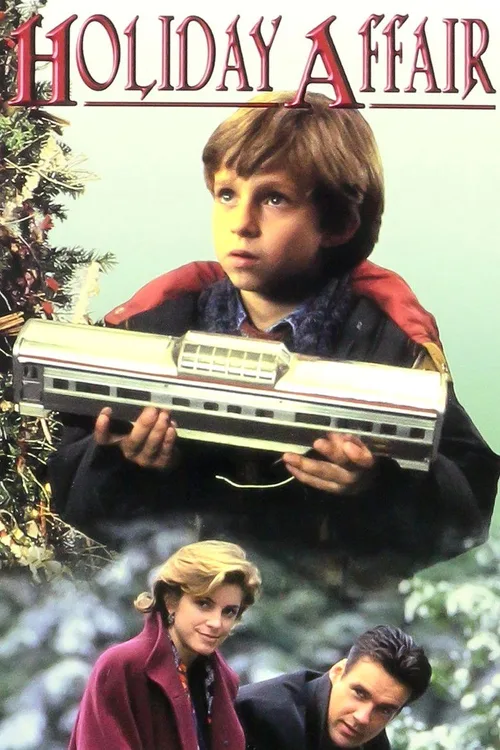
Holiday Affair (1996)
"Meeting cute" while Jodie's son Timmy enthuses over a model train set, Jodie and the raffish but likeable Steve immediately hit it off, but she is already engaged to conservative lawyer Paul Davis. The days between Christmas and New Year's Eve, Jodie finds herself in the unenviable position of choosing between two men whom she adores equally--a job not made easier by the well-meaning interference of son Timmy.
 rating 5/10 User rating 4 votes 56%
 ❄ Christmas Connection
The entire story takes place during the Christmas season, with the central meet-cute happening while the heroine is Christmas shopping undercover as a department store spy. The romantic tension plays out against a backdrop of holiday decorations, gift-giving dilemmas, and the heightened emotional stakes that December tends to manufacture. Christmas isn't just the setting; it's the reason any of this happens at all.
Our Review
The 1949 Holiday Affair had Robert Mitchum, Janet Leigh, and the kind of wry postwar melancholy that made even romantic comedies feel like they meant something. The 1996 TV remake has David James Elliott, Cynthia Gibb, and a Lifetime-adjacent warmth that is perfectly pleasant and will evaporate from your memory by New Year's Day. This is not necessarily a condemnation. Plenty of movies serve exactly that purpose, and at Christmas, there's an argument that comfort is its own kind of value.
The plot follows the original closely enough to feel intentional. Jodie Ennis (Gibb) is a young widow and single mother working as a secret shopper for a department store, tasked with buying competitors' toys and returning them. She's caught in the act by Steve Mason (Elliott), a sales clerk with a better radar than most, who lets her go anyway. The two keep crossing paths. She has a dependable, patient boyfriend, Carl (Tom Irwin), who has been waiting patiently for her to say yes to his marriage proposal for some time. Steve is the wrench in that plan.
What the 1996 Version Gets Right
The script, credited to Jennifer Miller, preserves the best structural element of the original: the love triangle is actually a fair fight. Carl is not a villain or a buffoon. He's a decent man who loves Jodie and her son Timmy (Curtis Blanck) and has been nothing but reliable. The movie doesn't stack the deck. You can genuinely see why she hesitates.
Cynthia Gibb is doing the real work here. Her Jodie is a woman who has already survived losing someone, and she plays the resistance to Steve not as stupidity but as self-protection. There's a scene where she tries to articulate why she'd choose safety over excitement, and Gibb sells it without making the character seem foolish. That's harder than it looks in a movie of this type.
Elliott, for his part, is doing his best Robert Mitchum impression without the benefit of Mitchum's particular gravity. Mitchum could say almost nothing and seem dangerous and appealing at once. Elliott is handsome and easygoing and warm, which works well enough for a TV movie but doesn't quite explain why Jodie would risk her stable life for him. The original had chemistry born from tension. This version has chemistry born from pleasantness, which is a different thing entirely.
The TV Movie Question
There's always the question with made-for-TV remakes of beloved films: why does this need to exist? The honest answer here is probably that it doesn't need to exist in any grand artistic sense, but it was made for an audience that wanted something cozy to watch in December 1996, and for that audience, it delivered.
Director Alan Myerson, who worked mostly in television, keeps things moving efficiently. He's not trying to reinvent anything. The Christmas setting gets its full due: decorations, department store chaos, snow, and the peculiar emotional pressure that December applies to every unresolved relationship in a person's life. The holiday backdrop isn't wallpaper. It's doing actual narrative work.
The young actor Curtis Blanck as Timmy avoids the trap of being unbearably precocious. The kid has opinions about Steve and Carl and expresses them without being written as a miniature adult dispensing wisdom. That's a specific kind of restraint that Christmas movies often fail to exercise.
Remake vs. Original: Worth the Comparison?
Comparing this directly to the 1949 film is a useful exercise but ultimately unfair. The 1949 version, directed by Don Hartman, had a budget, a studio, and two stars at the height of their appeal. It was also made in a different era of romantic comedy, when ambiguity was allowed to linger in a way that modern TV movies rarely permit. The 1996 version is tidier, warmer, and more resolved. Nothing is left uncomfortable.
That's both its commercial instinct and its creative limitation. The original's ending carries genuine weight because the film earns its conclusion through actual friction. The remake reaches the same destination without the same difficulty. It's the cinematic equivalent of taking a highway instead of a mountain road. You arrive, but you miss the view.
Still, the 1996 Holiday Affair knows what it is. It's not pretending to be the original. It has a good lead performance from Gibb, a functional romantic triangle, and enough Christmas atmosphere to justify its December slot. That's a workable formula. It worked in 1996, and it still works on a slow afternoon when you want something that won't demand much but won't insult you either.
Fun Facts
The original 1949 Holiday Affair was adapted from a short story called "Christmas Gift" by John D. Weaver, published in Good Housekeeping magazine. The TV remake retained the story's structure closely, including the specific detail of the heroine working as a comparison shopper.
David James Elliott was best known in 1996 for his role as Lieutenant Commander Harmon Rabb on the military legal drama JAG, which had premiered on CBS in 1995. The show ran for ten seasons, ending in 2005.
Cynthia Gibb had previously appeared in Salvador (1986) alongside James Woods and in the 1988 film Youngblood opposite Rob Lowe and Patrick Swayze before transitioning significantly into television work through the 1990s.
The 1949 original was Robert Mitchum's only romantic comedy during the height of his fame. He was better known for film noirs like Out of the Past (1947) and thrillers like Night of the Hunter (1955), making the casting in the original a genuine surprise to audiences at the time.
Janet Leigh, the female lead in the 1949 film, is widely remembered today for Psycho (1960), but she appeared in over 60 films throughout her career, with the original Holiday Affair considered one of her more charming early performances by critics who have revisited it.
Alan Myerson, who directed the 1996 remake, had prior experience with comedic television, including episodes of Police Squad in the early 1980s, the satirical precursor to the Naked Gun film franchise.
The 1996 film aired on Lifetime Television, which by the mid-1990s had established itself as the dominant cable channel for TV movies aimed at women, particularly around the holiday season. Lifetime reportedly commissioned dozens of original holiday films throughout the 1990s.
Cast