He's Icin' & Slicin'
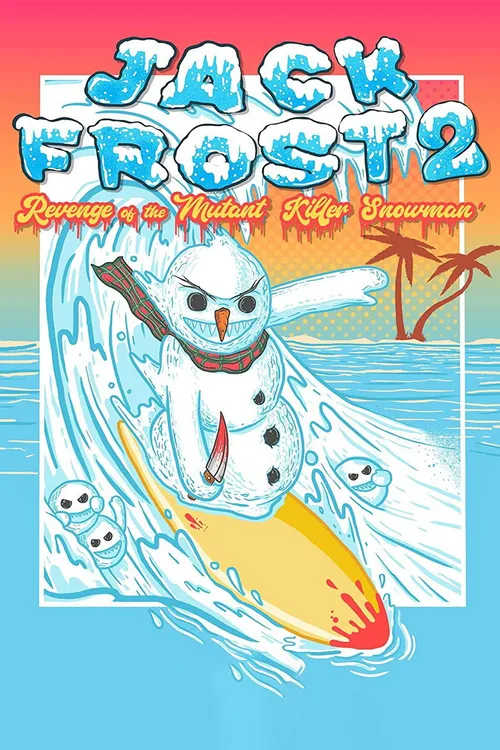
Jack Frost 2: The Revenge of the Mutant Killer Snowman (2000)
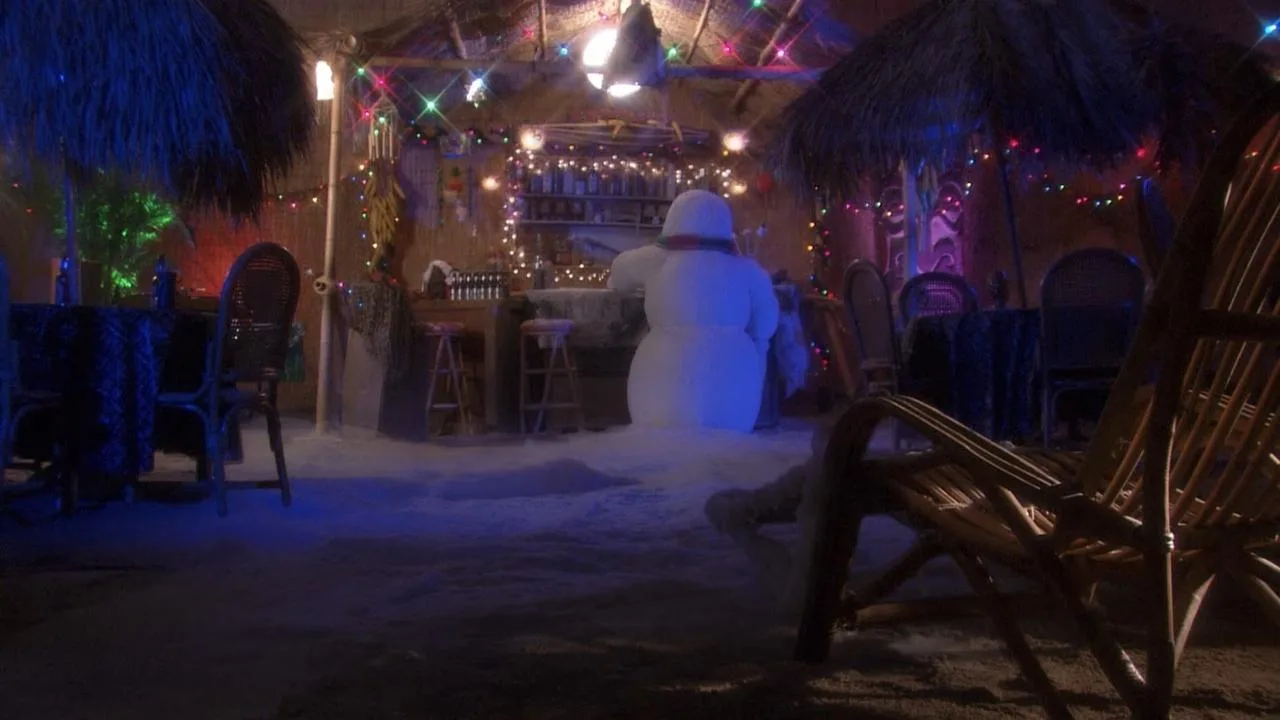
The sheriff and his deputies from the first movie decide to take a vacation in the Caribbean. Their holiday will be short-lived, however, as the thawed murderer gets inadvertently re-frozen and brought back to life. As if that weren't bad enough, he now has the ability to remain frozen even in tropical temperatures, and he's headed south to settle some old scores.
 rating 3/10 User rating 72 votes 44%
 ❄ Christmas Connection
Jack Frost 2 centers entirely on a murderous snowman -- the most literalized Christmas symbol in horror cinema -- who follows his targets to a tropical island precisely because his existence is tethered to snow, winter, and Christmas. The film opens at Christmas, Jack reforms just in time for the holiday, and his entire mythology is built from Christmas iconography: carrots, snowballs, icicles, and winter cold weaponized as instruments of death.
Where to Watch


Our Review
The original Jack Frost (1997) was a low-budget horror comedy about a serial killer who merges with genetic material and becomes a murderous snowman. It cost almost nothing, looked like it cost nothing, and had the rough charm of a movie where everyone clearly knew exactly how absurd their project was. Writer-director Michael Cooney shot it in 1992 for under a million dollars after a $30 million version with Renny Harlin attached fell apart. The snowman puppet was immobile -- the crew spent $50,000 on it and got one static foam prop -- so Cooney compensated with close-ups and creative angles. Constraints became personality.
The sequel throws all of that away by having more resources and less instinct about how to use them.
The Plot of Jack Frost 2, Such as It Is
Sheriff Sam Tiler (Christopher Allport) is suffering from PTSD after the events of the first film. His psychiatrist recommends a vacation. He takes his wife Anne (Eileen Seeley) to a tropical island in the South Pacific for the wedding of his deputy Joe Foster (Chip Heller). Meanwhile, at an FBI facility, a janitor spills coffee into the tank of antifreeze holding Jack Frost's remains. This revives Jack, who promptly heads for the tropics -- because Jack absorbed some of Sam's blood in the first film, tethering him psychically to Sam's location.
A killer snowman. Following people to a tropical island. To continue his revenge.
The film was shot over four weeks in Southern California. It rained the entire four weeks, which means the tropical paradise on screen has a notable absence of actual sun. This is either the most ironic or most fitting production circumstance in the history of low-budget Christmas horror cinema.
What Jack Frost 2 Actually Does Well
The premise delivers one genuinely clever inversion: the antifreeze that killed Jack in the first film no longer works on him. He absorbed Sam's genetic material along with the blood, which makes him immune to his previous weakness. This is the kind of sequel logic that at least shows someone was thinking about internal consistency, even in a movie about a psychic snowman.
Jack has also gained new powers. He can "birth" snowballs that hatch into small baby snowmen, which then kill independently. One of these kills a character by driving an icicle through his eye. Cooney finds the final weakness through the same genetic logic: Sam is allergic to bananas, so Jack shares that vulnerability. The baby snowmen dissolve on contact with banana juice. The eventual resolution involves a blender and a great deal of banana.
Scott MacDonald returns to voice Jack, and he remains the best thing in both films. His delivery has genuine menace cut with a kind of exhausted contempt, which is the correct tone for a serial killer who has been reduced to chasing his nemesis across an ocean.
Why the Sequel Can't Replicate the Original
Cooney himself noted the problem in interviews: the snowman suit in the sequel was "almost too improved." The first film's personality came from its limitations. Because the puppet couldn't move convincingly, Cooney shot around it. The resulting film feels more dangerous than it should, because you never quite see Jack in a way that lets you laugh at him comfortably. The sequel shows too much, too clearly, and too often.
The film scored 0% on Rotten Tomatoes from six critic reviews, with an average rating of 3.3/10. The IMDb score sits at 3.7. These numbers reflect a specific kind of failure: not the endearing ineptitude of a microbudget production that doesn't know any better, but the more frustrating failure of a film that should understand its own material and mostly doesn't.
The kills are creative on paper -- ice anvil crush, icicle through the eye, being devoured by baby snowmen -- but the execution lacks the deranged commitment that makes bad-good horror work. Cooney shoots in digital widescreen, a format the crew reportedly struggled with, and the result looks cheaper than the original despite presumably having more money to spend.
The Title Change and the Michael Keaton Problem
The original 1997 film was simply called Jack Frost. In 1998, a completely unrelated Warner Bros. film starring Michael Keaton -- a family drama about a father who dies and returns as a snowman -- was also released as Jack Frost. Video rental customers kept picking up the wrong one. Some were disappointed to find a slasher film instead of a Michael Keaton drama. Others were presumably disappointed to find a Michael Keaton drama.
This confusion directly influenced the subtitle of the sequel. Cooney added "Revenge of the Mutant Killer Snowman" specifically so that nobody could accidentally rent it expecting something appropriate for children. This is the most honest subtitle in horror cinema: every single word is accurate.
Is This a Christmas Movie?
More than most films that get debated for the label. Jack Frost is a Christmas monster in the most literal possible sense -- he is a snowman, he kills people with Christmas-coded weapons (icicles, snowballs, a carrot nose used as a plot device), and both films take place during the Christmas season. The sequel ends with a giant carrot crushing two sailors, implying Jack has survived and is still at large. Jack Frost 2 commits to its Christmas identity with more conviction than it commits to almost anything else.
The film was completed in 1998 but sat unreleased until 2000, which gives it the additional quality of being a Christmas movie that missed Christmas twice before finally reaching audiences.
Fun Facts
Jack Frost 2 holds a 0% approval rating on Rotten Tomatoes from six critic reviews, with an average score of 3.3/10 -- a perfect score in the wrong direction.
The film was completed in 1998 but not released until 2000, meaning it spent two full years sitting on a shelf before finding its audience.
The entire four-week shoot took place on a Southern California island intended to double as a South Pacific paradise. It rained every single day of production, resulting in a tropical vacation film with almost no visible sunshine.
Director Michael Cooney added the "Revenge of the Mutant Killer Snowman" subtitle specifically because video rental customers kept accidentally renting the horror original instead of the 1998 Michael Keaton family drama, also titled Jack Frost.
Scott MacDonald voices the killer snowman in both films. In the sequel, Jack's weakness shifts from antifreeze to bananas -- because Jack absorbed Sheriff Sam's blood and Sam is allergic to bananas, the film's internal logic being more coherent than its execution.
Cooney noted in interviews that the improved snowman costume in the sequel was "almost too good," and that the immobile foam puppet in the first film gave that movie its unintentional personality through forced close-ups and obscuring camera work.
The original 1997 Jack Frost was made for under one million dollars after a version with director Renny Harlin attached and a $30 million budget fell apart. The sequel's budget was similarly minimal, shot on digital video in a format the production crew admitted struggling to use.
The film's baby snowmen -- spawned by Jack as living weapons -- are defeated by banana juice, delivered via blender. This is the only killer snowman franchise to use tropical fruit as a plot-critical weapon.
Cast