

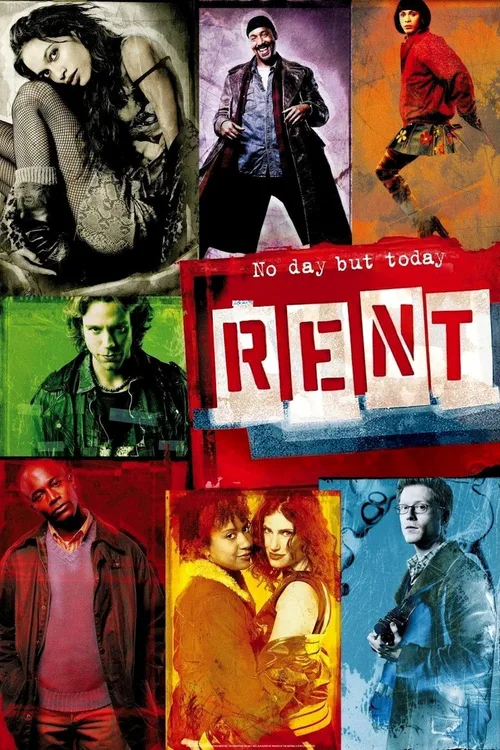
No day but today.
Rent (2005)
In New York City's gritty East Village, a group of bohemians strive for success and acceptance while enduring the obstacles of poverty, illness and the AIDS epidemic.
 rating 7/10 User rating 590 votes 68%
 ❄ Christmas Connection
Rent opens and closes on Christmas Eve, with "Seasons of Love" measuring an entire year from one December 24 to the next. The holiday framing is structural, not decorative: Christmas is when the characters are most desperate, most alive, and most aware of what they're losing.
Where to Watch


Our Review
Jonathan Larson died on January 25, 1996, at 35, from an undiagnosed aortic dissection. He was found on his kitchen floor at 3 a.m., the morning of Rent's first preview performance at the New York Theatre Workshop. His musical went on to win the Pulitzer Prize and four Tony Awards. Nearly a decade later, the original Broadway cast reassembled to make a film version. Rent (2005) is many things: a time capsule, a tribute, a slightly clumsy movie, and one of the most sincere musicals ever committed to screen.
What Rent Is Actually About
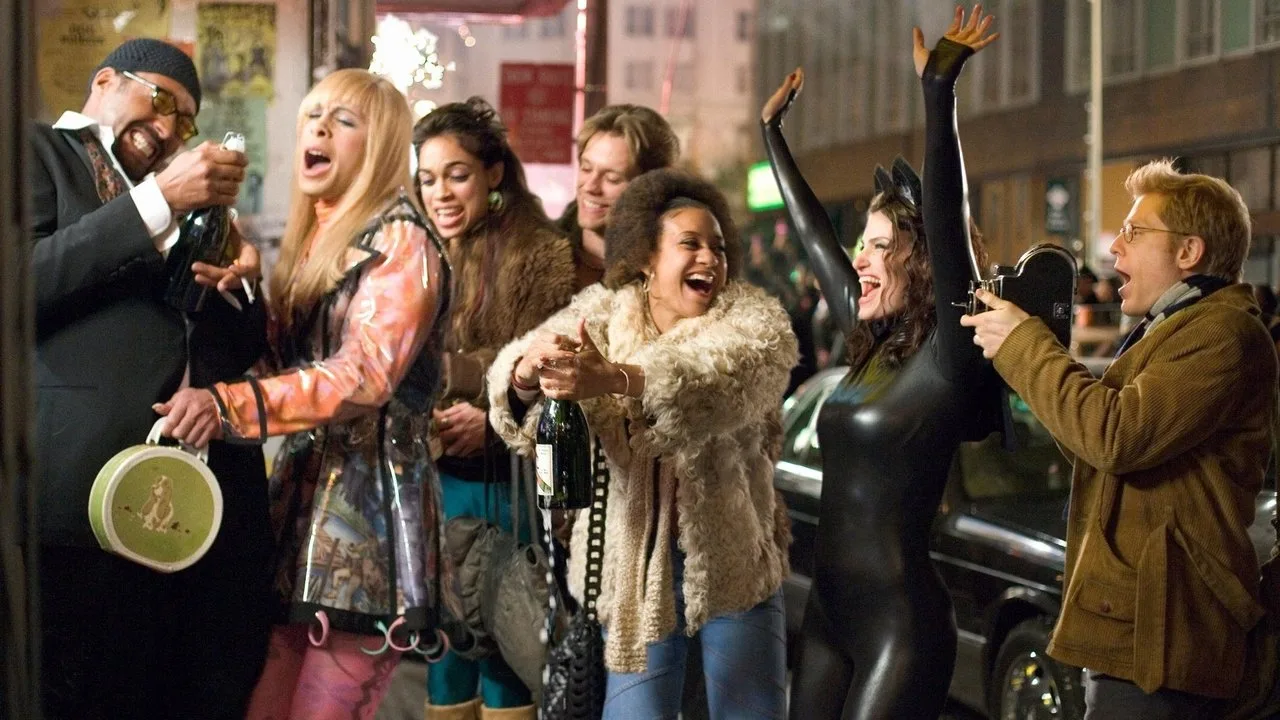
The story spans exactly one year in the lives of a group of broke artists and activists living in New York's East Village, beginning and ending on Christmas Eve. Mark Cohen (Anthony Rapp) is a filmmaker with no money and a dead camera battery. His roommate Roger (Adam Pascal) is an HIV-positive musician who hasn't written a song in a year. Their landlord Benny (Taye Diggs) has married into money and wants them out. Around them: Collins (Jesse L. Martin), a philosophy professor who falls for Angel (Wilson Jermaine Heredia), a drag performer with AIDS; Maureen (Idina Menzel), Mark's ex, a performance artist of baffling ambition; Joanne (Tracie Thoms), Maureen's new girlfriend; and Mimi (Rosario Dawson), an exotic dancer who is also HIV-positive and falls for Roger.
Larson adapted it from Puccini's 1896 opera La Boheme, updating tuberculosis-ravaged 1840s Paris to AIDS-crisis 1990s Manhattan. The parallels are deliberate and precise. Mimi maps to Mimi Musetta, Collins to Colline, Roger to Rodolfo. Larson's genius was recognizing that Puccini's tragedy wasn't specific to consumption or Paris. It was about young people dying before they got old enough to stop being interesting.
Why the Film Works Despite Itself
Director Chris Columbus made two Home Alone films and the first two Harry Potter pictures. He is a competent craftsman who tends to sand down edges. That instinct is exactly wrong for Rent, which is supposed to have edges. The film is visually safe in ways the stage show wasn't, and Columbus can't quite figure out what to do with his cameras during the big ensemble numbers.
What saves it is the cast. Six of the eight leads are original Broadway company members reprising roles they first played in 1996. Idina Menzel, two years removed from her original-cast-recording of Wicked, is as electric here as she was on stage. Jesse L. Martin, already familiar to TV audiences from Law and Order, plays Collins with a warmth that makes "I'll Cover You" devastating in its reprised form. Adam Pascal's voice has a ragged quality that suits Roger's wreckage. Only Rosario Dawson and Tracie Thoms are newcomers, both replacing actresses who aged out or were otherwise unavailable, and both are convincing.
The decision to keep the original cast was commercially unusual and artistically essential. These actors spent years living inside these characters. The result is a film that feels less directed than documented.
Is Rent a Christmas Movie?
This question comes up more than it should, and the answer is: technically yes, thematically complicated. The narrative opens on Christmas Eve with Mark and Roger facing eviction, unable to pay rent. It closes on the following Christmas Eve after a year of loss, love, and survival. "Seasons of Love," the show's most famous number, is explicitly about measuring the 525,600 minutes of a year, which runs from December to December.
But Rent is not about Christmas in the way most Christmas movies are. It doesn't celebrate the season. It uses it as a frame. Christmas Eve in the East Village, 1989, was cold and dark and many people were dying. The holiday appears in the story the way it appears in real life for a lot of people: as a deadline, a reunion, a reckoning. It's Christmas as pressure rather than Christmas as comfort.
The opening sequence is actually one of the film's best. The loft, the broken radiator, the La Vie Boheme reprise over dinner that becomes an act of defiance. It captures something the later, sunnier sequences lose.
"Seasons of Love" and the Problem with Perfection
The film opens with the cast standing on a bare stage in front of a microphone, performing "Seasons of Love" directly to camera. It's a theatrical choice Columbus made deliberately, and it mostly works. The song itself is unusual: it stops the story before it starts, steps outside the fiction, and asks the audience to agree that a year's worth of grief and joy is worth measuring. As an opening gambit, it's bold. As a moment of pure performance from actors who've sung this song thousands of times, it's extraordinary.
The risk Columbus took was breaking the fourth wall immediately, then abandoning that approach for the rest of the film. The result is a movie that establishes a theatrical grammar and then forgets it. The stage-to-screen problem Rent never fully solves is the same one that plagues most musical adaptations: what reads as raw and immediate on a bare stage becomes literal and odd when you put cameras and locations around it.
Fun Facts
Jonathan Larson died of an aortic dissection on January 25, 1996, the morning of Rent's first preview performance. He had been misdiagnosed with food poisoning and then a virus in the two days before his death. He was 35 years old.
Rent won the Pulitzer Prize for Drama in 1996, making Larson one of the few composers to win the prize posthumously. The same year it took four Tony Awards including Best Musical.
Daphne Rubin-Vega, the original Broadway Mimi, was pregnant at the time of filming and could not reprise her role. Rosario Dawson replaced her. Similarly, Fredi Walker felt she was too old to reprise Joanne, and Tracie Thoms stepped in.
Rent is based on Giacomo Puccini's 1896 opera La Boheme. Larson updated the setting from 1840s Paris to 1980s and 1990s New York's East Village, and replaced tuberculosis with HIV/AIDS as the defining illness of his characters' lives.
The film was a significant box office disappointment. Made on a budget of approximately $40-50 million, it earned only $29 million domestically and $31.6 million worldwide, failing to recoup its production costs in theaters.
Six of the eight principal cast members in the 2005 film originated their roles in the 1996 Broadway production: Anthony Rapp, Adam Pascal, Idina Menzel, Jesse L. Martin, Taye Diggs, and Wilson Jermaine Heredia. Only the roles of Mimi and Joanne were recast.
The musical ran on Broadway from April 1996 to September 2008, a total of 5,123 performances, making it one of the longest-running shows in Broadway history at the time of its closing.
The final shot of the credits thanks Jonathan Larson by name: "Thank you, Jonathan Larson" appears on screen, a quiet acknowledgment that everything onscreen belongs to a man who never got to see it on film.
Cast