

Mrs. Miracle (2009)
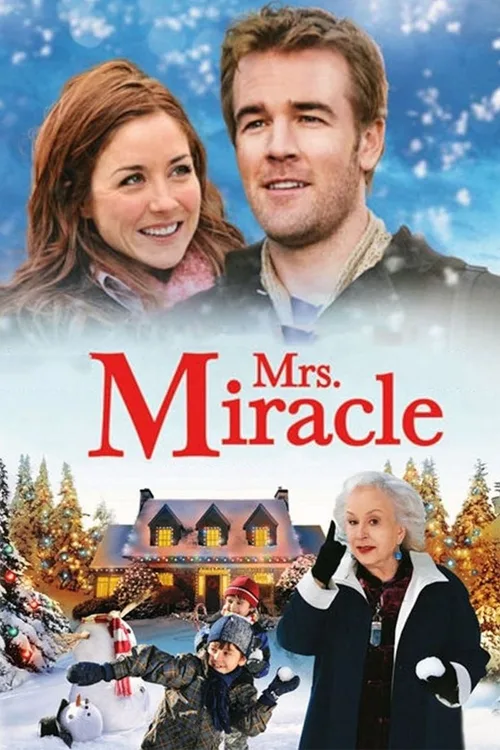
Overwhelmed widower Seth Webster is searching for a housekeeper to help him with his unruly six year old twin sons. "Mrs. Miracle" mysteriously appears and quickly becomes an irreplaceable nanny, chef, friend... and matchmaker.
 rating 6/10 User rating 115 votes 60%
 ❄ Christmas Connection
Mrs. Miracle is set entirely during the Christmas season, with the holiday providing the reason the magical housekeeper arrives, the backdrop for the growing romance, and the deadline by which the family must heal. Christmas is not decoration here; it is the engine driving every plot beat. The film premiered December 5, 2009, as part of Hallmark's very first Countdown to Christmas event, cementing its place as a foundational holiday title.
Where to Watch


Our Review
There is a particular strain of Hallmark Christmas movie that functions less like cinema and more like a weighted blanket: low stakes, warm lighting, and a plot that would barely fill a short story. Mrs. Miracle belongs to that strain. It also, somehow, rises above it. The combination of Doris Roberts at full comic power and James Van Der Beek doing his best work in years produces something that earns its sentimentality rather than simply assuming it.
The setup is stripped from Debbie Macomber's 1996 novel of the same name. Seth Webster is a widowed Seattle father of two exhausting six-year-old twin boys. He cannot keep a housekeeper. A parade of sensible women quits within days. Then Mrs. Emily Merkle arrives, apparently from nowhere, with a resume no one can verify and an uncanny ability to fix exactly what needs fixing. Chaos becomes order. Loneliness becomes something that might eventually become love.
You know where this is going. The film knows you know. It proceeds anyway, with enough confidence in its cast to make the predictability feel comfortable rather than lazy.
What Doris Roberts Actually Does Here
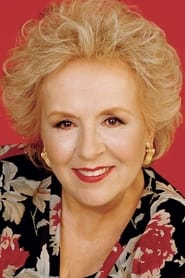
Roberts won four Emmy Awards for playing the smothering Marie Barone on Everybody Loves Raymond. In Mrs. Miracle she plays almost the opposite character: a woman who solves problems by stepping back rather than inserting herself into them. The restraint is deliberate and impressive. Roberts finds the comedy in understatement, a raised eyebrow here, a knowing pause there, and never tips over into the winking magical-nanny cliche the role could easily have become.
She also handles the film's theological freight with a light touch. The character is implied to be angelic, or at least something adjacent to it. Roberts plays this not as cosmic mystery but as confident eccentricity, which is the correct choice. The moment a performer starts acting like they know they're an angel, the movie dies.
James Van Der Beek, Unexpectedly Solid
Van Der Beek had spent a decade after Dawson's Creek trying to shake Dawson Leery loose from his public image. Mrs. Miracle gave him something useful: a character defined by exhaustion and grief rather than brooding teenage intensity. Seth Webster is not glamorous. He burns toast. He loses arguments with eight-year-olds. Van Der Beek plays this without vanity, and the result is one of his more credible adult performances.
His chemistry with Erin Karpluk, who plays Reba Maxwell, is modest but functional. The romance subplot is not the point of the movie and the film wisely does not pretend otherwise. The twins, played by real-life brothers, carry more of the emotional weight than any adult relationship does.
The Hallmark Formula, Examined
Mrs. Miracle premiered on December 5, 2009, as part of Hallmark Channel's very first Countdown to Christmas event. That event has since become a cultural institution, running dozens of original movies every holiday season. This film was one of the founding texts.
What the formula gets right, and what this movie demonstrates, is that low-stakes domestic drama is not inherently lesser drama. The question of whether Seth Webster will stop being sad and let someone new into his life is not geopolitically significant. It is, however, recognizably human. The Christmas setting amplifies this because the holiday carries genuine cultural weight around family, loss, and the gap between what Christmas is supposed to feel like and what it actually feels like when something has gone wrong in your house.
The film was shot in British Columbia, primarily in the Maple Ridge area, though it presents itself as Seattle. This is standard Canadian co-production geography. The Christmas atmosphere is built through production design rather than exterior shots: the Webster house is draped in decorations, the boys demand a real tree, and snow appears on cue for emotional beats.
Where It Earns Its Rating
The film is not without problems. Several supporting characters exist only to be obstacles or comic relief without any texture behind them. The pacing in the middle third slackens as the movie waits for its characters to catch up to what the audience already knows. And the theological implications of Mrs. Merkle's nature are raised and then politely dropped, which is either admirable restraint or a missed opportunity, depending on your tolerance for ambiguity in family films.
But the core is sound. Roberts and Van Der Beek are doing real work. The twins are genuinely funny without crossing into the grating precocity that ruins most child performances in this genre. The ending is earned rather than imposed.
Macomber's novel had more subplots, including a storyline involving difficult in-laws that was cut entirely for the adaptation. The trimming was correct. What remains is a movie that knows exactly how large it wants to be and stays inside those limits.
Who This Is For
If you have already seen the movie twice and are looking for a reason to watch it a third time, this review will not talk you out of it. If you are skeptical of Hallmark Christmas movies on principle, Mrs. Miracle is a reasonable entry point because it has a legitimate lead performance anchoring the sentiment. It will not convert you. It might surprise you.
Roberts died in April 2016. The franchise she started here continued without her: Call Me Mrs. Miracle in 2010, A Mrs. Miracle Christmas in 2021, and Joyful Mrs. Miracle in 2024. None of them have what this one has, which is Roberts doing a very specific kind of comedy that took her six decades to perfect.
Fun Facts
Mrs. Miracle premiered December 5, 2009, as part of Hallmark Channel's very first Countdown to Christmas programming event, making it one of the founding films of what became a massive annual tradition that now spans dozens of original movies each season.
Doris Roberts, who plays Mrs. Merkle, won four Emmy Awards for Outstanding Supporting Actress in a Comedy Series during her run on Everybody Loves Raymond (1996-2005), making her one of the most decorated actresses ever to headline a Hallmark Christmas movie.
Debbie Macomber's original novel was published in 1996, meaning it sat on shelves for 13 years before being adapted. Macomber went on to become one of the most frequently adapted authors in Hallmark's history, with her books forming the backbone of multiple holiday franchises.
The film was shot in Maple Ridge, British Columbia, Canada, though it is set in Seattle, Washington. The mountain visible in background shots was the key clue that dedicated location hunters later used to identify the actual filming house.
James Van Der Beek, who plays widower Seth Webster, later placed fifth on Season 28 of Dancing with the Stars in 2019 and went on to create and star in the Viceland comedy What Would Diplo Do? in 2017, one of the stranger career pivots in modern television.
The Mrs. Miracle franchise grew to four Hallmark productions spanning 15 years, but Doris Roberts appeared in only the first two: the original 2009 film and its 2010 sequel Call Me Mrs. Miracle. She died in April 2016 at age 90.
Macomber's source novel included a subplot involving antagonistic in-laws that was cut entirely from the screenplay to bring the runtime down to television length. Reviewers who read both versions generally agreed the movie was better for the omission.
Cast