

One Magical Wish Can Change Everything !
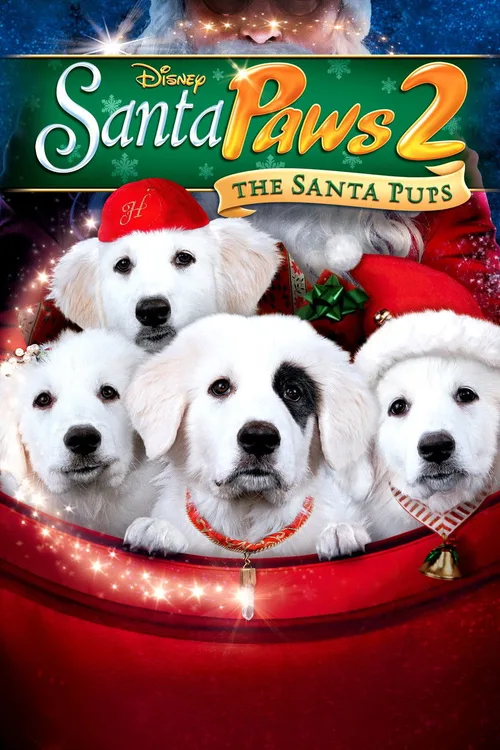
Santa Paws 2: The Santa Pups (2012)
When Mrs. Claus travels to Pineville, the merriest place on the planet, a quartet of magical puppies stow away on her sled, granting joyful wishes to the town's boys and girls. However, something goes terribly wrong - the Christmas spirit begins to disappear. Now, the Santa Pups and Mrs. Claus must race to save Christmas magic from running out for all.
 rating 3/10 User rating 123 votes 61%
 ❄ Christmas Connection
Santa Paws 2 is set entirely at the North Pole and in a Christmas-obsessed small town during the holiday season, with the entire plot hinging on four magical puppies who grant Christmas wishes. The central conflict is literally the disappearance of the Christmas spirit from a town, and the resolution involves caroling, goodwill, and a radio broadcast to restore it. There is no reading between the lines here.
Where to Watch


Our Review
By late 2012, Robert Vince had built one of the most improbable production empires in family entertainment: a pipeline of Disney direct-to-video movies starring talking golden retriever puppies. Starting from the original 1997 theatrical Air Bud, which made three times its $3 million budget, Vince had steadily expanded his animal kingdom into a franchise of over a dozen films. Santa Paws 2: The Santa Pups, released November 20, 2012, sits somewhere in the middle of this sprawl. It is the sequel to 2010's The Search for Santa Paws, and the second film to focus not on the Buddies themselves but on the magical dogs of the North Pole. It arrived with zero fanfare, landed on DVD and Blu-ray, and made its way onto countless television sets in the days between Thanksgiving and Christmas. This is exactly how it was designed to work.
What Santa Paws 2 Is Actually About
The premise is admirably compact. Mrs. Paws has given birth to four puppies: Hope, Jingle, Charity, and Noble. Four months old and already magical, the pups can grant wishes. When Mrs. Claus (Cheryl Ladd) travels by sled to the small town of Pineville, the Santa Pups stow away. They begin fulfilling Christmas wishes for the townspeople, which goes well until a grieving twelve-year-old boy named Carter Reynolds, who has lost his Christmas spirit since his mother's death, makes an angry wish for the Christmas spirit to disappear entirely. Noble grants it. The whole town turns cold, commercial, and joyless overnight.
Carter and his younger sister Sarah (Kaitlyn Maher), along with Mrs. Claus and three sisters she befriends, have to fix the mess before Christmas is ruined. The solution involves a radio broadcast and everyone deciding to behave decently again. There is a lesson in there somewhere about grief and guilt, though the film does not have quite enough time to sit with it.
The emotional core is Carter's arc. He's not a villain. He's a kid who misses his mother and has redirected that pain into contempt for everything she loved. It's a legitimate dramatic starting point, and Josh Feldman plays it with enough honesty that the film occasionally earns its more sentimental moments. The problem is that the pups keep cutting away to the pups, and the pups are doing pup things. The tonal gear-shifting never fully resolves.
Cheryl Ladd as Mrs. Claus
Cheryl Ladd spent four years on Charlie's Angels (1977 to 1981), replaced Farrah Fawcett, performed the National Anthem at Super Bowl XIV in 1980, and released a gold record during that same period. By 2012 she was 61 years old and taking the Mrs. Claus role with the kind of warm professionalism that elevates the material around her without drawing attention to the gap in quality.
She's genuinely good here. Mrs. Claus in this film is not a background figure. She has her own storyline in Pineville, befriending three sisters who are arguing over an inheritance. She sings a duet with Kaitlyn Maher called "Christmas Cold." She carries scenes. The decision to put Ladd at the center of the human plot rather than hiding her in the North Pole is the best creative call the film makes.
The Direct-to-Video Formula, Applied Faithfully
Robert Vince shot the film in Fernie, British Columbia, a small mountain town that doubles convincingly for the snowy American Midwest. The production does what it always does: functional coverage, cheerful set dressing, practical dog wrangling, and a budget that gets the images on screen without ever aspiring to the visual richness of Disney's theatrical releases.
The talking dog effects are achieved through the same digital mouth manipulation used across the Buddies franchise. The mouths move. The words are spoken by adult voice actors. The dogs look like dogs. Children under ten accept this without protest. Adults have varying tolerances.
The songs land unevenly. "Time to Celebrate Christmas," performed by Obba Babatunde, Kaitlyn Maher, and George Newbern, is a functional piece of holiday cheer. Maher's solo "My Blue Christmas" is more interesting because she can actually sing, and she does, with the unsettling precision of a child who has been singing professionally since age four. Maher had appeared on America's Got Talent in 2008 and was the only cast member carried over from the first film. Her presence gives the movie a consistent emotional anchor it would otherwise lack.
Is This a Christmas Movie Worth Watching?
That depends entirely on who is watching it. The target audience is children between four and nine years old who have already worked through the available supply of better Christmas movies. For that audience, Santa Paws 2 delivers: talking puppies, Christmas magic, a simple moral about empathy and grief, and 90 minutes that end before bedtime. It does not condescend more than the genre requires. The villain is not a villain. The pups are cute. Mrs. Claus is warm and present.
For anyone outside that demographic, the film is a document of how efficiently a direct-to-video Christmas franchise can operate. By 2012, Vince and producer Anna McRoberts had refined the formula across more than a dozen films. They knew the running time, the tone, the number of songs, the ratio of dog content to human drama. The first twelve films in the Buddies franchise had grossed $220 million in home video sales by 2014. This is not an accident. It's a production system, and Santa Paws 2 runs through it cleanly.
The film's lowest point is its resolution. After Noble's bad wish plunges Pineville into spiritual emptiness, the fix is a radio broadcast in which Carter apologizes and people decide to feel Christmas again. The mechanics of the magic are never explained, which would be fine if the film had established any rules. It hasn't. The Christmas spirit disappears because a dog granted a wish, and returns because a child asked nicely on the radio. The pups who caused the problem are immediately forgiven and sent back to the North Pole. Carter's grief, which was the actual source of the trouble, is resolved with a hug.
That's the film's real limitation: it gestures at something genuinely interesting about a child who cannot mourn, then chooses puppies instead.
Fun Facts
The film was shot entirely in Fernie, British Columbia, a ski town of roughly 5,000 people in the Rocky Mountains. Fernie has become a repeat filming location for the Buddies franchise due to its reliable snowfall and small-town aesthetic.
Cheryl Ladd, who plays Mrs. Claus, was born Cheryl Jean Stoppelmoor in Huron, South Dakota in 1951. Before becoming famous on Charlie's Angels, she provided the singing voice for the character Melody on Hanna-Barbera's Josie and the Pussycats cartoon (1970), billed as "Cherie Moor."
Kaitlyn Maher was seven years old when she appeared on America's Got Talent in 2008, making it to the semifinals. She became the youngest singer to be nominated for a Grammy-related award and appeared in multiple Buddies franchise films across several years.
The four Santa Pups are named Hope, Jingle, Charity, and Noble. Their names are all traditional Christmas virtues or associations, with "Noble" being the pup who grants Carter's destructive wish, giving the naming an unintentional irony.
Richard Kind, who voices the Jack Russell Terrier elf dog Eddy in this film, is best known for his role as Paul Lassiter on the NBC sitcom Spin City and as a recurring character in Larry David's Curb Your Enthusiasm.
The first twelve films in the combined Air Bud and Buddies franchise had grossed approximately $220 million in home video sales by March 2014, according to Disney's own tracking. This made the Disney Buddies line one of the top-grossing direct-to-video franchises in history, behind only the Disney Fairies series at roughly $300 million.
The original 1997 Air Bud film had a $3 million production budget and grossed nearly $27 million in theaters. The direct-to-video pivot that followed was a deliberate business decision: lower production costs, predictable home video revenue, and an audience that would not compare the films to theatrical competition.
Cast