
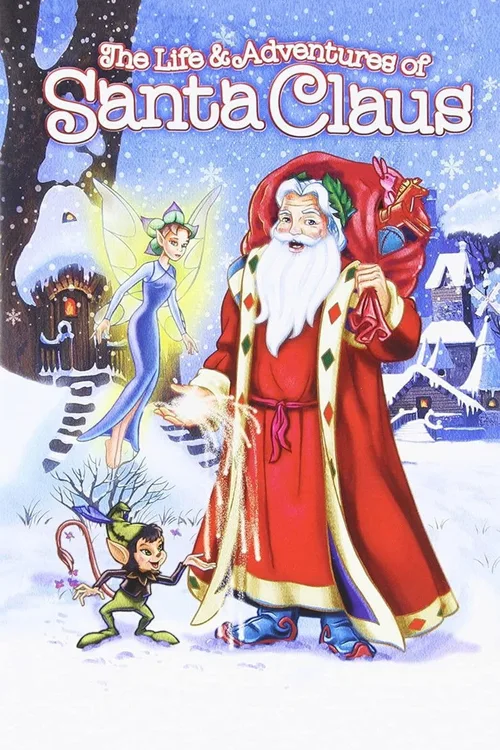
The Life & Adventures of Santa Claus (2000)
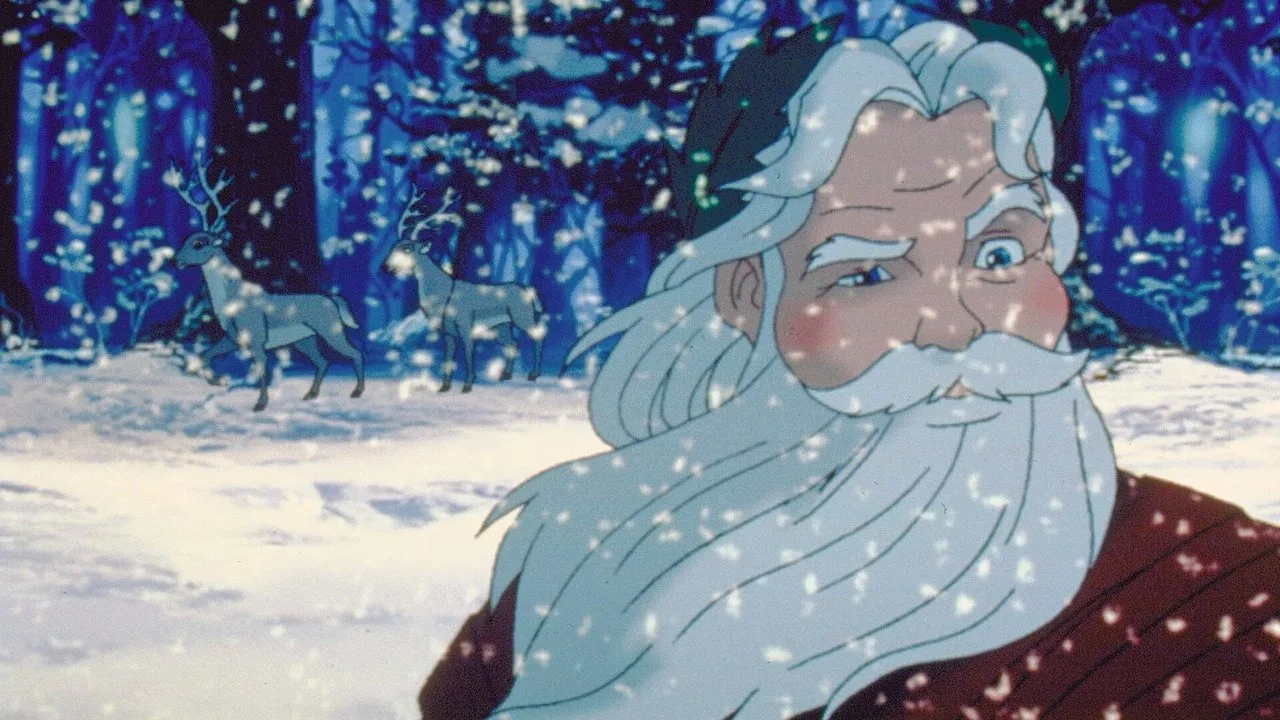
Based on the popular book by L. Frank Baum, the beloved author of The Wonderful Wizard of Oz, comes the incredible story of The Life & Adventures of Santa Claus. Many centuries ago, long before toys had even been invented, a baby abandoned at the edge of an enchanted forest was adopted and raised by a beautiful wood nymph, thus beginning the life story of Santa Claus. From his first truly magical childhood through the discovery of his life's work of making children happy, discover the origin of every tradition surrounding Santa Claus, from toys, stockings and lighted trees to reindeer and sleigh. Journey back to a time of magic and wonder, and experience this heartwarming tale that will bring joy each holiday season.
 rating 6/10 User rating 43 votes 70%
 ❄ Christmas Connection
This film is the origin story of Santa Claus himself, tracing the full arc of how a human orphan raised by immortals becomes the gift-giver the world knows. Every Christmas tradition in the film, from toy-making to reindeer to Christmas Eve delivery, is explained from first principles. It doesn't get more Christmas than this.
Where to Watch

Our Review
Most people know L. Frank Baum as the man who invented Oz. Fewer know that two years after The Wonderful Wizard of Oz, in 1902, Baum published a complete mythology for Santa Claus. Not a short story. A full book, with its own cosmology of immortals, forest nymphs, evil shape-shifters, and a grand council of magical beings who vote on whether to grant a mortal man immortality. It reads like Tolkien doing holiday content. The 2000 animated film from Mike Young Productions takes that material and produces something that is, by turns, genuinely lovely and frustratingly safe.
What the Baum Book Actually Contains
Before judging the film, it helps to understand what it was working with. Baum's source novel is strange and ambitious. Claus is a human infant discovered in the Forest of Burzee, raised by a wood nymph named Necile and placed under the protection of Ak, the Master Woodsman of the World. He grows up among fairies, knooks, ryls, and other immortals before being sent into the human world as a young adult. What he sees there, poverty, neglect, children left to suffer, pushes him toward toy-making as an act of care. The Awgwas, invisible evil beings, start stealing the toys because kindness is bad for their business. A full-scale war follows. Then Claus gets old, and the immortals hold a vote on whether to grant him eternal life.
That's a rich, genuinely unusual premise. Santa Claus as a mortal man who earned immortality through decades of selflessness is a more interesting concept than the jolly pre-existing magical figure most Christmas specials hand you.
The 2000 Film's Approach
Director Glen Hill and screenwriter Hank Saroyan stick reasonably close to that structure. The film opens in Burzee, runs through Claus's childhood with the immortals, follows him into the human world, stages the war with the Awgwas, and ends with the vote. The reindeer enter the story organically: a knook named Will lends Claus two deer named Mistletoe and Holly so he can travel to villages before daybreak, and the tradition grows from there. The stocking origin is here too, as is the chimney entrance. Baum invented most of these explanations wholesale, and the film is faithful enough to preserve that inventive spirit.
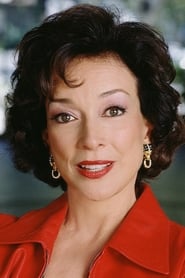
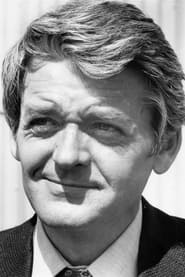
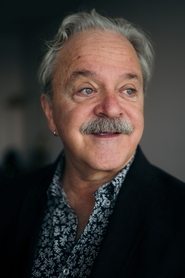
The voice cast lands solidly. Robby Benson, who voiced the Beast in Disney's Beauty and the Beast in 1991, plays young Claus with the same earnest warmth that made that performance work. Hal Holbrook brings genuine weight to Ak, the forest patriarch who serves as Claus's father figure, mentor, and eventual advocate before the immortals' council. Dixie Carter voices Necile with warmth. Jim Cummings handles old Santa Claus, which is fitting given that Cummings had already voiced the character in other productions and essentially owns the vocal type.
The animation is clean and colourful. Mike Young Productions was a mid-tier outfit, established in Los Angeles in 1990, and this sits at their upper range of quality. It's not theatrical animation, but it's better than a lot of what was going into direct-to-video releases in 2000. The Forest of Burzee, with its painterly backgrounds and soft light, is the best-looking part of the film. The Awgwas, rendered as shadowy insectoid creatures, look appropriately menacing for a children's film.
Where It Goes Wrong
The songs are where the film loses confidence in its own material. Composer Misha Segal and lyricist Harriet Schock contributed a Celtic-influenced score that works well as underscore. The original songs, though, are the kind of cheerful, functional numbers that feel written to fill runtime rather than to advance the story. None of them will follow you out of the room.
The film also smooths out the darker edges of Baum's book. The version of human misery that Claus witnesses in the source text is genuinely sobering. The film softens that into something more easily digestible, which is understandable for a G-rated children's release, but it strips away the moral seriousness that gives Claus's mission its weight. In the book, you understand why he devotes his life to children. In the film, you get the general idea.
The Awgwas' battle is staged competently, but it lacks the scale the book implies. And the film's pacing drags in the middle section, when Claus is establishing his workshop and the film isn't quite sure what to do with itself between the establishment of the world and the climactic conflict.
The Shadow of 1985
This version exists in the shadow of Rankin/Bass's 1985 stop-motion adaptation of the same source material, which is the more respected of the two. The 1985 special used Animagic stop-motion, the same technique Rankin/Bass had employed for decades on Rudolph the Red-Nosed Reindeer, and it carries the weight of that tradition. The 2000 film was never going to win that comparison. It's a direct-to-video release aimed at a generation of kids who hadn't seen the earlier version, and on those terms it works well enough.
The more meaningful comparison is to Baum's own book, freely available through Project Gutenberg. If you read the novel alongside this film, you'll notice what was kept, what was trimmed, and what was invented to pad the runtime. Queen Lurline of the fairies is largely absent. Some characters appear who aren't in the book at all. The core mythology survives the translation, but the texture of Baum's world, that sense of a fully imagined magical cosmology with its own rules and hierarchies, is compressed into something more conventional.
What It Gets Right
The film earns real credit for taking the premise seriously. The immortality vote that closes the film, in which the various representatives of the magical world debate whether Claus has earned the right to continue his work forever, is genuinely moving. It treats the question of what makes a life worth preserving with more seriousness than most Christmas films attempt. Holbrook's Ak arguing before the council is the film's best scene, and the quiet ending, Claus's face as he understands what has been given to him, is handled with restraint.
Mary Kay Bergman, who voices Martha in the film, died in November 1999, just months before the film's October 2000 release. It was among her final completed projects. She had voiced dozens of characters across South Park, the early Disney direct-to-video sequels, and the Scooby-Doo revival. Hearing her in this film is a small, specific reminder of how much she contributed to a generation of animated features that rarely get credited for their craft.
The film is available on streaming platforms including Tubi, which means it costs nothing to find out whether it works for you. Put it on for children who are old enough to follow a fantasy story with some narrative complexity. Don't put it on expecting the 1985 version. On its own terms, it's a decent adaptation of one of the stranger pieces of Christmas mythology ever written by a major American author.
Fun Facts
L. Frank Baum published "The Life and Adventures of Santa Claus" in 1902, just two years after "The Wonderful Wizard of Oz." It was one of several non-Oz fantasy books he wrote when he tried to move on from Oz, before popular demand pulled him back to that series.
Robby Benson, who voices young Claus in the 2000 film, is best known for voicing the Beast in Disney's "Beauty and the Beast" (1991) and its sequels. He had largely transitioned from on-screen acting to voice work and directing by the time this film was made.
The 1985 Rankin/Bass adaptation of the same book was the final production the company made using their "Animagic" stop-motion technique, closing out a run that had begun with "Rudolph the Red-Nosed Reindeer" in 1964.
In Baum's original 1902 novel, the reindeer are given to Claus by a knook (a magical being responsible for caring for animals) because Claus needs to complete his Christmas Eve rounds before daybreak. The 2000 film names the first two reindeer Mistletoe and Holly, which matches the book.
Mary Kay Bergman, who voiced Martha in this film, died on November 11, 1999, at age 38. The film was released posthumously in October 2000. Bergman had voiced virtually all the female characters on South Park's first two seasons and was the official voice of Disney's Snow White from 1989 until her death.
Mike Young Productions, which made this film, was founded in Los Angeles in 1990. The studio later produced the 2002 revival of "He-Man and the Masters of the Universe" before being acquired by the French animation group MoonScoop in 2005.
Baum's book gives Santa Claus the full name "Neclaus," meaning "Necile's little one" in the language of the immortals, a reference to the wood nymph who adopted him. The 2000 film shortens this to Nicholas, which is how the name is commonly rendered in adaptations.
The Council of Immortals sequence that ends the film, in which magical beings from across the world vote on granting Claus eternal life, comes directly from Baum's source text. Baum structured the entire book toward that vote, making it one of the few Santa Claus stories in any medium to treat his immortality as something he had to earn rather than something he always possessed.
Cast