
He couldn't stop the war, but he wouldn't let the war stop Christmas.
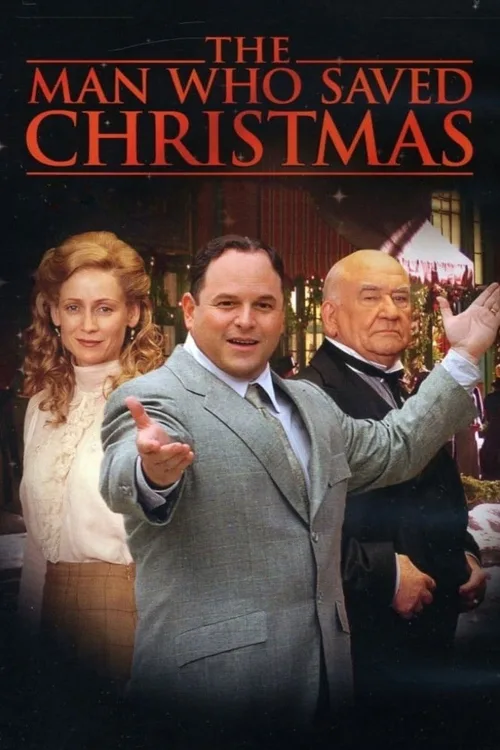
The Man Who Saved Christmas (2002)
Alfred Carlton Gilbert invented the Erector Set and is trying to get it onto the toy shelves of the country. A.C. is startled to be summoned to the White House, where top officials ask him to convert the toy factory into a weapons manufacturing company for the duration of the war. "No" is really not an option, for fear of being labeled unpatriotic so the switch is made. Later, government officials ask A.C. to be their spokesman for a campaign to avoid "toy giving" for the coming holidays and buy war bonds instead. With a young son himself, who looks forward to Christmas like any other child, what will A.C. do this time?
 rating 7/10 User rating 8 votes 61%
 ❄ Christmas Connection
The entire plot turns on whether Christmas will be cancelled for American children in 1918. A.C. Gilbert's lobbying effort to preserve toy manufacturing is framed explicitly as a fight to save Christmas, and the climax takes place in the weeks before the holiday. The movie earned its title honestly.
Where to Watch


Our Review
The real A.C. Gilbert was not a modest man, and the historical record backs him up. Born in Salem, Oregon in 1884, he won an Olympic gold medal in pole vault at the 1908 London Games, earned a Yale medical degree he never used, invented the Erector Set in 1913 while watching steel girders go up from a commuter train window, and then in late October 1918 walked into a room full of U.S. Cabinet secretaries with a bag of toys and talked them out of cancelling Christmas. The 2002 CBS TV movie The Man Who Saved Christmas covers this last chapter, and it turns out the story barely needs embellishment.
What the Film Gets Right About A.C. Gilbert
Jason Alexander plays Gilbert, and the casting is more interesting than it first appears. By 2002, Alexander was four years removed from Seinfeld and had spent much of the intervening period reminding audiences he could do things other than George Costanza. Gilbert is a different animal entirely: optimistic, entrepreneurial, physically vigorous, and motivated by a genuine belief that toys build better engineers. Alexander plays him without irony, which is the right call. The character needs to be believed, not winked at.
The film's central dramatic crisis is accurate. In 1918, the Council of National Defense was weighing whether to ban toy manufacturing entirely, redirecting factory capacity to war production. As president of the Toy Manufacturers of America, Gilbert secured a 15-minute audience with senior government officials and showed up with a satchel of demonstration toys. Secretary of the Navy Josephus Daniels asked where he could buy a toy submarine. Secretary of Commerce William Redfield pushed a toy train around the table, noting he had learned engineering basics on one as a child. Interior Secretary Frank Lane picked up a book on aviation. Gilbert's argument was not sentimental. He told them that the country needed future engineers and scientists, and toys were how you built them. The war council agreed. The press dubbed him "the man who saved Christmas," and the name stuck.
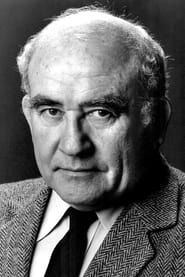
Ed Asner plays Gilbert's father, Charles. Asner was one of the great character actors in American television, a seven-time Emmy winner who could make even a thin role feel lived-in. Here he anchors the family scenes and gives the film some of its better dramatic weight. Kelly Rowan plays Mary Gilbert, A.C.'s wife, in a role that does what most wives-in-biopics do: she believes in him before everyone else does and holds things together while he chases the mission. It is not a substantial part, but Rowan handles it without making it feel like furniture.
A Made-for-TV Movie That Knows What It Is
Director Sturla Gunnarsson shoots the film with the clean, unhurried competence of network television in the early 2000s. This is not a criticism. The movie does not pretend to be Schindler's List. It has a 96-minute runtime, a PG-13 rating, and a clear target audience: families who want something with historical substance that won't require explaining anything to the kids afterward.
The production design is serviceable. New Haven in 1918 is suggested rather than constructed, and Washington's corridors of power look appropriately oppressive without being elaborate. The screenplay, by Joseph Maurer, Debra Frank, and Steve L. Hayes, adds a complication the historical record does not necessarily support: Gilbert's older brother is missing in action in Europe, creating a personal stake in the war alongside the professional one. This kind of biographical fiction is standard practice in the genre, and it works better here than it usually does because it gives Alexander somewhere to put his character's internal conflict.
The toy demonstration scene in Washington is the film's centerpiece, and it delivers. Watching senior government officials forget themselves and start playing with miniature submarines and trains has genuine comedy in it, and the scene earns its warmth without becoming saccharine. Gilbert's pitch, that toys are tools for building minds, is presented straight and it holds up.
The History Is More Interesting Than the Movie
The one place the film undersells its material is in the portrait of Gilbert as a whole man. The real A.C. Gilbert tied for the Olympic pole vault gold medal in London under disputed circumstances: British officials initially barred his bamboo pole with a spikeless tip, and when they finally allowed him to compete with a conventional pole, the judging awarded a tie rather than a clear win. He arrived in Washington in 1918 not as an unknown toy salesman but as a Yale-educated Olympic champion who had already sold millions of Erector Sets. When Cabinet secretaries played with his toys, they were playing with toys made by a man whose biography was already formidable. The movie gestures at this but doesn't quite land the weight of it.
By 1935, the A.C. Gilbert Company had sold more than 30 million Erector Sets. Gilbert accumulated more than 150 patents over his 50-year career. His company went bankrupt in 1967, six years after his death, and the Erector Set brand eventually passed through several owners before landing with Meccano. The factory site in New Haven, a few blocks from Yale, is now known as Erector Square, repurposed as artist studios.
Is It Worth Your Time?
If you have seen every major Christmas film and are working your way through the second tier, yes. The Man Who Saved Christmas is a solidly made biography with a true story that most people have never heard. The central event, an Olympic athlete and toy inventor walking into wartime Washington with a bag of gadgets and persuading the government to leave Christmas alone, is genuinely remarkable. Alexander anchors it with more seriousness than the premise might suggest it deserves, and Asner gives the supporting cast a ceiling worth reaching for.
It is not a film that reaches beyond its category. It is exactly as good as a CBS Christmas biographical drama from 2002 should be, which turns out to be good enough.
Fun Facts
A.C. Gilbert tied for the Olympic gold medal in pole vault at the 1908 London Games alongside Ed Cook of Cornell, the only tie for gold in the history of that event. British officials had initially barred Gilbert's bamboo pole as unfamiliar equipment.
Gilbert founded his company in 1909 in Westville, Connecticut, originally called the Mysto Manufacturing Company, selling magician's supply kits. The Erector Set came four years later, in 1913, after Gilbert watched steel girders being erected for power lines from a New Haven to New York commuter train.
At his Washington meeting in October 1918, Gilbert spread toys across the table including toy submarines, toy trains, air rifles, and aviation picture books. Secretary of Commerce William Redfield reportedly pushed a toy train around the table and said he had learned engineering fundamentals from one just like it as a child.
By 1935, the A.C. Gilbert Company had sold more than 30 million Erector Sets. Gilbert held over 150 patents across his 50-year career.
The A.C. Gilbert Company went bankrupt in 1967, six years after Gilbert's death in 1961. The former factory complex near Yale in New Haven, Connecticut is now known as Erector Square and operates as artist studios and small business offices.
Ed Asner, who plays Gilbert's father in the film, won seven Primetime Emmy Awards during his career, including five for the same character (Lou Grant) in two different series: a comedy and a drama.
Director Sturla Gunnarsson is an Icelandic-Canadian filmmaker best known for documentary work, including Beowulf and Grendel (2005). The TV movie was a Canadian-American co-production by Alliance Atlantis Communications.
The film aired on CBS on December 15, 2002, a Sunday night, at 9 p.m. Eastern. It was later released on Blu-ray and DVD, earning a Dove Foundation "Family-Approved" seal.
Cast