
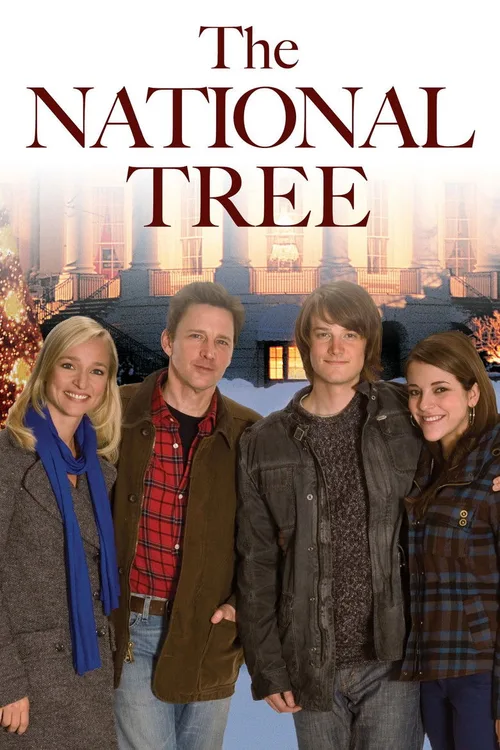
The National Tree (2009)
A teenager has his Sitka Spruce tree chosen to be planted outside the White House as the new national Christmas Tree.
 rating 5/10 User rating 23 votes 52%
 ❄ Christmas Connection
The entire plot is built around the real American tradition of the National Christmas Tree, a live tree planted near the White House and lit by the president each December. The film culminates in a presidential tree-lighting ceremony, and the cross-country road trip is explicitly a Thanksgiving-to-Christmas journey. Every dramatic beat connects back to the tree itself.
Where to Watch


Our Review
There is a real tradition in the United States where a live tree is transported from somewhere in the country to the grounds near the White House, planted with ceremony, and lit by the president in December. It has happened every year since 1923, when Calvin Coolidge flipped a switch to illuminate a 48-foot balsam fir strung with 2,500 red, white, and green bulbs. The National Tree, a 2009 Hallmark Channel film directed by Graeme Campbell, uses that tradition as its engine and then fills the tank with a road trip, a teenage vlogger, a gruff widower dad, and one Sitka spruce named after a newborn boy. The premise is completely absurd. The film is also surprisingly watchable.
What The National Tree Is Actually About
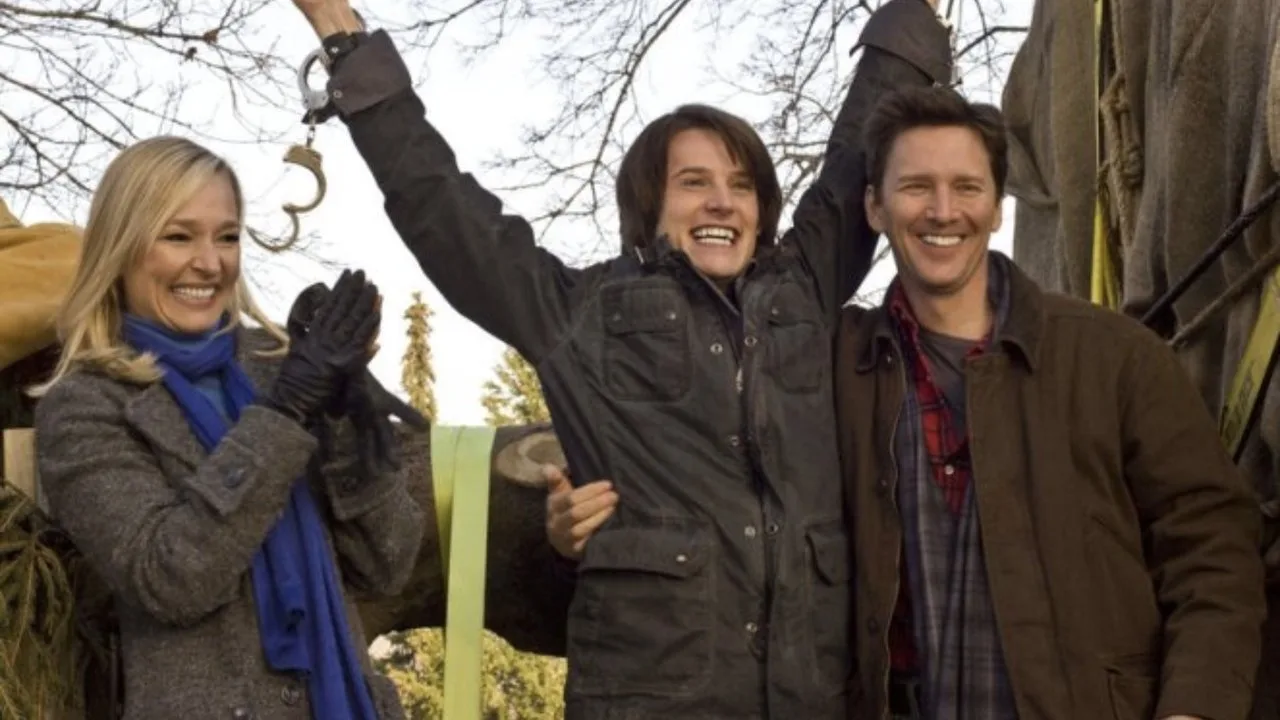
Rock Burdock, seventeen years old and living in Liberty, Oregon, wins a national contest to have his tree, a Sitka spruce his father Corey planted the day he was born, transplanted to the grounds near the White House for the Christmas season. Rock films the cross-country haul on video and posts it online, collecting followers. Corey, played by Andrew McCarthy, is overprotective and emotionally shut down since losing his wife. The road trip is supposed to fix that.
Evan Williams plays Rock with enough energy that you don't resent the character, which takes work given that "teen films himself for internet fame" was already a tired concept even in 2009. Kari Matchett plays Faith, a park ranger who helps the Burdocks navigate bureaucratic obstacles and provides the inevitable romantic interest for Corey. The plot is exactly what you expect it to be, beat by beat. Father and son argue. They connect. Something threatens the tree. The president's office gets involved. The tree gets lit.
The script, written by J.B. White from a story by Lloyd Fonvielle based on David Kranes's novel, doesn't try to hide what it is. It is a Hallmark movie about a father learning to let go of his son and, crucially, about a very large tree riding on a flatbed truck through American scenery. The scenery is largely Toronto, because the film was shot in Canada by QVF and Cypress Point Films, but the spirit is resolutely American highway.
Andrew McCarthy and the Long Arc from Brat Pack to Family TV
McCarthy came up through the 1980s as one of the defining faces of Brat Pack cinema. "St. Elmo's Fire" in 1985, "Pretty in Pink" in 1986, "Weekend at Bernie's" in 1989. Then the 1990s arrived and the label that had made him famous became a career ceiling. The phrase "Brat Pack" stuck to those actors the way a bad nickname follows you through school, and McCarthy later wrote about how it caused him to turn down projects specifically to avoid reuniting with castmates and feeding the perception.
By 2009, he had rebuilt steadily through television. He would go on to direct episodes of "Orange Is the New Black" and "The Blacklist," but in "The National Tree" he is in front of the camera playing a type he fits well: the closed-off man who is better with trees than with people. There is nothing revelatory in the performance, but it's competent and human in a way that Hallmark films don't always require of their leads.
What's interesting is the particular quality McCarthy brings to Corey. The character could easily slide into sitcom grumpiness, but McCarthy plays him as genuinely tired rather than cartoonishly stubborn. You get the sense of a man who has been managing grief by staying busy with physical work, and who finds emotional conversations as exhausting as they are necessary. For a Hallmark Channel film released on Thanksgiving weekend 2009, that's more than adequate.
The Sitka Spruce Deserves Its Own Section
A Sitka spruce is not a decorative tree. It is the largest spruce species on Earth, capable of reaching over 300 feet tall and living for more than 700 years. The oldest known individual specimens are pushing 600 years old. There is a Sitka spruce in Oregon's Clatsop County that stands 206 feet tall and measures nearly 18 feet in diameter. The species grows slowly in its early years, then accelerates, and can add significant height each decade once established.
The film's tree is described as fifteen years old, planted when Rock was born. A fifteen-year-old Sitka spruce in Oregon would be a substantial young tree, but not enormous. The movie uses this as an emotional anchor: the tree grew as the boy grew, and moving it is a kind of severance. That's effective as a metaphor even if the logistics of transplanting a fifteen-year-old conifer across three thousand miles of American highway are not something the script examines closely.
In real National Christmas Tree history, the tradition the film nods to involves the Blue Room tree inside the White House, a separate tradition from the outdoor National Christmas Tree on the Ellipse. The movie conflates these somewhat for dramatic convenience. The outdoor tree tradition, the one involving a live tree planted on the Ellipse, has its own distinct history going back to 1924. None of this matters to the film's emotional logic, but it's worth knowing that the actual tradition is both older and more complicated than the movie suggests.
What Works and What Doesn't
The road trip structure gives the film permission to be episodic, which suits it. Each stop generates a small conflict or comic setback, and the tree sitting on the truck is a visual constant that holds the loosely connected scenes together. The vlogging subplot, which would feel more natural in 2009 than it does viewed now, establishes Rock as a person with his own audience and his own life outside his father's anxiety. This matters because the film's central argument is that Corey needs to see his son as a person rather than a project.
What doesn't work is the romance. Matchett's Faith is a plot device in a character costume. She appears at convenient moments, provides information and emotional warmth, and is given almost no interior life. The scenes between her and McCarthy have the flatness of two actors waiting for their cue to look meaningfully at each other.
The film also runs at 88 minutes but feels padded in its second act. The obstacles that block the Burdocks feel manufactured rather than organic, which is a structural problem in any road movie. You need the detours to feel like real detours, not like speed bumps installed by a screenwriter.
Still, the ending works. The president calling a park ranger's cell phone to authorize the tree planting is ludicrous, but Hallmark movies operate by their own internal logic, and within that logic it lands. The tree gets lit. The estranged father and son have worked something out. The Sitka spruce stands near the White House in December. This is exactly what you signed up for.
Fun Facts
The National Christmas Tree tradition began on December 24, 1923, when President Calvin Coolidge lit a 48-foot balsam fir from Vermont decorated with 2,500 red, white, and green electric bulbs. It was the only year a switch rather than a button was used to light the tree.
The film premiered on Hallmark Channel on November 28, 2009, Thanksgiving weekend, which placed it at the exact moment in the calendar that the real National Christmas Tree tradition occupies each year.
Andrew McCarthy, who plays Corey Burdock, wrote a memoir called "Brat: An 80s Story" in 2021 and later directed a documentary called "Brats" exploring how the Brat Pack label shaped his generation's careers. The National Tree was made during the long middle stretch between his 1980s fame and this late-career reflection.
Sitka spruce is the fifth-largest conifer species in the world and can live beyond 700 years. A specimen in Clatsop County, Oregon, the state where the film is set, stands 206 feet tall with a trunk nearly 18 feet in diameter.
Although the film was set in Oregon and Washington D.C., it was entirely shot in Toronto, Canada, by production companies QVF and Cypress Point Films. Director Graeme Campbell is a Canadian television veteran.
The real outdoor National Christmas Tree on the White House Ellipse is a separate tradition from the Blue Room tree inside the White House. Since 1978, a single living Norway spruce has served as the Ellipse tree, replanted and maintained on-site rather than transported from across the country as the movie's premise suggests.
The character Rock Burdock's video blog, which accumulates followers as the truck drives east, was written to reflect 2009 internet culture. YouTube had only been acquired by Google three years earlier, in 2006, and vlogging as a cultural phenomenon was still relatively new when the film aired.
Cast