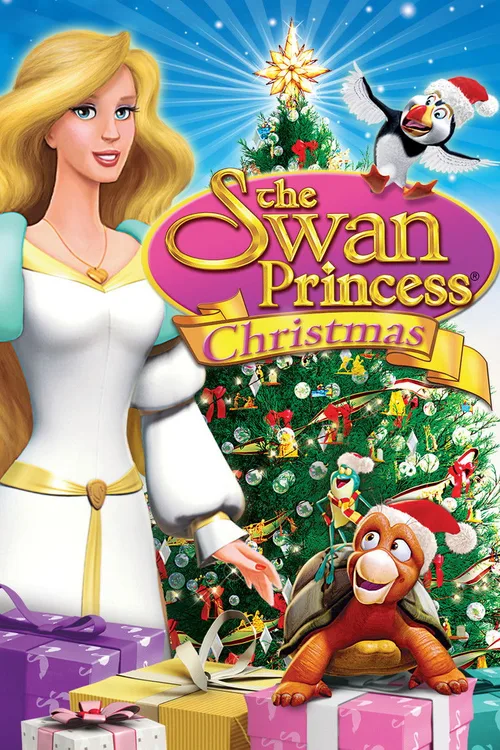
The Swan Princess Christmas (2012)
Princess Odette, Prince Derek and their trusted woodland friends reunite in this all-new adventure for their first Christmas celebration together! As the kingdom prepares for a festive holiday, the villainous Rothbart plots to destroy Christmas. Will the castle friends be able to stop Rothbart and save the day? Told in beautiful CG animation for the very first time and featuring music by Anna Graceman from TV’s America’s Got Talent, The Swan Princess Christmas is an enchanting musical holiday treat the whole family will enjoy!
 rating 4/10 User rating 52 votes 54%
 ❄ Christmas Connection
The entire plot revolves around Christmas spirit as a literal weapon: Odette's holiday songs physically weaken the villain Rothbart, and the film's central conflict is his attempt to destroy the kingdom's Christmas cheer before it destroys him. Christmas isn't backdrop here; it's the plot engine. The film opens with the kingdom preparing for its first royal Christmas and ends with the Christmas spirit literally reviving a dead prince.
Where to Watch


Our Review
The Swan Princess Christmas arrives fourteen years after the original trilogy wrapped up, and it brings with it a premise so committed to its own absurdity that you almost have to respect it. The villain is a ghost. Christmas songs physically hurt him. The only way to defeat him is for Princess Odette to keep singing until he catches fire. This is the movie's actual plot, presented without irony, scored with what sounds like Vassal Benford's synthesizer collection getting its annual workout.
This is the fourth film in the Swan Princess series, directed again by Richard Rich, the man who left Disney in the late 1980s to build his own studio and eventually produce one of the more underrated theatrical animated films of the 1990s. The original Swan Princess came out in November 1994, the same autumn The Lion King dominated every cinema on earth. It earned roughly $9.8 million against a $21 million budget and was considered a catastrophic failure. Then home video happened. The film became a genuine hit on VHS, built a devoted audience of kids who wore out their tapes, and spawned three direct-to-video sequels through 1998. Then nothing for over a decade, until this.
What Happened to the Animation
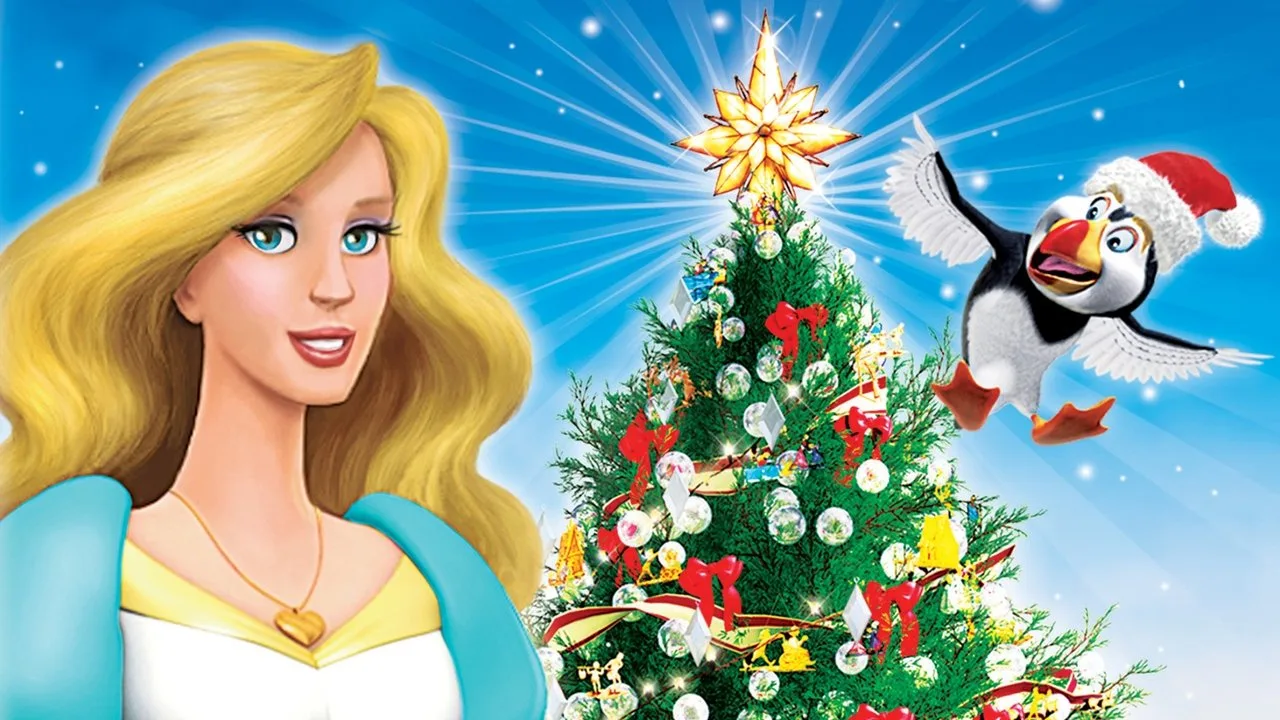
The original Swan Princess was drawn by hand, cel-painted at Hanho Heung-Up in Seoul. It looked like a real movie. The Swan Princess Christmas was produced entirely in 3D CGI, and the gap between the two is genuinely difficult to watch. The models have a plasticky, underlit quality. Odette's eyes are the specific variety of uncanny that lodges in your memory. Characters move like they're walking through invisible syrup.
In 2012, Pixar released Brave. DreamWorks released Rise of the Guardians. These are not fair comparisons in terms of budget, but they illustrate what was possible at the time. The Swan Princess Christmas looks like a video game cutscene from about 2003. Not a good video game. One made by a small studio working under time pressure for a console that was already being discontinued.
The shift from 2D to CGI wasn't just aesthetic. It erased the specific visual identity the original films had built. Whatever warmth the hand-drawn style carried is gone, replaced by something that resembles nothing so much as a promotional render for a holiday retail campaign.
The Christmas Spirit vs. The Forbidden Arts: A Genuine Plot Summary
Rothbart, who died in the first film, has returned as a ghost. He is visible only to a black cat named Number 9, whom he recruits by promising nine extra lives. His plan is to destroy the kingdom's Christmas spirit before it destroys him, since the Christmas spirit is established as the one force more powerful than his Forbidden Arts magic. He begins sabotaging decorations and undermining holiday morale.
The resolution involves Odette singing a song called "The Season of Love" with such sustained conviction that Rothbart catches fire and dies permanently this time. Before this happens, Derek is mortally wounded. The Christmas spirit then revives him. The royal Christmas tree, previously corrupted by Rothbart, is also restored.
This is a perfectly serviceable premise for a 1995 direct-to-video feature aimed at six-year-olds. In 2012, for an 81-minute film, it feels thin. The plot lacks the connective tissue that would make the stakes feel real. Number 9 exists mostly to give Rothbart someone to talk to. The animal sidekicks, Jean-Bob the frog and Speed the turtle, provide comic relief that lands inconsistently. Puffin shows up. Everyone gets a scene.
The Singing Problem
Laura Bailey, one of the most recognizable voice actresses working today, is credited here as "Elle Deets," which is strange. She provides Odette's speaking voice but not her singing voice, which belongs to Summer Eguchi. Similarly, Yuri Lowenthal voices Derek but Michaelangelo handles his songs. The split-vocal approach creates a subtle but persistent wrongness: the characters sound like themselves right up until they open their mouths to sing, at which point they become someone else entirely.
The songs themselves are an odd stylistic mix. They aim for something between contemporary pop and holiday warmth and land somewhere in between in a way that satisfies neither. Common Sense Media noted they lean toward hip-hop and R&B styling, which sits awkwardly against the medieval fairy-tale setting. The Christmas album released alongside the film contains 17 songs from the movie, which works out to roughly one song every five minutes. That is a lot of singing for a story this slight.
What It Gets Right
The film is thoroughly, unmistakably Christmas. Whatever its production limitations, it commits to the holiday with no ambiguity. The kingdom is decorated, the music is relentless, the villain is literally allergic to Christmas spirit. For very young viewers, particularly those already attached to the characters from the original films, this delivers exactly the festive comfort it promises.
James Arrington is the only voice actor to return from the original 1994 theatrical film and its three sequels, providing continuity across all four installments. Doug Stone reprises Speed from the sequels. Sean Wright returns as Rothbart. For fans of the series, this continuity matters.
The film also has genuine warmth in its quieter moments, particularly in how it frames Odette and Derek's relationship. They are depicted as an actual couple, comfortable with each other, facing a threat together rather than apart. This is more than some holiday sequels manage.
Fun Facts
The original Swan Princess (1994) was a box-office failure, earning roughly $9.8 million against a $21 million budget, but became a hit on VHS home video, a reversal that directly led to the entire sequel series including this film.
Director Richard Rich previously directed The Fox and the Hound (1981) and The Black Cauldron (1985) at Walt Disney before being fired and founding his own studio to produce the original Swan Princess.
This was the first Swan Princess film produced entirely in CGI, abandoning the hand-drawn cel animation style of the original trilogy, with cel painting on the originals done at Hanho Heung-Up in Seoul, South Korea.
Laura Bailey, who voices Odette, is credited under the pseudonym "Elle Deets." Bailey would later become one of the most acclaimed voice actors in games and animation, including lead roles in The Last of Us Part II and Critical Role.
The film released a standalone Christmas album on October 22, 2012, containing 17 songs, followed by a more complete 34-track soundtrack on November 8, 2012.
The villain Rothbart, who died at the end of the original 1994 film, returns as a ghost specifically because he needs to destroy the kingdom's Christmas spirit before it can be used against his Forbidden Arts magic. Christmas spirit is formally established as the superior supernatural force in this film's universe.
The Swan Princess Christmas was the first film in the series to be released in 14 years, following The Swan Princess: The Mystery of the Enchanted Kingdom in 1998. The series then continued producing sequels regularly after 2012, eventually reaching over ten installments.
Cast