
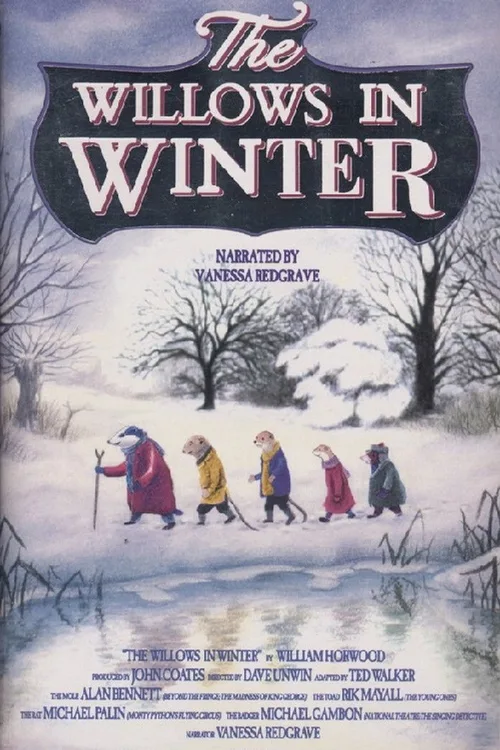
The Willows in Winter (1996)
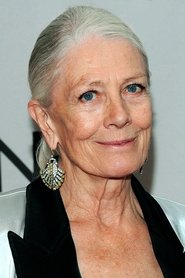
Hailed as the "rightful heir" to "The Wind in the Willows", William Horwood's critically acclaimed sequel comes to magical life in this beautifully animated feature-length classic. Join four of the best-loved characters in children's literature for their heart-warming and hilarious new adventure along the Riverbank, narrated by Academy Award-winner Vanessa Redgrave.
 rating 8/10 User rating 13 votes 65%
 ❄ Christmas Connection
The Willows in Winter is set entirely during winter and the Christmas season, with a blizzard driving the central crisis. The rescue of Mole from the Wild Wood happens against a backdrop of snow, cold, and the warmth of friendship that British Christmas storytelling returns to again and again. It aired on Christmas Day 1996 on ITV, cementing its place in the annual British holiday viewing ritual.
Our Review
Most Christmas specials ask very little of you. They arrive, they comfort, they leave. The Willows in Winter asks rather more: that you sit with the specific, quiet dread of a small animal lost in a blizzard, and trust that his friends will find him. It's a film about loyalty tested by weather, and it gets at something true about the season without once mentioning Christmas by name.
The 1996 ITV film is a sequel to the well-regarded 1995 adaptation of Kenneth Grahame's The Wind in the Willows, and it picks up the River Bank animals in the grip of winter. Mole, fretful and restless, ventures alone into the Wild Wood during a snowstorm and vanishes. Ratty, Badger, and Toad must go looking for him. The plot is that simple, and the film is confident enough not to dress it up.
The Voice Cast That Makes This Work
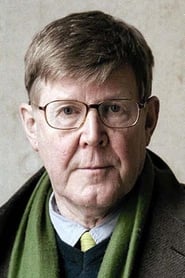
The three lead voices are doing serious work here. Michael Palin plays Rat with a kind of worried decency that suits the character exactly. He doesn't play for laughs, though the script gives him opportunities. Alan Bennett as Mole is the surprise: his particular brand of mild, self-deprecating gentleness makes Mole's panic in the Wild Wood genuinely affecting rather than comic.
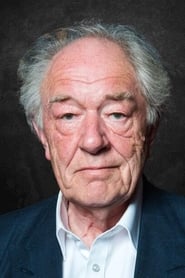
Michael Gambon's Badger is the anchor. Gambon had a gift for sounding like the oldest and most competent person in any room, and Badger needs precisely that. When Badger decides a thing will be done, Gambon makes you believe the matter is settled. It's a performance built on weight rather than warmth, which is right for the character.
The 1995 original also featured Rik Mayall as Toad, reprised here. Toad is the comedic release valve, and Mayall understood that Toad's ridiculousness has to be played absolutely straight to work.
TVC London and the Animation That Built British Childhood
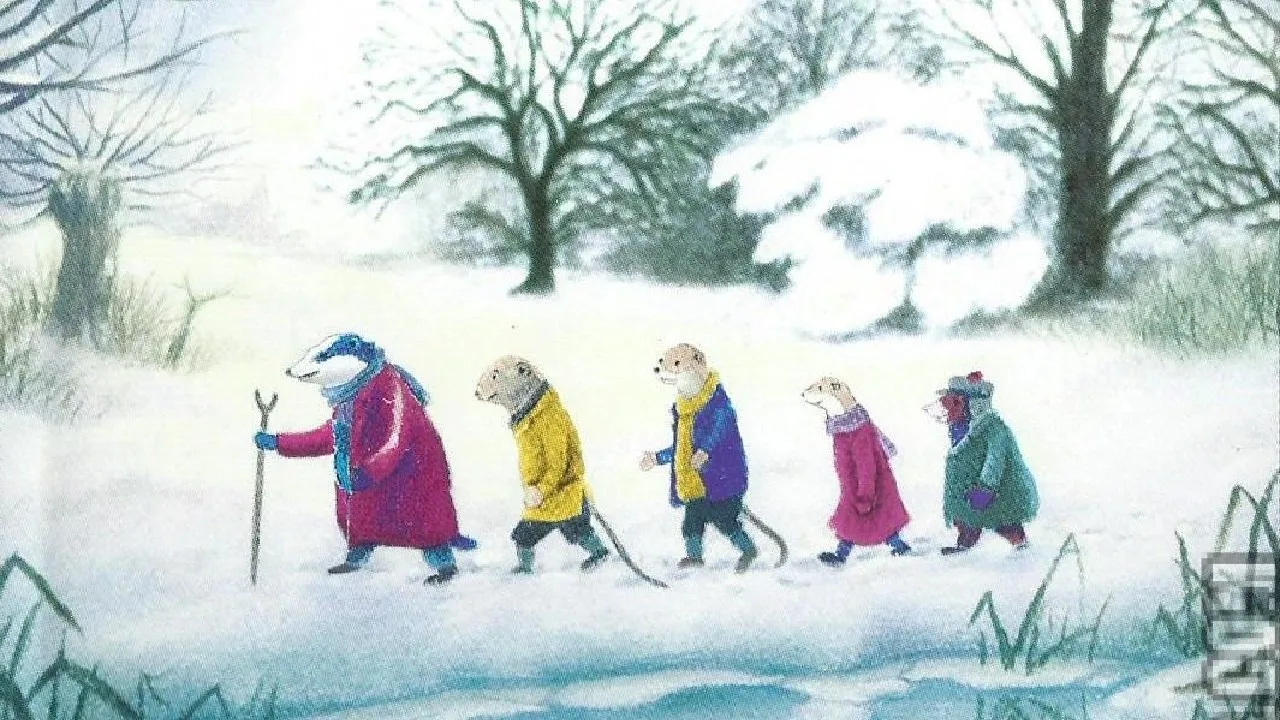
TVC London produced both this film and its predecessor, but the studio's other claim to Christmas fame is harder to miss: they also animated The Snowman in 1982. You can see the same hand at work. The backgrounds have a watercolour softness. The Wild Wood in a blizzard is rendered as properly frightening: dark, dense, disorienting. The River Bank in firelight is properly safe.
This was not cheap television animation. The studio took the source material seriously enough to make winter look cold and the snow look heavy. Mole stumbling through the Wild Wood carries actual visual weight, which is more than most animated films of the period managed.
William Horwood wrote the original novel that this film adapts. Horwood was commissioned to write authorized sequels to Grahame's book, and The Willows in Winter was published in 1993. The film follows the novel reasonably closely, keeping the seasonal crisis and the rescue at its centre.
Is The Willows in Winter a Christmas Movie?
It aired on Christmas Day 1996. That's about as clear a statement of intent as you get.
But the film itself is more interested in winter as a state of mind than as a holiday backdrop. The danger Mole faces is real: exposure, disorientation, the Wild Wood at its most hostile. The warmth that resolves the film, the friends gathered around the fire at Badger's house, earns its comfort because the film made you feel the cold first. This is the British Christmas tradition at its most honest. The warmth means something because the cold was real.
Grahame's original book barely touches Christmas directly, but The Wind in the Willows has always belonged to winter. Chapter Five, "Dulce Domum," in which Mole smells his old home and suddenly needs to return to it, is one of the most quietly devastating pieces of writing about belonging in the English language. The Willows in Winter understands that inheritance and builds from it.
What It Gets Right That Others Get Wrong
The film doesn't rush Mole's rescue. It lets the anxiety build. Ratty's growing alarm, Badger's methodical organisation of the search, the point where the characters accept they might not find him in time: these are earned emotional beats, not shortcuts to the warm ending.
There's also no false jeopardy. The Wild Wood is dangerous because wild woods are dangerous when you're small and it's winter. The film doesn't invent a villain or a ticking clock. The threat is simply nature, which is both more honest and more frightening.
If you grew up in Britain watching Christmas specials, you know the shape of this film even if you've never seen it. The animation style, the literary source, the casting of distinguished British character actors rather than pop stars: it fits exactly into the tradition that produced The Snowman and the Raymond Briggs adaptations. That tradition produced things worth watching. This is one of them.
The final image of the animals warm at Badger's fire, Mole safe among friends, is not earned by sentiment. It's earned by the blizzard that came before it.
Fun Facts
TVC London, the animation studio behind The Willows in Winter, also produced The Snowman (1982) and Father Christmas (1991), making them one of the defining studios of British Christmas animation.
William Horwood's novel The Willows in Winter was published in 1993 and was the first of four authorized sequels he wrote to Kenneth Grahame's original 1908 book.
The film aired on ITV on Christmas Day 1996, a slot that British broadcasters treated as one of the most prestigious in the television calendar.
Alan Bennett, who voiced Mole, is best known for his long career as a playwright and author. His 1988 autobiographical television film Talking Heads is considered some of the finest British television ever made.
Michael Gambon, who voiced Badger, had already played the title role in the BBC's acclaimed The Singing Detective in 1986 and would go on to play Albus Dumbledore in six Harry Potter films, starting in 2004.
Rik Mayall reprised his role as Toad from the 1995 film. Mayall had made his name in anarchic British comedy with The Young Ones (1982-1984), making the casting a deliberate contrast to his usual screen persona.
Kenneth Grahame's original chapter "Dulce Domum," in which Mole is overwhelmed by longing for his old home, is widely cited as one of the finest pieces of prose in early 20th-century English children's literature, and it directly influenced the emotional core of this film.
The 1995 predecessor film The Wind in the Willows also starred Michael Palin, Alan Bennett, and Michael Gambon, making this sequel one of the few animated British Christmas films to retain its entire principal cast.
Cast