
Meet the ultimate dysfunctional family.
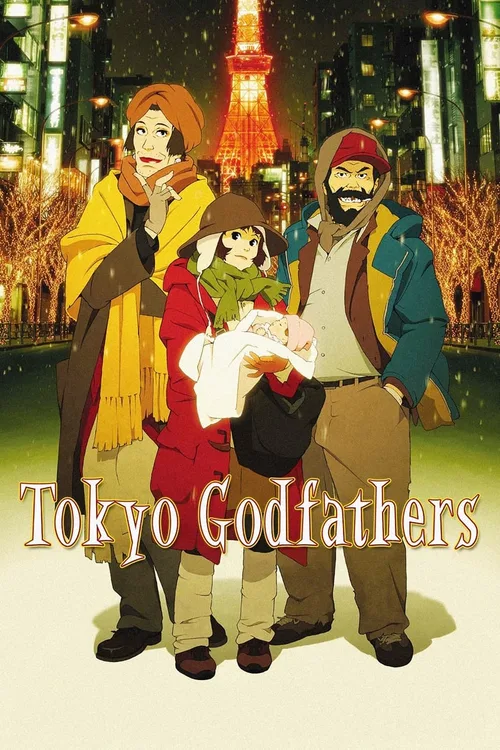
Tokyo Godfathers (2003)
On Christmas Eve, three homeless people living on the streets of Tokyo discover a newborn baby among the trash and set out to find its parents.
 rating 9/10 User rating 1,474 votes 79%
 ❄ Christmas Connection
Tokyo Godfathers is set entirely during the Christmas-to-New-Year period in Tokyo. The story begins on Christmas Eve when three homeless people discover an abandoned baby, and the entire plot revolves around their quest through a holiday-lit city to reunite the child with its parents.
Where to Watch


Our Review
Tokyo Godfathers opens with a nativity play performed for homeless people in a Tokyo park. Minutes later, three of those homeless people find a real baby in a dumpster. This is a Satoshi Kon film, so the line between sacred and profane doesn't so much blur as dissolve entirely. His 2003 anime takes the bones of a classic Christmas miracle story and sets it among people the world has thrown away, and the result is one of the best Christmas movies most Western audiences have never seen.
A Christmas Movie About the People Christmas Forgets
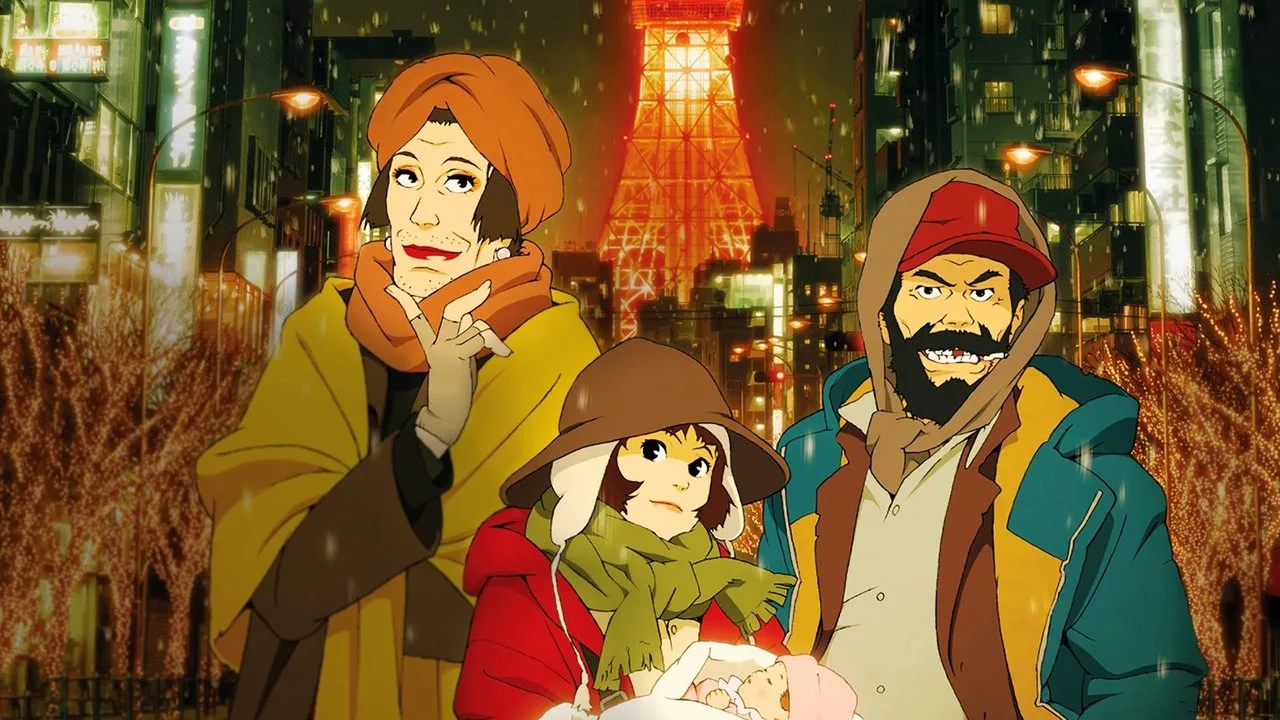
The three protagonists are Gin, a middle-aged alcoholic who claims to be a former cyclist; Miyuki, a teenage runaway with a knife and a grudge against her father; and Hana, a former drag queen with a huge heart and an even bigger temper. None of them are where they expected to be in life. All of them are sleeping in cardboard shelters when the movie begins.
When they discover the abandoned newborn, whom Hana names Kiyoko ("pure child"), the trio sets off across Tokyo to find the baby's parents. That's the plot. It sounds simple. It is not.
Kon constructs the story as a chain of outrageous coincidences. A dropped photo leads to an apartment. The apartment leads to a kidnapping. The kidnapping leads to a yakuza wedding. Each connection strains credibility, and that's the point. Kon is building a Christmas miracle from the ground up, showing us what it looks like when the universe conspires on behalf of people nobody else is rooting for.
Satoshi Kon's Most Accessible Film
Kon is best known for psychological thrillers like Perfect Blue (1997) and Paprika (2006), films that fold reality like origami until you can't tell which side you're looking at. Tokyo Godfathers is different. The narrative is linear. The characters are grounded. The emotional beats land without requiring a second viewing to decode.
But Kon's visual brilliance is fully present. The Tokyo he renders is staggeringly detailed: steaming manhole covers, konbini fluorescence at 2 a.m., snow accumulating on chain-link fences. He shoots animated "camera" movements that live-action directors would struggle to replicate, swooping through alleyways and across rooftops with a kineticism that keeps the two-hour runtime from dragging.
The character animation is extraordinary. Hana's theatrical gestures. Gin's defeated slouch. Miyuki's defensive crossed arms. You know these people within five minutes of meeting them, because Kon's animators gave every one of them a physical vocabulary as specific as a fingerprint.
Why the Coincidences Work
A common criticism of Tokyo Godfathers is that the plot runs on implausible luck. A character who needs to find someone stumbles into them. A life-threatening situation resolves through absurd timing. In a gritty drama, this would be lazy writing.
In Tokyo Godfathers, it's theology.
The film is explicitly structured as a nativity story. Three outcasts follow a "star" (the baby) through a hostile city. They bring gifts of care, protection, and love. The coincidences aren't plot holes; they're the mechanism of grace operating in a world that otherwise offers these characters nothing. Kon understood that the Christmas miracle genre only works when the recipients of the miracle have genuinely earned the audience's sympathy. He spends the first act making sure we know exactly what Gin, Hana, and Miyuki have lost before he starts giving things back.
The Voices Behind the Characters
Toru Emori brings a weary, gravel-voiced dignity to Gin that makes his lies about his past feel protective rather than pathetic. Yoshiaki Umegaki gives Hana a theatrical warmth that never tips into caricature, a performance that treats a transgender homeless woman with complete sincerity. Aya Okamoto's Miyuki is all sharp edges masking vulnerability, the kind of teenager who starts every sentence angry and ends it scared.
The three voice actors recorded their lines together rather than separately, which was unusual for anime production. You can hear it in the overlapping dialogue and the natural rhythm of their arguments. These people sound like they've been sleeping next to each other in the cold for months.
Christmas in Tokyo
Japan celebrates Christmas as a secular, commercial holiday rather than a religious one. KFC Christmas dinner is a genuine national tradition. Couples treat December 25th more like Valentine's Day than a family gathering. Kon uses this cultural context brilliantly. His Tokyo is draped in Christmas lights and holiday marketing, but the warmth is all surface. The actual human warmth in the film comes from three people society considers disposable.
There's a scene where the trio walks past a department store window display while carrying the baby. Shoppers bustle past. Nobody looks at them. The store's Christmas decorations are flawless. The contrast doesn't need a single word of dialogue to land.
Fun Facts
Tokyo Godfathers is loosely inspired by the 1948 John Ford Western "3 Godfathers," which itself was based on a 1913 novel by Peter B. Kyne about three outlaws who find an infant in the desert.
Satoshi Kon completed only four feature films before his death from pancreatic cancer in 2010 at age 46. Tokyo Godfathers was his third.
The film was co-written by Keiko Nobumoto, who also wrote the screenplay for Cowboy Bebop: Knockin' on Heaven's Door and the story for Wolf's Rain.
Kon deliberately chose to tell a straightforward story after the psychological complexity of Millennium Actress (2001), wanting to prove he could work outside his comfort zone.
The baby Kiyoko's name uses the kanji for "pure" or "clean," a deliberate parallel to the Christ child in the nativity story the film references.
Tokyo Godfathers was produced by Madhouse, the same studio behind Kon's other films, and featured character designs by Kenichi Konishi, who had previously worked as a key animator on Studio Ghibli productions.
In Japan, the film was released on November 8, 2003, weeks before Christmas, while its U.S. theatrical release didn't come until January 2004, after the holiday season had passed.
Cast