Yes, Virginia: There Is a Santa Claus
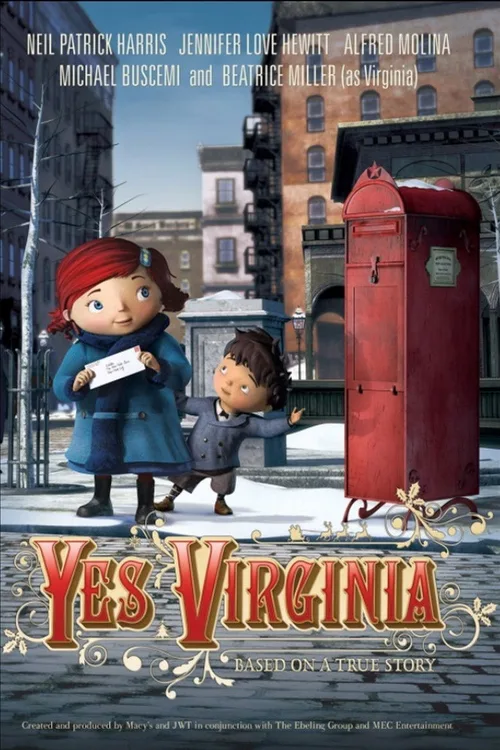
Yes, Virginia (2009)
New York City, 1897. A little girl named Virginia O'Hanlon loves Christmas more than anything else in the world. When a schoolyard bully challenges her belief in Santa Claus, Virginia embarks on a quest across the city to prove he is real. Based on the true story of the most famous newspaper editorial of all time.
 rating 7/10 User rating 27 votes 71%
 ❄ Christmas Connection
Yes, Virginia is built entirely around the most famous piece of Christmas writing in American history: Francis Church's 1897 editorial for The New York Sun affirming Santa Claus's existence to eight-year-old Virginia O'Hanlon. The special dramatizes that exchange and the broader question of childhood belief in Christmas magic. There is no version of this story that isn't a Christmas story.
Where to Watch


Our Review
In September 1897, a man named Francis Church sat down at a desk at The New York Sun, read a letter from an eight-year-old girl asking whether Santa Claus was real, and wrote 416 words that would be reprinted more than any other editorial in the English language. He did it anonymously, in an afternoon, and died nine years later without knowing his name would ever be attached to it. The 2009 animated special Yes, Virginia takes that story and does something surprisingly smart with it: rather than just illustrating the editorial, it dramatizes the moment of its creation.
What the 2009 Special Actually Is
This is a Macy's production. That fact is relevant but not damning. The special was commissioned as part of the department store's "Believe" campaign, produced by The Ebeling Group and JWT, and broadcast on CBS on December 11, 2009. For every letter to Santa dropped in a Macy's box that holiday season, the company donated one dollar to the Make-A-Wish Foundation. The Virginia O'Hanlon story was the campaign's anchor.
Knowing the corporate origin explains the special's warmth and its limits. It's polished, earnest, and slightly soft around the edges. It does not take risks. But it does the core thing well: it treats Francis Church's editorial as genuinely worth dramatizing, and it casts Alfred Molina as Church.
That casting is the best decision the production makes.
Alfred Molina as Francis Church
Molina's Church is a weary man. He's a veteran Civil War correspondent who covered the bloodiest conflict in American history for The New York Times, then spent decades at The Sun writing anonymous editorials nobody would ever credit to him. By 1897 he had lost his taste for sentimentality. When his editor hands him Virginia's letter, he's visibly reluctant to engage with it.
What Molina does with the performance is make the editorial's famous words feel like something Church arrives at rather than something he always believed. The voice acting is restrained and specific, which in an animated Christmas special aimed at children is a genuine achievement. Molina brings the same craft to this 25-minute TV production that he brought to any theatrical feature.
Neil Patrick Harris and Jennifer Love Hewitt voice Virginia's parents, Dr. Phillip and Laura O'Hanlon. Harris is warm and credible. Hewitt is given less to do but handles it gracefully. The real vocal surprise is Beatrice Miller, who was ten years old when she recorded Virginia's dialogue. She was born February 7, 1999, which put her almost exactly the same age as the historical Virginia when Church wrote his response. That coincidence gives the performance a naturalness that a professional adult voice actor might not have found.
The Source Material and What It Asks of an Adaptation
The challenge in adapting Church's editorial is that it isn't a story. It's a philosophical argument in the form of a newspaper column. Church doesn't narrate Virginia discovering Santa exists. He asserts that Santa exists the way love and generosity exist: not materially, but as real forces in human experience. It's a sophisticated position to hand to an eight-year-old.
Writer Chris Plehal solves this by building a story around the editorial rather than from it. Virginia writes her letter. Church writes his response. The special dramatizes both sides of that correspondence, showing why Virginia's question mattered enough to prompt a serious answer. The result is structurally unusual for an animated children's special: a significant portion of the runtime is an adult man sitting at a desk, thinking.
It works because Molina makes thinking visible. It also helps that Church's actual words are delivered largely intact. The editorial's most quoted lines land with their original weight.
The Animation and the Macy's Question
The CGI animation, produced by Jam Filled Toronto, is competent and period-appropriate in design. The late-Victorian New York setting is rendered with care: gas lamps, cobblestones, newspaper offices with ink-stained desks. The character designs are slightly stylized, softer than photorealistic, which suits the material. This is not a special trying to impress with technical showmanship.
The Macy's presence is visible but not overwhelming. The company's famous store appears in the background. The "Believe" campaign's donation mechanic is referenced in framing material. None of this intrudes on the dramatization itself. The special runs 25 minutes without commercials and uses them well.
The One Show recognized the campaign with an award. CBS renewed the broadcast in subsequent years. A Virginia O'Hanlon balloon debuted in the 2010 Macy's Thanksgiving Day Parade. The DVD sold with 10 percent of proceeds going to the Make-A-Wish Foundation. Whatever one thinks of Christmas specials as marketing vehicles, this one spent its budget on something that holds up.
Is This Christmas Special Worth Watching?
The 1974 animated version of the same story, produced by Bill Melendez and narrated by Jim Backus, has a longer track record and a looser, warmer charm. If you've seen that version, this 2009 special is a different experience rather than a replacement. The Molina performance alone justifies the 25-minute investment.
For children old enough to sit with a story that pauses to let an adult wrestle with a philosophical question, it's genuinely good television. For adults who know that Virginia O'Hanlon spent 47 years teaching in the New York City school system and answered letters about her Santa inquiry until she died in 1971, it carries some weight.
The real Francis Church never knew his editorial would still be in circulation 130 years later. He wrote it in an afternoon, didn't sign it, and moved on. The animated version of him sits at the end of his workday, reads what he's written, and seems faintly surprised by it. That detail, small as it is, is the most honest thing in the special.
Fun Facts
Francis Church's 416-word editorial was published anonymously on September 21, 1897, and Church's identity as its author wasn't publicly known until after his death in 1906. The Sun started reprinting it annually in 1920 and continued until the paper closed in 1950.
Virginia O'Hanlon was born July 20, 1889, and spent 47 years as a teacher and principal in the New York City public school system. She retired in 1959 and continued receiving mail about her 1897 letter until her death on May 13, 1971, at age 81.
Beatrice "Bea" Miller, who voiced Virginia in the special, was born February 7, 1999, making her approximately ten years old during production, almost exactly the same age as the historical Virginia O'Hanlon when she wrote her letter.
The special was commissioned by Macy's as part of its "Believe" campaign, which donated one dollar to the Make-A-Wish Foundation for every letter to Santa dropped in collection boxes at Macy's stores. The campaign ran for multiple holiday seasons.
A Virginia O'Hanlon character balloon created for the campaign made its debut in the 2010 Macy's Thanksgiving Day Parade, the first time the character had appeared in balloon form in the parade's history.
Church's editorial has been translated into at least 20 languages and is widely cited as the most reprinted editorial in the English language. Columbia University, where Church studied, holds an annual Yule log ceremony at which Virginia's letter and Church's response are read aloud.
Alfred Molina, who voiced editor Francis Church, is best known for film roles including Doc Ock in Spider-Man 2 (2004) and Inigo Montoya's nemesis Rugen in stage productions. His casting against type, as a cynical journalist rather than a villain or antagonist, was one of the production's stronger creative choices.
The special was directed by Pete Circuitt and written by Chris Plehal, and animated by Jam Filled Toronto (then known as Starz Animation Toronto). It premiered December 11, 2009, on CBS and was subsequently released on DVD in October 2010.
Cast