
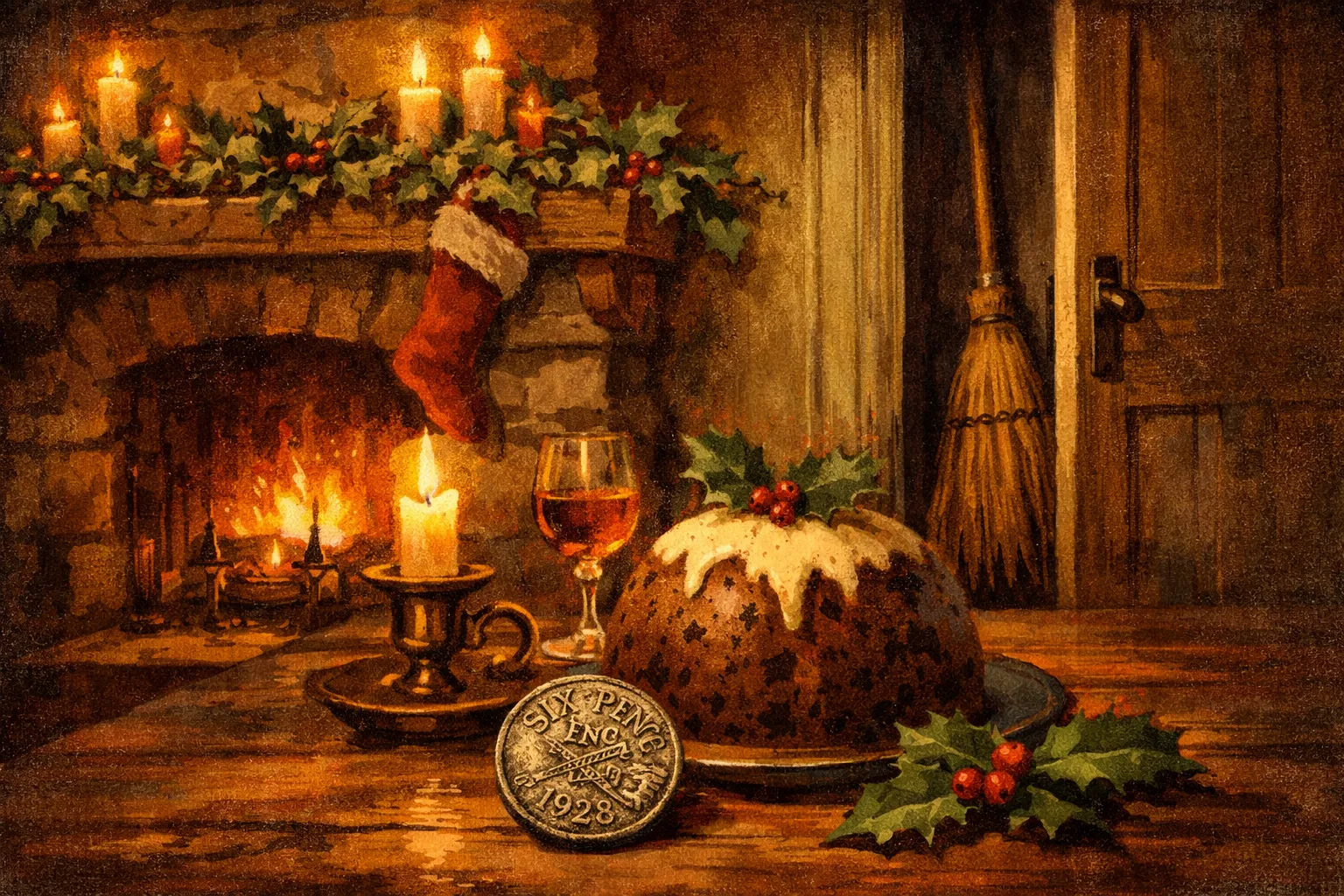
Christmas Superstitions and Festive Folklore Beliefs
Hiding brooms from witches, stirring pudding east to west, and never leaving decorations past Twelfth Night. The superstitions behind Christmas reveal a season once governed more by fear than by cheer.
For most of its history, Christmas was not primarily about joy. It was about surviving the darkest stretch of the year without attracting the attention of whatever might be lurking in it. The Christmas superstitions that accumulated across Europe over centuries reveal a season thick with anxiety: about spirits, about luck, about the fragile line between a good year and a catastrophic one. People didn't just celebrate at Christmas. They performed rituals designed to keep disaster at bay.
Contents
- 1. Christmas Eve Superstitions: The Most Dangerous Night
- 2. Christmas Tree Superstitions and When to Decorate
- 3. Christmas Decorations Superstitions: Twelfth Night and Beyond
- 4. Christmas Day Superstitions and Luck Traditions
- 5. Christmas Pudding and the Silver Sixpence
- 6. Holly, Mistletoe, and Other Protective Plants
- 7. Romantic Divination on Christmas Eve
- 8. Frequently Asked Questions
Many of these beliefs predate Christianity entirely. They belong to midwinter, to the solstice, to the old agricultural calendar where December was the hinge on which the next harvest turned. When the Church absorbed these dates, it absorbed the superstitions too. Some were Christianized. Some were simply tolerated. And a surprising number survived intact into the 20th century.
What follows is not a cute list of quirky holiday facts. These are the rules that governed Christmas behavior across Britain, Ireland, Scandinavia, and Central Europe for hundreds of years.
Christmas Eve Superstitions: The Most Dangerous Night
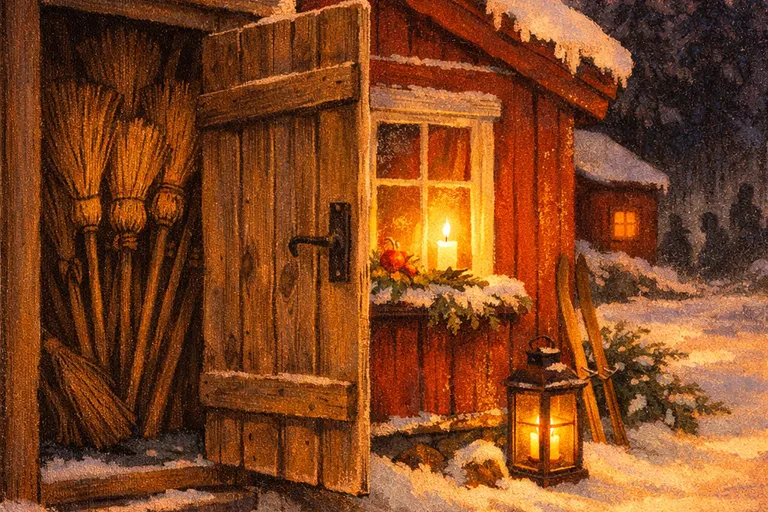
Christmas Eve was the night when the boundary between the human world and the spirit world was believed to be at its thinnest. In Norwegian folklore, witches and evil spirits roamed freely on December 24th, looking for transportation. Families hid every broom in the house to prevent witches from stealing them for a midnight ride. Some households also fired shotguns into the air at dusk to scare off anything unseen. The tradition of hiding brooms persisted in parts of Norway well into the 20th century.
In Serbian tradition, the twelve days beginning on Christmas Eve were called the "unbaptized days," a period when demonic forces were at their most active. A creature called the karakondzula would leap onto the back of anyone foolish enough to be outdoors after dark, forcing its victim to carry it until a rooster crowed at dawn.
Animals held a special status on Christmas Eve. A widespread belief across Britain and Central Europe held that farm animals knelt at midnight in honor of Christ's birth, and that they could speak in human language. But listening to what they said was considered extremely dangerous. In some versions, anyone who eavesdropped on the animals' midnight conversation would die within the year.
Candles lit on Christmas Eve had their own rules. Once placed and lit, a Christmas candle should never be moved or snuffed out before it burns down naturally. Blowing out a Christmas candle was thought to invite death into the household. In Ireland, a large candle was placed in the window on Christmas Eve to guide Mary and Joseph, and extinguishing it before morning was unthinkable.
Christmas Tree Superstitions and When to Decorate
The timing of Christmas decorations was not a matter of personal preference. It was a matter of safety. In much of Europe, bringing greenery into the house before Christmas Eve invited bad luck. The logic was straightforward: evergreen branches housed tree spirits. Bringing them indoors too early gave those spirits time to cause trouble before the protective rituals of Christmas could contain them.
An undecorated tree was considered particularly dangerous. A bare tree standing in the corner of a room was an open invitation for malevolent spirits to take up residence. This is one reason decorating happened quickly: once the tree was inside, it needed to be dressed immediately to make it safe.
Early Appalachian settlers in North America carried a related practice. They would tap the trunk of a freshly cut tree before bringing it inside, believing this knocked loose any spirits clinging to it. The tree was then shaken vigorously at the door, an action that served double duty as both spiritual cleansing and practical needle removal.
The type of greenery mattered too. Holly was celebrated for its protective powers, said to be effective against witches and lightning strikes. But which variety entered the house first on Christmas Day determined household dynamics for the coming year. According to English folklore recorded by Snopes, prickly holly entering first meant the husband would "hold sway," while smooth holly guaranteed the wife would reign.
Christmas Decorations Superstitions: Twelfth Night and Beyond
If the rules for putting decorations up were strict, the rules for taking them down were absolute. All Christmas greenery had to be removed by Twelfth Night, January 5th (or January 6th, depending on local counting). Missing this deadline didn't just mean bad luck. It meant the tree spirits you'd brought inside would remain trapped in your home for the entire year.
Some regional folklore was more specific. In parts of England, every pine needle left on the floor after the tree was removed represented a goblin that would visit the house. Other versions claimed each forgotten needle predicted a death. The cleanup was, understandably, thorough.
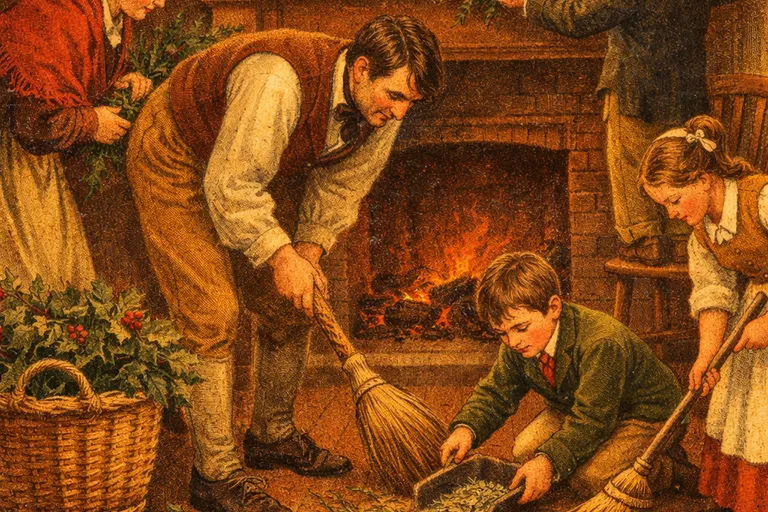
Disposal methods were contentious. Most traditions insisted that holly, ivy, and Christmas greenery should be burned. But in certain areas of Britain, burning holly was considered deeply unlucky, and the branches had to be buried or left to rot naturally. The contradiction suggests that these rules evolved independently in different communities, each convinced their version was the only safe one.
Ivy occupied a peculiar position. Growing on the outside of a house, it was protective. Brought inside, it attracted bad luck. It was never to be given as a gift to anyone who was ill. This indoor-outdoor split reflects an older understanding of ivy as a liminal plant, belonging to the boundary between civilization and wilderness.
Christmas Day Superstitions and Luck Traditions
Christmas Day itself was dense with predictive superstitions. The weather on December 25th was read like a diagnostic report for the entire year ahead. The Old Farmer's Almanac records the widespread belief that weather on each of the twelve days of Christmas predicted conditions for the corresponding month. A rainy December 28th meant a wet April. A sunny January 1st promised a warm May.
Another common belief held that a green Christmas foretold a white Easter, and vice versa. "A green Christmas makes a fat churchyard" was a saying recorded across England, Germany, and Scandinavia, meaning that a mild December would lead to illness and death in the months ahead. The logic was not entirely wrong. A mild winter without hard frosts meant disease-carrying insects survived longer.
Being born on Christmas Day carried its own set of beliefs, and they varied wildly by region. In most of Britain, a Christmas birthday was considered fortunate. The child could neither be drowned nor hanged, according to one common claim. In Scotland, the belief was more dramatic: a child born on December 25th had the power to see and command spirits. In parts of Germany and Poland, the opposite applied. A child born during the Twelve Days of Christmas risked becoming a werewolf.
The first person to enter a home on Christmas morning determined the household's luck. This "first footer" tradition, better known in its New Year's form, also applied to Christmas in many communities. A dark-haired man was the best omen. A woman entering first was considered unlucky in much of northern England and Scotland.
Christmas Pudding and the Silver Sixpence
The Christmas pudding was the single most superstition-laden object in the British household. Its preparation followed rules that had nothing to do with cooking and everything to do with fortune.
Stir-up Sunday, the last Sunday before Advent, was the traditional day to make the pudding. The name comes from the Book of Common Prayer of 1549, which begins the day's collect with "Stir up, we beseech thee, O Lord." Since Victorian times, families took the phrase literally. Every member of the household had to take a turn stirring the pudding with a wooden spoon, and the stirring had to go from east to west, honoring the direction the Magi traveled to Bethlehem.
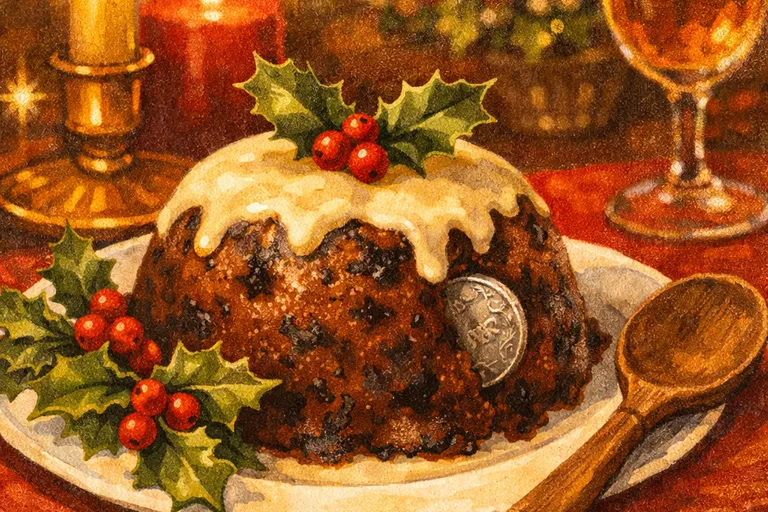
The pudding was supposed to contain thirteen ingredients, representing Christ and the twelve apostles. A silver coin was baked inside. Whoever found it in their serving would enjoy wealth in the coming year. The coin was originally a silver farthing. After World War I, it became a threepenny bit. By 1937, the silver sixpence had become standard. The Royal Mint has periodically reissued sixpences specifically to keep this tradition alive.
Other tokens were sometimes included: a tiny wishbone for good luck, a silver thimble for thrift, and an anchor for safe harbor. The pudding was, in effect, a fortune-telling device disguised as dessert.
Holly, Mistletoe, and Other Protective Plants
Evergreen plants were not just decorative during the Christmas season. They were armor. Holly's sharp leaves were believed to snag evil spirits, preventing them from entering the home. Hanging it above doorways was a defensive measure, not an aesthetic choice. The red berries were associated with Christ's blood in Christian tradition, but the plant's protective reputation predates Christianity by centuries.
Mistletoe occupied a complicated space. The Druids considered it sacred, especially when found growing on oak trees. Pliny the Elder recorded their elaborate harvesting rituals in his Natural History around 77 AD. But many churches banned mistletoe from their premises because of exactly these pagan associations. York Minster in England was a rare exception, placing mistletoe on the altar during the Christmas season and using the occasion to issue a general pardon.
The kissing tradition that developed around mistletoe in 18th-century England came with its own superstition: refusing a kiss under the mistletoe brought bad luck. The original practice required plucking a berry with each kiss. When the berries ran out, the kissing stopped. Leaving mistletoe hanging after Twelfth Night was as dangerous as leaving any other greenery, and some believed it specifically invited romantic misfortune.
Romantic Divination on Christmas Eve
Young women across Britain and Central Europe used Christmas Eve as an opportunity for romantic fortune-telling. The methods were creative and occasionally bizarre.
In one English tradition, an unmarried woman would knock on the door of a pigsty at midnight. If a mature pig grunted in response, her future husband would be an older man. If a young piglet squealed, she'd marry someone handsome and youthful. In the Czech Republic, women would throw a shoe over their shoulder toward the door. If the shoe landed with the toe pointing toward the exit, she would marry and leave home within the year. If the heel pointed outward, she'd stay another year.
Peeling an apple in one continuous strip and tossing the peel over your left shoulder was supposed to reveal the first initial of your future spouse in whatever shape the peel formed on the floor. This tradition appeared across Britain, Ireland, and parts of Germany. The success rate of reading letters in apple peel went unrecorded.
Frequently Asked Questions
Why is it bad luck to leave Christmas decorations up past Twelfth Night?
European folklore held that evergreen branches and Christmas trees housed nature spirits. Bringing them indoors for Christmas was safe only because the season's rituals contained those spirits. After Twelfth Night (January 5th or 6th), the protective period ended, and any remaining greenery would trap the spirits inside the home, bringing misfortune for the entire year. Some versions warned that goblins would take up residence in forgotten decorations.
What are the most common Christmas Eve superstitions?
The most widespread Christmas Eve superstitions include the belief that animals can speak at midnight but that listening to them brings death, that candles lit on Christmas Eve must never be moved or extinguished before burning out naturally, and that brooms should be hidden to prevent witches from using them. In Norway, hiding brooms on Christmas Eve was practiced into the 20th century.
Is it bad luck to put up a Christmas tree before Christmas Eve?
In traditional European folklore, yes. Bringing an evergreen tree or greenery into the house before December 24th was believed to invite bad luck because the tree spirits would have too long to cause trouble before the protective Christmas rituals began. Many families decorated only on Christmas Eve for this reason. The modern trend of decorating in late November or early December would have horrified earlier generations.
What is the superstition about the Christmas pudding silver coin?
A silver coin baked into the Christmas pudding is said to bring wealth to whoever finds it in their serving. The tradition dates back to medieval Twelfth Night cakes, which contained a dried bean or pea that made the finder "king" or "queen" for the evening. In Britain, the coin evolved from a silver farthing to a threepenny bit after World War I, and then to a silver sixpence from 1937 onward.
Why do Norwegians hide brooms on Christmas Eve?
Norwegian folklore holds that witches and evil spirits emerge on Christmas Eve looking for brooms to ride. Families hid all brooms in the house, and some also fired guns into the air at dusk to frighten away supernatural visitors. The belief connects to pre-Christian Scandinavian traditions associating the winter solstice with increased supernatural activity. The practice persisted in rural Norway into the 1900s.
Does being born on Christmas Day bring good or bad luck?
It depends on where you ask. In most of Britain, a Christmas birthday was considered extremely fortunate, and the child was said to be immune to drowning or hanging. In Scotland, Christmas-born children were believed to have the power to see and command spirits. In parts of Germany and Poland, however, children born during the Twelve Days of Christmas were feared to be at risk of becoming werewolves.