

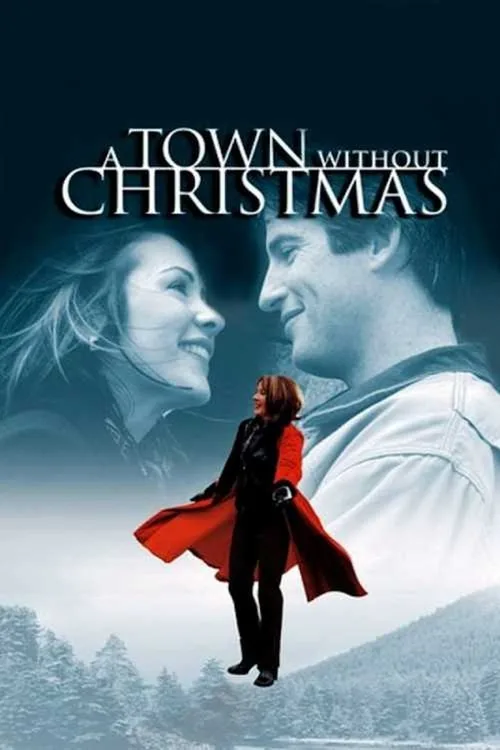
A Town Without Christmas (2001)
In the small town of Seacliff, Wash., a child's letter to Santa Claus captures the nation's attention. When the little boy, Chris, writes that he wishes to leave this world so he will no longer be a burden to his divorcing parents, a race begins to find him before he harms himself.
 rating 6/10 User rating 16 votes 58%
 ❄ Christmas Connection
The entire film pivots on a child's letter to Santa Claus, a missing boy found only because Christmas tradition made someone pay attention. Santa, the post office, carol-singing, and small-town holiday community spirit are not backdrop elements here -- they are the plot engine. Without Christmas, there is no story.
Our Review
On December 16, 2001, CBS aired a TV movie about a child's letter to Santa Claus. Forty-four million people reportedly tuned in, making A Town Without Christmas the highest-rated TV movie of that entire year. It earned that audience the old-fashioned way: genuine sentiment, two well-cast leads, and a premise that anyone who ever wrote a letter to Santa as a kid will find hard to dismiss.
The setup is grimmer than the title suggests. A young boy named Chris, living in the fictional Pacific Northwest town of Seacliff, Washington, writes a letter to Santa asking to stop existing. He believes he has become a burden to his divorcing parents. The letter reaches the local post office, word spreads, and the town mobilizes to find him before something irreversible happens. This is not a film about wrapping paper and eggnog. It's a film about a child in pain who reaches for the one address he trusts most.
What Patricia Heaton Brings to the Role
Patricia Heaton plays M.J. Jensen, a big-city television reporter sent to Seacliff to cover the story. The character is deliberately prickly: professional to the point of coldness, more interested in the angle than the boy. This was 2001, the year Heaton won her second consecutive Emmy for Everybody Loves Raymond. She was at full wattage, and taking a role as a jaded journalist in a small-town Christmas movie instead of resting on sitcom success was a reasonable gamble.
It pays off. Heaton does not play the redemption arc with big swelling moments. She lets M.J. thaw incrementally, resisting the easy beats that lesser TV movies lean on. The moment she stops thinking about the story and starts thinking about Chris is not underlined with a score swell. It just happens, quietly, and Heaton trusts the audience to notice.
Peter Falk as the Angel Nobody Asked For
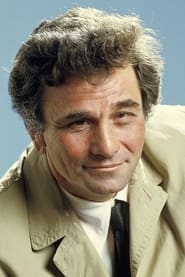
Max, the mysterious elderly stranger played by Peter Falk, is coded as an angel from his first appearance. The film doesn't make this a twist -- the audience figures it out long before the characters do. What makes Max work is Falk's specific quality of lived-in patience. He was 74 when this filmed, four Emmy Awards from Columbo deep into a career that started with two consecutive Academy Award nominations (for Murder, Inc. in 1960 and Pocketful of Miracles in 1961). He has nothing to prove, and it shows. Max is eccentric and persistent in exactly the way Columbo was -- always circling, always knowing more than he lets on, one more question before he lets anyone leave.
The comparison to Columbo is not accidental. Falk built his whole career on the technique of apparent bumbling concealing absolute precision. Max is that same character in a different coat. CBS noticed. They brought Falk back for Finding John Christmas in 2003 and When Angels Come to Town in 2004, creating a loose trilogy. Ernie Hudson rounds out the main ensemble as Ted, the third adult searching for Chris, and adds warmth without becoming scenery.
Is "A Town Without Christmas" Actually Good?
It is good at what it tries to be. Director Andy Wolk keeps the pacing steady without rushing the emotional pivots. The script, by Michael J. Murray and Ken Gross, resists the temptation to explain Max too explicitly. The film was shot in Chester, Nova Scotia, between April 8 and May 10, 2001, which gives it a genuinely overcast, northern-coast feel that the Pacific Northwest setting demands. There is something slightly lonely about the light in this movie, which is the right choice for a story about a child who feels invisible.
What the film does not do especially well is surprise. The plot mechanics are standard-issue. The romance that develops between M.J. and the local struggling writer David Reynolds (Rick Roberts) moves along its expected track. If you've watched a CBS Sunday night movie before 2005, you'll recognize all the furniture. The film earns its sentiment, but it does not earn much beyond that.
None of that mattered to the 44 million people watching. They came for the feeling, and the feeling is delivered cleanly.
A Child's Letter as the Engine of Everything
The most interesting thing about the film is what it trusts. It trusts that a letter to Santa, written by a desperate child, is inherently dramatic. It doesn't need to parody the premise or wink at adult viewers who no longer believe. The letter is treated as the serious document it is, the way any plea for help should be treated, and the town's response to it -- dropping everything, organizing, searching -- is treated as the obvious and correct thing to do. The film is essentially an argument that Christmas spirit is not about decorations but about paying attention to the people around you who are struggling.
That's a smaller, quieter message than most Christmas movies reach for. It suits the Nova Scotia light and Patricia Heaton's underplayed performance. It also explains why the sequel network wanted Peter Falk's Max back twice more -- he's the most honest thing in the movie, and that's exactly what angel characters are supposed to be.
Fun Facts
A Town Without Christmas was the highest-rated TV movie of 2001, drawing an estimated 44 million viewers on CBS on December 16, 2001.
The film was shot entirely in Chester, Nova Scotia, Canada, between April 8 and May 10, 2001, though the story is set in the fictional coastal town of Seacliff, Washington.
Peter Falk received two Academy Award nominations in consecutive years at the start of his film career -- for Murder, Inc. (1960) and Pocketful of Miracles (1961) -- before his television work overtook his film reputation.
Patricia Heaton won the Primetime Emmy for Outstanding Lead Actress in a Comedy Series in both 2000 and 2001 for Everybody Loves Raymond, making her one of the few performers to win in consecutive years in that category.
The success of this film launched a CBS trilogy: Peter Falk returned as the angel Max in Finding John Christmas (2003), co-starring Valerie Bertinelli, and again in When Angels Come to Town (2004), co-starring Katey Sagal.
Falk won four Primetime Emmy Awards for playing Lieutenant Columbo (1972, 1975, 1976, and 1990), with the last win coming 18 years after the first -- a span no other actor in that category has matched.
The three films starring Falk as Max were later packaged and sold together on DVD under the title Max the Angel: Christmas Collection.
Cast