

How far would you go to make a wish come true?
All I Want For Christmas (1991)
Siblings Ethan and Hallie O'Fallon plot to get their divorced parents back together in time for Christmas.
 rating 6/10 User rating 126 votes 56%
 ❄ Christmas Connection
All I Want for Christmas is set entirely during the Christmas season in New York City, with the holiday serving as the engine of the entire plot. The children's wish to reunite their parents is made to a department store Santa, and the film builds to a climax on Christmas Eve. Without Christmas, there is no movie.
Where to Watch


Our Review
In 1991, a modest little film called All I Want for Christmas landed in theaters, made a quiet impression, and then spent the next three decades living in the shadow of the Christmas movie giants that surrounded it. It came out the year after Home Alone had rewritten the rules for family holiday films, which is roughly the same as opening a restaurant next to the most popular place in town the morning after a glowing review. Against those odds, it holds up better than you'd expect.
The Setup Is Thin. The Cast Saves It.
The premise is almost painfully simple. Hallie O'Brien (Thora Birch) and her older brother Ethan (Ethan Randall, later known as Ethan Embry) are children of divorce living with their mother in New York City. Their dad lives nearby. They want their parents back together. Hallie decides to make this her Christmas wish to a department store Santa, and the film's plot follows from there.
That's it. There's no elaborate scheme, no booby traps, no criminal masterminds. The story is quiet by design, trading in small domestic emotions rather than slapstick escalation.
What keeps it working is the cast. Thora Birch, who was ten years old during production, does most of the heavy lifting in the film. She's not performing cute, she's performing determined, which is a harder thing to pull off and more interesting to watch. Ethan Embry, then fourteen, is charming in the way that certain teenage actors manage to be before self-consciousness takes over. The dynamic between them feels like an actual sibling relationship rather than two child actors hitting marks.
Harley Jane Kozak and Jamey Sheridan play the parents with enough warmth that you understand why the kids want to fix this. Lauren Bacall, as the imperious grandmother Lillian, sweeps in and out of scenes as if she's doing the film a favor by appearing at all. She probably was.
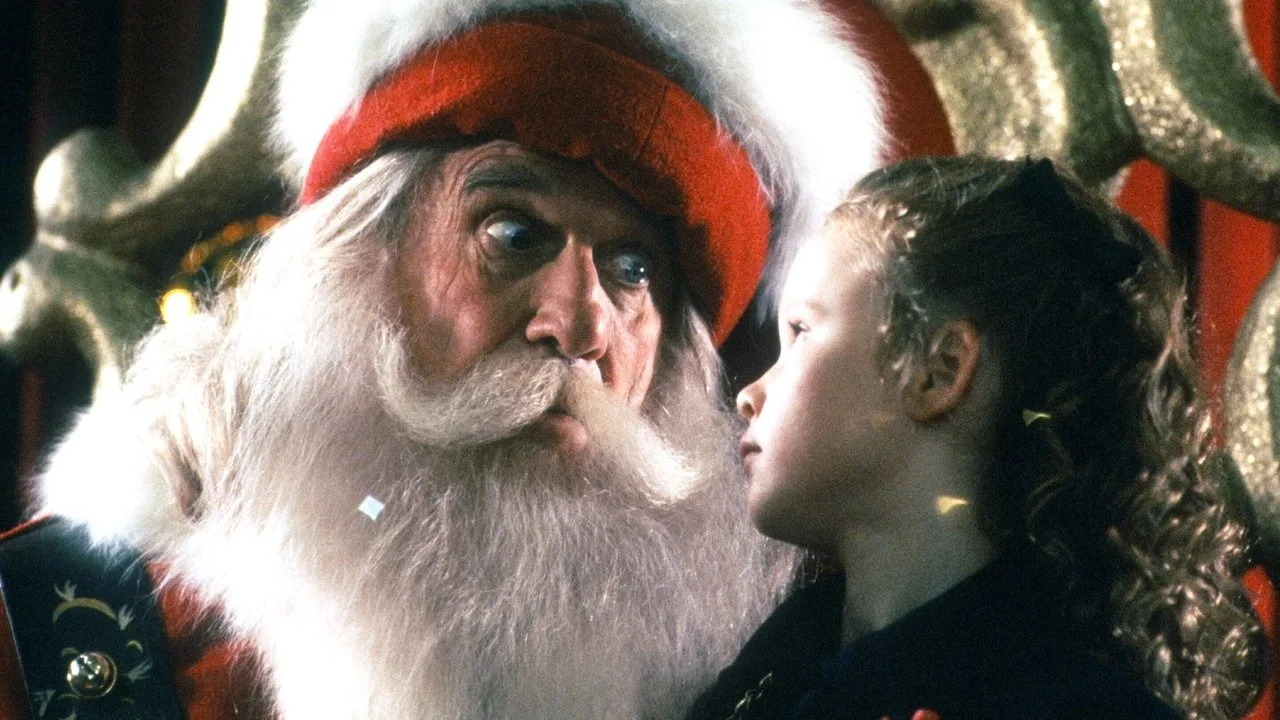
Leslie Nielsen as Santa Claus
The casting decision that ages best is Leslie Nielsen as Santa Claus. By 1991, Nielsen had already completed his pivot from serious character actor to comedy legend via Airplane! and the Naked Gun films. Casting him as Santa was a smart piece of movie logic: audiences expected him to be funny, he plays it almost completely straight, and the result is a Santa who is somehow both silly and genuinely kind.
Nielsen's Santa doesn't do much. He listens to Hallie's wish, takes it seriously, and offers a small amount of guidance. That restraint is the joke and it works. A winking, mugging Nielsen Santa would have been exhausting. The deadpan version is oddly touching.
New York City as the Real Co-Star
Director Robert Lieberman, who came from a background in television commercials and music videos, shoots New York in December with genuine affection. The film uses the city as more than a backdrop. The department stores, the streets, Central Park in winter, the particular way Manhattan looks when it's cold and the windows are lit: these details give the film a sense of place that generic studio Christmas productions never achieve.
There's a sequence involving a horse-drawn carriage in Central Park that is unabashedly sentimental and completely aware of it. The movie knows it's leaning into the postcard version of New York Christmas and leans in anyway. On a small production, that kind of conviction counts for something.
What It Gets Right About Divorce and Kids
The film is careful not to vilify either parent. The divorce is presented as something that happened, not as something one parent did to the family. This is a less common choice in children's films than you'd think, and it means the story doesn't require a villain or a redemption arc. It just needs two people who, maybe, given the right circumstances and a little push from their children, might find their way back to each other.
There's a limit to how believable that premise is for adult viewers. Children of divorce who have watched their parents remarry other people, move to different cities, or spend years in conflict will find the wish-fulfillment here extremely transparent. But the film isn't making an argument about how divorce actually resolves. It's offering a fantasy to kids who grew up in split families and never stopped wanting a different ending.
Hallie's wish to Santa is not a request for toys or experiences. She wants her family whole again. That specificity, and the seriousness with which the film takes it, is what separates this from pure holiday schmaltz.
The Verdict
This is not a great film. It's a good one, made with care, performed by a cast that includes at least two child actors who went on to have real careers. It doesn't overstay its welcome at 92 minutes, it never turns cruel or mean-spirited, and it gives Lauren Bacall a few lines of actual dialogue rather than just scenery to chew.
If you grew up in the early 90s and caught this on cable, the nostalgia hit is real. If you're coming to it fresh, you'll find a minor Christmas film with an honest emotional core and a Santa played by the man who also played Frank Drebin. That's an unusual combination and it works.
The final image of the film is a family together in the snow, framed like the holiday card they finally became. It's unsubtle. It's also the exact ending the movie promised from its first frame, delivered without apology. That kind of follow-through is rarer than it sounds.
Fun Facts
Ethan Embry was credited as "Ethan Randall" in this film. He began using his birth surname, Embry, professionally later in the 1990s, which is why many viewers who recognize him from Can't Hardly Wait (1998) or Empire Records (1995) don't connect him to this film.
Thora Birch was ten years old when All I Want for Christmas was filmed. She had already appeared in Paradise (1991) opposite Don Johnson and Melanie Griffith. By the time she was eleven she had two theatrical features in release the same year.
Leslie Nielsen was 65 years old during production. He had spent the first twenty-five years of his career as a serious dramatic actor before Airplane! (1980) permanently rebranded him as a comedian, a transition he later said he found completely liberating.
Lauren Bacall, who plays the children's grandmother Lillian Stone, was 67 when the film was released. She had won her first Academy Award less than a decade later, in 1996, for The Mirror Has Two Faces, suggesting this period of her career involved more strategic flexibility than critics typically credited.
Director Robert Lieberman directed the acclaimed TV movie Table for Five (1983) before pivoting heavily toward commercial and music video work. He later directed the feature Fire in the Sky (1993), making All I Want for Christmas an unusual entry in a career that doesn't otherwise emphasize holiday family fare.
The film was produced by Paramount Pictures with a reported production budget in the range of typical mid-tier studio family productions of the period. Its theatrical run was modest, but it found a much longer second life through cable broadcast on networks like ABC Family during the 1990s and 2000s, which is how most people under 40 first encountered it.
The film's title comes from the broader cultural vocabulary of Christmas wishes rather than any specific song, though Mariah Carey's "All I Want for Christmas Is You" was released in 1994, three years later. The film predates the song entirely.
Cast