
Wishes Can Come True.
Annabelle's Wish (1997)
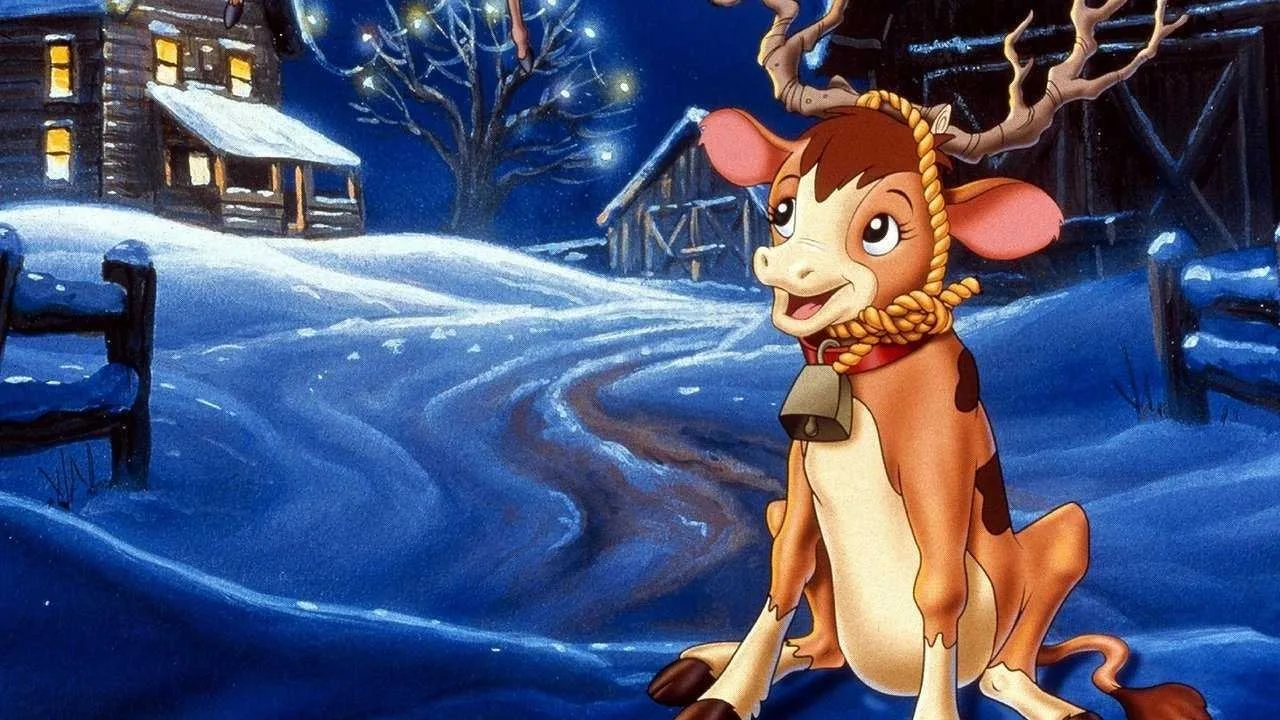
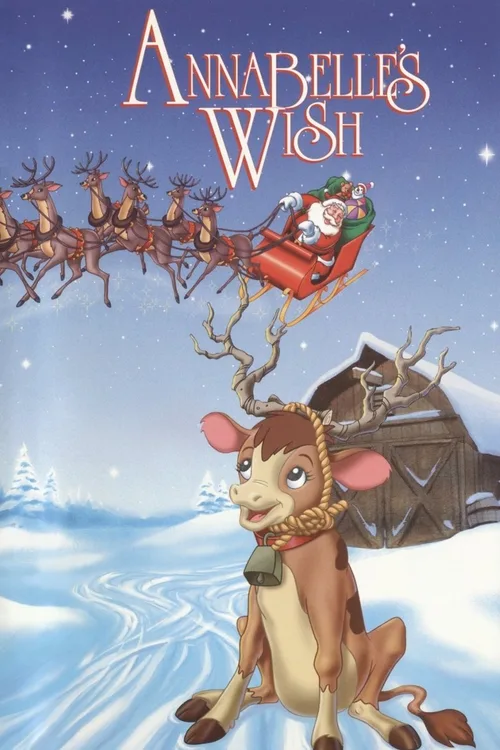
Annabelle - a calf who has a special wish for Christmas - wants to be a reindeer and help Santa Claus drive his sleigh as he delivers his presents! Annabelle's friends tell her not to get her hopes up, but to everyone's surprise, Santa does indeed meet up with Annabelle, and the calf gets to help Santa make the holiday special for one young boy.
 rating 6/10 User rating 102 votes 65%
 ❄ Christmas Connection
Annabelle's Wish is built entirely around Christmas mythology: Santa Claus grants all animals the ability to speak on Christmas Day, and the central plot turns on that gift. The story begins on Christmas Eve and returns to Christmas Day for its emotional climax. Without Christmas, there is no movie at all.
Where to Watch

Our Review
In 1997, a direct-to-video animated film arrived with a premise so earnestly strange it could only have been produced in the decade that also gave us VeggieTales and a dozen knock-off Lion Kings. A calf is born on Christmas Eve. Santa Claus grants her the power of speech. She decides she'd rather fly. She gives that speech away to a mute child. Randy Travis narrates the whole thing. That's Annabelle's Wish, and it is exactly as sincere as it sounds.
Produced by Ralph Edwards Films, the movie never got a theatrical release. It went straight to home video and straight into the Christmas morning rotation of a generation of American children, most of whom probably remember it far more vividly than they remember why it made them cry.
What the Film Gets Right About Sacrifice
The setup borrows from a simple folk premise: on Christmas Day, all animals can speak, a tradition that appears in various European and American folklore. Annabelle is born into this world, discovers she loves talking, and then meets Billy, a boy who lost his ability to speak after a traumatic accident. The bond between them is drawn simply, which suits the target audience. But the film earns its emotional payoff because it doesn't hedge on what the sacrifice actually costs.
Annabelle doesn't lend her voice. She doesn't find a workaround. She gives it up permanently, and the movie is honest about that. By the end, when Billy speaks for the first time, the weight of what Annabelle did is still in the room. For a direct-to-video children's film from a small production company, that's genuine craft.
The ending adds one more layer: Santa, recognizing the sacrifice, makes Annabelle one of his reindeer and grants her the ability to fly. It's a reward the film earns by not cheapening the sacrifice that preceded it.
The Voice Cast Is a Strange Delight
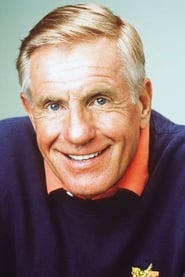
Jim Varney voices Burl, a farmhand, essentially playing a gentler cousin to his Ernest P. Worrell character. Cloris Leachman and Rue McClanahan both appear, adding a level of credibility that few direct-to-video productions from this era could claim. Leachman was a one-time Oscar winner by this point. McClanahan had spent seven seasons on The Golden Girls. Neither of them were doing this for career advancement.
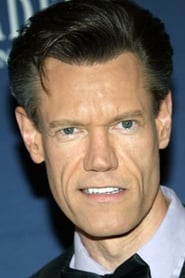
Randy Travis as narrator is the smartest casting decision in the film. His voice carries genuine warmth without sentimentality, and country music listeners who caught this on cable around the holidays recognized it immediately. His presence gave the film a kind of ambient Americana credibility.
Direct-to-Video Christmas in the 1990s
The 1990s home video market for children's Christmas content was genuinely enormous, and Annabelle's Wish fit a specific slot: longer than a holiday special, shorter than a theatrical feature, cheap enough to produce on a small budget, and sentimental enough to get parents to leave it on. The animation is limited by any standard, closer in quality to a television special than to a Disney film. Backgrounds are flat, character movement is minimal, and the color palette leans heavily on greens and reds with very little variation.
None of that mattered to the audience. The film moved well on VHS and found a second life in the early days of DVD releases, which extended its reach into the early 2000s. It became the kind of movie that exists in collective childhood memory without anyone quite being able to explain how it got there.
Is It a Christmas Movie?
This one isn't debatable. The entire premise is Christmas mythology: Santa as an active character, reindeer flight as an aspirational goal, and Christmas Day as the hinge on which the plot turns. The film has no meaning outside the Christmas context. It's one of the rare cases where you can say the holiday isn't just a setting. It's the actual subject.
It's also, notably, a film about generosity rather than about receiving gifts. Annabelle's wish isn't for something she keeps. That's a genuine distinction from most children's Christmas content, and it's part of why the film has lasted as long as it has.
The final image is Annabelle soaring over a snow-covered farm while Billy calls out her name from below. It's a small film that ends on exactly the right frame.
Fun Facts
Annabelle's Wish was produced by Ralph Edwards Films, the production company founded by Ralph Edwards, the creator and host of the long-running game show Truth or Consequences. It was an unusual detour into animated children's content for a company built around live television.
Jim Varney, who voices the farmhand Burl, was best known at the time for his Ernest P. Worrell character, which he had played in nine theatrical films between 1987 and 1998. Varney died in 2000, making Annabelle's Wish one of his final film projects.
Randy Travis had sold more than 15 million albums by the time he recorded his narration for this film, making him one of the best-selling country artists of the 1980s and early 1990s. His casting brought instant name recognition to a production that had almost no theatrical marketing.
The belief that animals are granted the power of speech at midnight on Christmas Eve is documented in folklore across multiple European countries, including Germany, Austria, and parts of Scandinavia. The film draws on this tradition directly rather than inventing its own mythology.
Rue McClanahan, who voices a character in the film, had recently completed her run on The Golden Girls when the show ended in 1992. She and Cloris Leachman, who also appears, had both won Emmy Awards before their involvement with this production.
The film was released directly to VHS in 1997 without a theatrical run, which was standard practice for animated Christmas content targeting the holiday home video market. Studios like Universal and Fox routinely produced or acquired such titles to fill retail shelves in November and December.
TMDB lists the film's runtime at approximately 47 minutes, placing it in the no-man's land between a television special and a feature film. This length was common for direct-to-video holiday titles aimed at young children in the 1990s.
Cast