
YOU'VE BEEN WANTING TO SEE HER IN A PICTURE LIKE THIS!
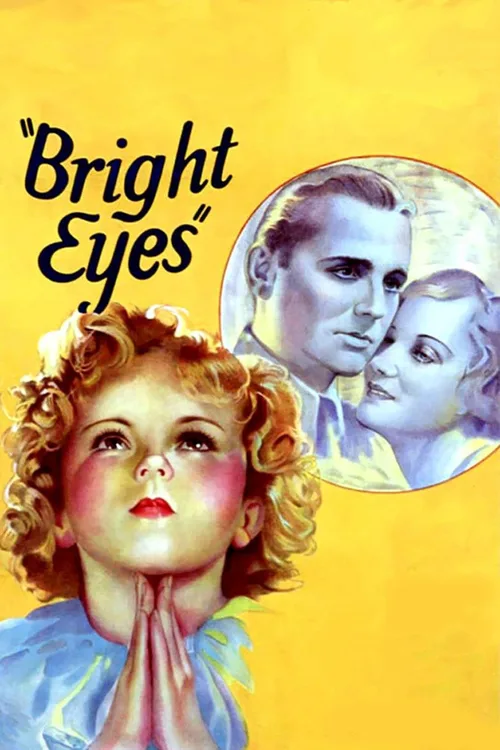
Bright Eyes (1934)
An orphaned girl is taken in by a snobbish family at the insistence of their rich, crotchety uncle, even as her devoted aviator godfather fights for custody.
 rating 7/10 User rating 28 votes 67%
 ❄ Christmas Connection
Bright Eyes is set largely during the Christmas season, with the holiday providing the emotional backdrop for its central custody dispute. The film's most famous sequence, Shirley Temple performing "On the Good Ship Lollipop" aboard a plane on Christmas Eve, ties the song directly to the holiday setting. A Christmas morning scene and the general atmosphere of festive goodwill frame the film's resolution.
Where to Watch


Our Review
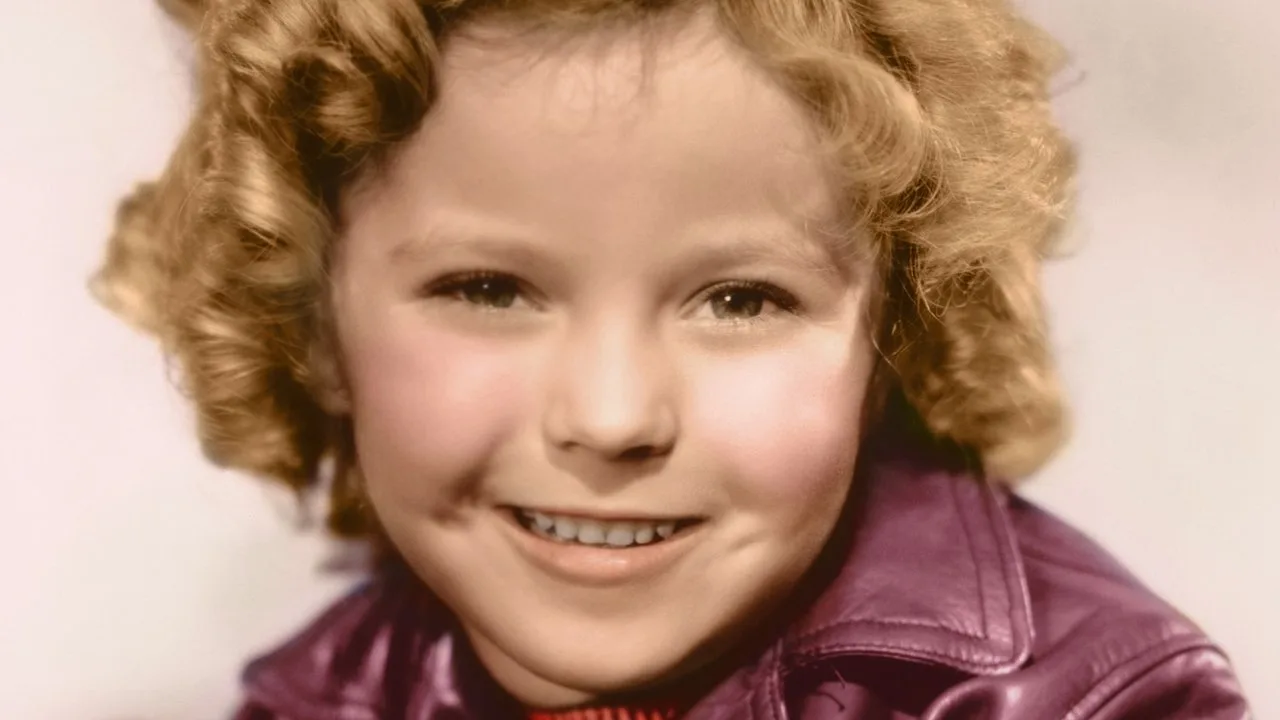
By 1934, Shirley Temple had appeared in enough two-reel shorts and supporting roles to demonstrate what she could do. Fox knew it had something. Bright Eyes was the studio's formal bet that she could carry a feature on her own, and the film was written specifically to test that theory. It passed the test comprehensively. The movie made roughly $1.5 million at the box office against a modest production budget, and it established Temple as the biggest box office draw in Hollywood, a position she held for four consecutive years.
That commercial context matters because Bright Eyes is, at its core, a star vehicle built around a six-year-old. Once you understand that's what you're watching, the film's odd tonal mixture makes more sense.
What Bright Eyes Is Actually About
Shirley plays Shirley Blake, the daughter of a pilot killed in an accident before the story begins. Her mother works as a maid for the wealthy Smythe family, a household populated by a scheming, child-hating heiress named Joy (played with impressive malice by Jane Withers) and her parents, who spend the film being manipulated by their awful daughter. When Shirley's mother also dies, the question of who should raise the child splits the adult characters into camps: James Dunn plays Loop Merritt, a pilot friend of Shirley's late father who wants to adopt her; the wealthy Smythes represent the alternative, with their money but limited warmth.
The custody angle gives the film its dramatic spine, but the real pleasure is watching Temple navigate scenes with adults who treat her as an equal. She's not played as a prop or a device. Director David Butler stages her scenes so that she drives them, reacting, interrupting, pushing conversations in directions the script needs them to go. It's a performance built on precision timing from a child who had been performing since age three.
Jane Withers as the Scene-Stealing Villain
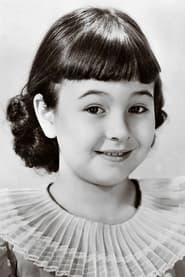
Temple gets the poster and the songs, but Jane Withers deserves more attention than she typically receives for her role as Joy Smythe. Withers plays the character as a genuine antagonist, a spoiled, manipulative child who sabotages toys and throws tantrums with real commitment. Fox was reportedly uncertain whether audiences would accept a film where a child was portrayed so unsympathetically. They were wrong to worry. Withers became a Fox contract player off the strength of this performance and appeared in roughly 30 films over the following decade.
The contrast between Temple's Shirley and Withers' Joy is the film's sharpest creative choice. One child is poor, cheerful, and generous; the other is wealthy, grasping, and miserable. The moral is not subtle. But Withers plays the villain with enough genuine energy that Joy never feels like a simple cartoon.
The Song That Outlived the Film
"On the Good Ship Lollipop" is now so associated with Shirley Temple that it functions almost as shorthand for a certain era of Hollywood. Temple performs it aboard a small plane during a Christmas Eve flight, surrounded by pilots. The song was written by Sidney Clare and Richard Whiting specifically for this film and for Temple's particular skills. It became the first song by a child performer to sell over 500,000 copies of sheet music.
The song has little to do with Christmas as a holiday. It describes a fantasy land of candy and confections. But the Christmas Eve setting of the scene, combined with Temple's delivery, gave it a warmth that audiences connected to the season. It remains the one element of Bright Eyes that most people recognize, even if they've never seen the film itself.
Is Bright Eyes a Christmas Movie?
More so than many films that get the label. The Christmas season isn't incidental decoration here. The holiday frames the film's emotional resolution, the custody question gets answered against a backdrop of Christmas morning, and the film's central theme, that a child deserves love over money, maps directly onto what the holiday is supposed to represent. Bright Eyes doesn't work as hard at its Christmas setting as later Temple films like The Little Colonel, but the holiday is genuinely woven into the story rather than dropped in for a single scene.
For viewers today, watching Bright Eyes requires adjusting to a pace and a performance style that belongs entirely to early sound Hollywood. The sentimentality is heavy. Some plot mechanics creak. But Temple herself holds up in ways that are genuinely surprising. She doesn't perform childhood; she just exists in it, which is why her work in this film reads as naturalistic even now. James Dunn, who won an Academy Award a decade later for A Tree Grows in Brooklyn, provides reliable support without overwhelming the frame.
The film clocks in at 84 minutes and wastes very little of them.
Fun Facts
Bright Eyes was the first film written specifically for Shirley Temple as the star rather than adapted from existing material or built around a pre-existing property. Fox screenwriter David Butler crafted the story with Temple's specific abilities in mind, including her dancing, her singing range, and her improvisation habits on set.
Jane Withers, who played the villainous Joy Smythe, was seven years old during filming, one year older than Temple. Withers reportedly had to be coached to act badly toward Temple on screen because she idolized her co-star and found it difficult to be unkind even for the camera.
"On the Good Ship Lollipop" was written in a single afternoon by composer Richard Whiting and lyricist Sidney Clare after they were told the film needed an original song for Temple to perform on an airplane set. The song became one of the best-selling pieces of sheet music of 1934.
Shirley Temple earned $1,000 per week during the filming of Bright Eyes. Her father negotiated her contract with Fox but later established a trust for her earnings. Temple later wrote that she discovered most of the money had been spent by the time she reached adulthood.
The film was released on December 28, 1934, positioning it deliberately as a Christmas release. Fox moved up the release date from a planned January window after strong preview screenings indicated it could capitalize on holiday audiences.
Director David Butler went on to direct five more Shirley Temple films, making him the director most closely associated with her Fox output. Butler later said Temple required almost no direction on emotional scenes because her instincts were reliable enough that intervention typically made performances worse rather than better.
Bright Eyes marked the beginning of a four-year stretch from 1934 to 1938 during which Shirley Temple was listed as the number one box office star in America, a record unmatched by any child performer before or since.
Cast