

Be careful what you wish for.
Candy Cane Lane (2023)
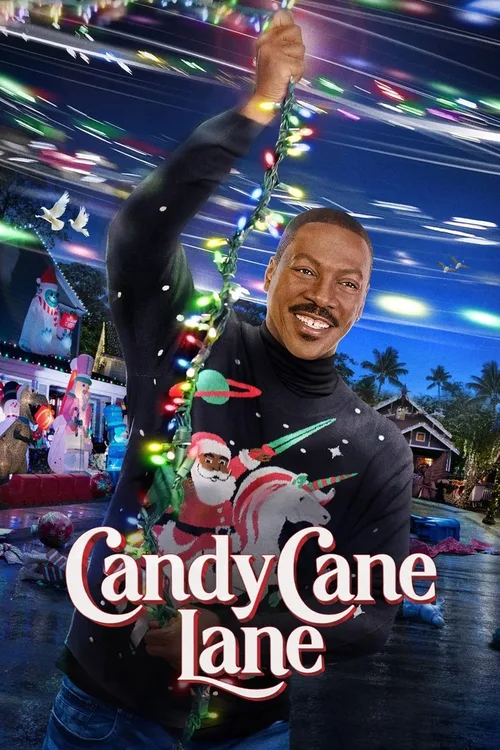
A man, determined to win the neighborhood's annual Christmas decorating contest, makes a pact with an elf to help him win. However, the elf casts a spell bringing the twelve days of Christmas to life, bringing chaos to the small, unsuspecting town.
 rating 6/10 User rating 484 votes 59%
 ❄ Christmas Connection
The entire film revolves around a neighborhood Christmas decorating contest, with the 12 Days of Christmas carol brought magically to life. Every scene drips with holiday lights, lawn displays, and seasonal chaos.
Where to Watch


Our Review
Eddie Murphy hasn't starred in a Christmas movie before Candy Cane Lane, which seems like an oversight for someone who's been one of America's biggest comedy stars for over four decades. The 2023 film, directed by Reginald Hudlin, finally corrects that. Murphy plays Chris Carver, a father so obsessed with winning his neighborhood's annual Christmas lights decorating contest that he makes a deal with a mysterious elf named Pepper. The elf delivers, but the 12 Days of Christmas come to life in ways nobody wanted.
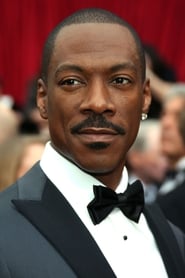
Eddie Murphy on Christmas Lights and Candy Cane Lane
The setup is simple and effective. El Segundo, California has a real street famous for its Christmas displays, and the film builds its fictional Candy Cane Lane around that tradition. Chris Carver has been the perennial runner-up in the decorating contest for years. His neighbor Bruce (played by an underused but game cast) always takes the trophy.
When Chris encounters Pepper, played by Jillian Bell with manic glee, she offers him an enchanted advent calendar. Open a door, get a spectacular new decoration. The catch? Each decoration summons a real, living version of one of the gifts from "The Twelve Days of Christmas." So Chris ends up with actual calling birds, a genuine partridge (and its pear tree), and a troupe of very confused lords-a-leaping loose in the suburbs.
The escalation is where the film works best. Murphy's slow-burn exasperation as each new day brings a more absurd creature or character to his lawn is genuinely funny. He's at his best when he's reacting, not mugging, and director Hudlin lets several scenes breathe enough for Murphy's timing to land.
The Cast Makes It Work
Tracee Ellis Ross plays Carol Carver, and the film gives her more to do than most Christmas movie spouses get. She's running her own candy business, juggling family logistics, and eventually becomes central to solving the elf problem. Ross and Murphy have an easy chemistry that makes you wish they'd been paired up years ago.
The Carver kids are standard-issue movie children with standard-issue subplots. One daughter is navigating a school crush. The other is dealing with growing up. These threads are fine. They're not the reason anyone pressed play.
Jillian Bell steals every scene she's in. Her Pepper is less a villain and more a cosmic trickster who seems to be having the time of her life ruining Chris's. Bell commits fully to the bit, and the film is noticeably less interesting whenever she's offscreen.
Where Candy Cane Lane Falls Short
The CGI is a problem. Amazon Studios reportedly spent a significant budget on the film, but the animated creatures, particularly the swans and geese, look like they wandered in from a mobile game. When the comedy depends on physical interactions between Murphy and these digital creations, the seams show.
The script by Kelly Younger also can't quite decide what kind of movie it wants to be. The first half plays as a grounded suburban comedy about competitive decorating. The second half lurches into a fantasy adventure with magic rules that keep changing. A tighter middle act would have helped.
There's also a familiar "dad learns to stop competing and start being present" arc that the film executes without much surprise. You know where it's going the moment Chris misses his daughter's school event for a decorating errand. Murphy sells the emotional beats, but the screenplay doesn't give him anything new to work with.
Is Candy Cane Lane a Christmas Movie Worth Watching?
Yes, with caveats. It's a solid family comedy that delivers about 60% of its jokes effectively and has enough Christmas atmosphere to satisfy anyone looking for holiday viewing. The Christmas lights and decorations are genuinely spectacular in several scenes, and the film captures the specific madness of neighborhoods that go all-out for December.
Murphy is reliably good, Ross deserves more leading roles, and Bell is a blast. The 12 Days of Christmas premise is clever enough to carry the film even when the execution stumbles. It's not a new classic, but it fills a specific niche: a contemporary Christmas comedy with a predominantly Black cast and a star who still knows how to command a screen.
The last image that sticks: Murphy standing on his lawn at dawn, surrounded by the wreckage of eleven pipers piping, staring at the one remaining door on the advent calendar, knowing it's only going to get worse. That's the movie at its best. One man, a bad deal, and a partridge that won't leave.
Fun Facts
Candy Cane Lane was Eddie Murphy's first Christmas movie in his 40+ year career, released on Amazon Prime Video on December 1, 2023.
The film is inspired by a real street in El Segundo, California, where residents have been putting up elaborate Christmas light displays since the 1960s. The actual street draws tens of thousands of visitors each holiday season.
Director Reginald Hudlin previously directed Eddie Murphy in Boomerang (1992), making Candy Cane Lane their reunion after more than 30 years.
Tracee Ellis Ross, who plays Carol Carver, is the daughter of Diana Ross. She improvised several of her scenes with Murphy, and Hudlin kept the improvised takes in the final cut.
Jillian Bell spent three hours daily in prosthetic elf makeup, including pointed ear tips and exaggerated eyebrows, to transform into the character Pepper.
The production built an entire fake neighborhood on a studio backlot in Los Angeles, installing over 500,000 individual Christmas lights for the decorating contest scenes.
The "Twelve Days of Christmas" carol referenced throughout the film dates back to at least 1780, when it first appeared in the English children's book "Mirth Without Mischief."
Cast