
Some people change your life forever.
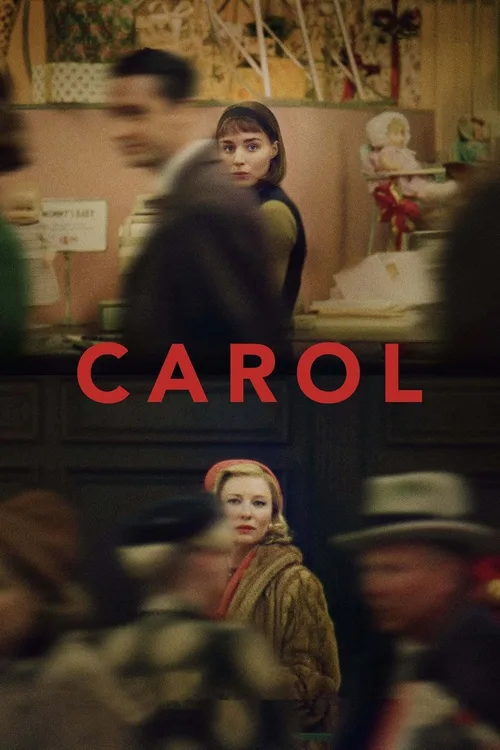
Carol (2015)
In 1950s New York, a department-store clerk who dreams of a better life falls for an older, married woman.
 rating 8/10 User rating 3,913 votes 75%
 ❄ Christmas Connection
Carol is set almost entirely during the Christmas season in 1950s New York. The holiday functions as more than backdrop: gift-giving triggers the central relationship, department store shopping scenes anchor the plot, and the festive atmosphere contrasts sharply with the characters' private struggles.
Where to Watch


Our Review
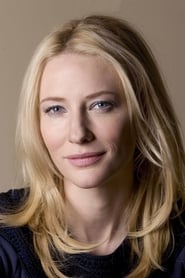
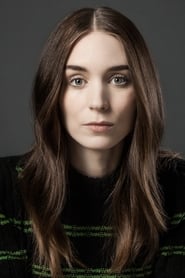
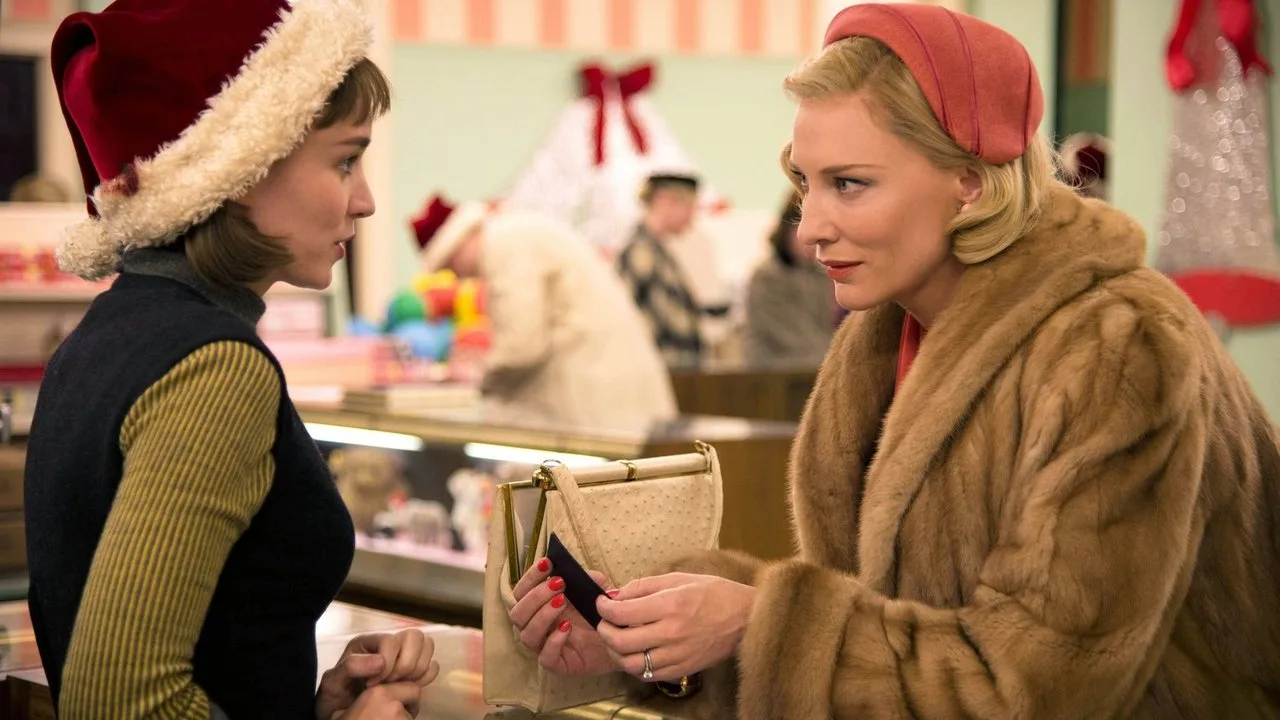
Todd Haynes' Carol opens on a shot through a street grate, looking up at 1950s Manhattan dressed for the holidays, and that framing tells you everything about the film. This is a story about people observed from odd angles, seen through barriers, watched when they think no one is looking. Based on Patricia Highsmith's 1952 novel "The Price of Salt," the 2015 film follows Therese Belivet (Rooney Mara), a young shopgirl working the toy counter at a department store, and Carol Aird (Cate Blanchett), a wealthy woman in the middle of a painful divorce who wanders in to buy a Christmas gift for her daughter.
What follows is one of the most carefully constructed love stories of the past decade.
Cate Blanchett and Rooney Mara in Carol
Blanchett plays Carol as a woman who has spent years performing a version of herself for other people. Her smile arrives a beat too late. Her charm is real but weaponized out of habit. When she spots Therese across the department store counter, something shifts. Blanchett lets you see it happen in real time, a micro-adjustment in posture that the camera barely catches.
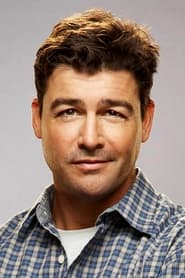
Mara's performance is the harder trick to pull off. Therese is quiet, uncertain, not yet fully formed as a person. In lesser hands, she'd be a blank slate. Mara fills her silences with specificity. Watch the way she handles her camera, the way she holds a coffee cup in Carol's presence, the way she freezes when Harge (Kyle Chandler) appears. Every gesture carries information.
The two performances operate on different frequencies that slowly converge. By the time they reach the film's emotional center, a hotel room in Waterloo, Iowa, the shift feels earned rather than inevitable.
Todd Haynes and the Art of Period Filmmaking
Haynes doesn't make nostalgia films. He makes films about people trapped inside the aesthetics of their era. His 1950s New York is beautiful but claustrophobic. Department stores gleam with postwar abundance. Suburban homes look like magazine spreads. None of it offers comfort.
Cinematographer Edward Lachman shot the entire film on Super 16mm, which gives the image a soft, grainy texture that looks like faded Kodachrome photographs. The camera frequently peers through windows, car windshields, and doorways. You're always aware of the glass between the characters and the world outside. This isn't a stylistic quirk. It's the visual grammar of the closet.
Carter Burwell's score, built around a single recurring piano theme, does what good film music should: it tells you what the characters can't say out loud.
Is Carol a Christmas Movie?
Carol is absolutely a Christmas movie, though it's not competing with Die Hard for the title. Christmas is the engine of the plot. Therese works at a department store during the holiday rush. Carol comes in to buy a train set. The gift Carol leaves behind (her gloves) becomes the object that connects them. A Christmas card with Carol's address becomes Therese's lifeline.
The holiday setting also does real thematic work. The 1950s Christmas ideal of family togetherness is exactly what's being used as a weapon against Carol. Her husband Harge (Kyle Chandler, doing a lot with very little) leverages holiday gatherings, family expectations, and the threat of a "morality clause" to maintain control. Christmas in this film isn't cozy. It's the institution that makes Carol's choices so costly.
Patricia Highsmith's Hidden Novel
Highsmith published "The Price of Salt" in 1952 under the pseudonym Claire Morgan. She had good reason. The novel was remarkable for its time because it gave its lesbian protagonists a hopeful ending rather than the punishment that publishers typically demanded. Highsmith didn't publicly acknowledge the book as hers until 1990, nearly four decades later.
Screenwriter Phyllis Nagy, who had been trying to adapt the novel since the mid-1990s, kept that sense of hope intact. The film's final shot, one of the great endings in recent cinema, mirrors the novel's closing lines almost exactly. No tragedy, no punishment, no noble sacrifice. Just two people choosing each other with open eyes.
The Cast Beyond the Leads
Kyle Chandler turns Harge from a stock villain into something more unsettling: a man who genuinely believes he's the wronged party. Sarah Paulson, as Carol's longtime friend Abby, delivers warmth and weariness in equal measure. She's the person who already went through what Carol is going through, and survived, but not without scars.
The film earned six Academy Award nominations in 2016, including Best Actress for Blanchett and Best Supporting Actress for Mara (a categorization that frustrated many, since Mara is arguably the lead). It won none, losing in every category. The snub has aged poorly.
Fun Facts
Cinematographer Edward Lachman shot Carol entirely on Super 16mm film to replicate the look of 1950s color photography, particularly the work of photographers Saul Leiter and Ruth Orkin.
Patricia Highsmith based "The Price of Salt" partly on a real encounter. While working at a Bloomingdale's toy department in 1948, she served a woman in a mink coat who left a lasting impression.
Rooney Mara won Best Actress at the 2015 Cannes Film Festival for her performance, sharing the prize with Emmanuelle Bercot for "Mon Roi."
Screenwriter Phyllis Nagy first acquired the rights to adapt the novel in 1997. The film took nearly 18 years to reach the screen, cycling through multiple directors and potential stars.
The train set Carol buys for her daughter is a period-accurate Lionel model. The prop department sourced a working 1950s set for the department store scenes.
Cate Blanchett and Rooney Mara deliberately avoided spending time together off-set during early filming so that their characters' initial awkwardness would feel genuine.
Todd Haynes asked the entire cast to watch only films and television from the 1940s and 1950s during production, banning modern media to keep them in period.
Cast