
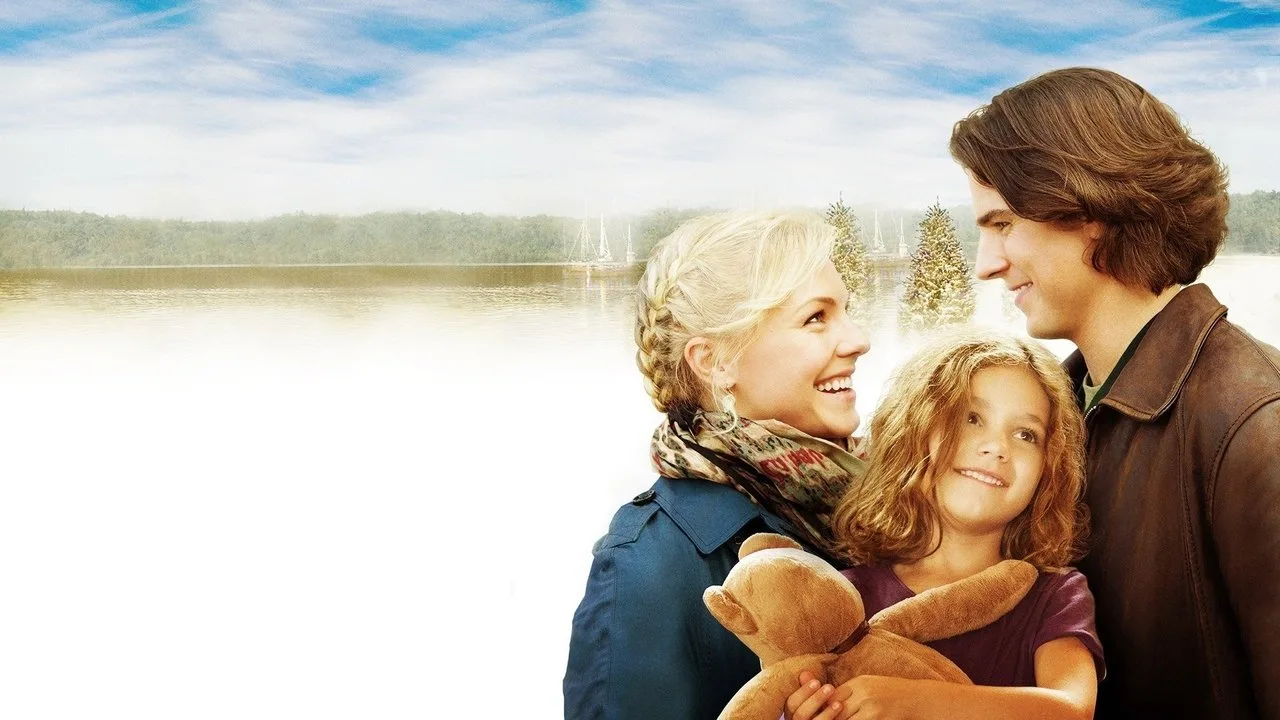
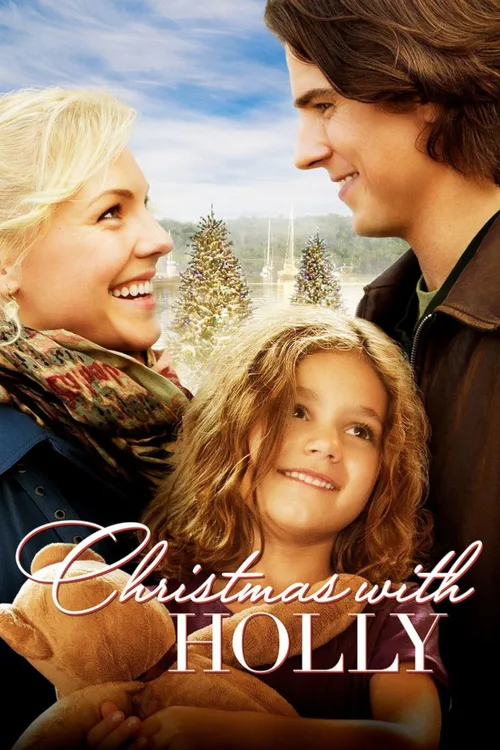
Christmas with Holly (2012)
After being dumped at the altar on her wedding day, Maggie Conway moves to the island town of Friday Harbor in Washington State, where she meets Mark Nagle, the local coffee shop owner.
 rating 6/10 User rating 100 votes 63%
 ❄ Christmas Connection
The film is set during the Christmas season in the small-town Pacific Northwest, where a toy shop, holiday decorations, and the spirit of starting over give the story its entire emotional scaffolding. Holly's grief and eventual healing are framed explicitly around the holiday, and the title character's name is not subtle. Without Christmas, there is no movie.
Where to Watch


Our Review
There is a specific kind of television movie that lives or dies by whether you trust the child actor. "Christmas with Holly," the 2012 Hallmark Hall of Fame adaptation of Lisa Kleypas's 2010 novel Christmas Eve at Friday Harbor, casts a mute, traumatized six-year-old as its emotional engine. Get that right, and the whole thing runs. The twins Lucy and Josie Gallina, splitting the role of Holly, largely get it right, and the film is better for it than it has any business being.
What "Christmas with Holly" Is Actually About
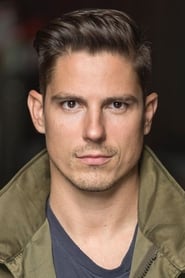
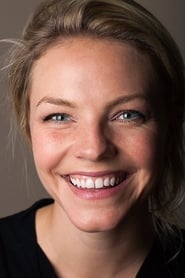
Holly stopped speaking after her mother died in a car accident. Her uncle Mark (Sean Faris) moves her from Seattle to Friday Harbor, a small ferry-connected town in Washington's San Juan Islands, to live near his brothers and their vineyard. He's grieving too, in the blunt, functional way men in these films are allowed to grieve. Into this arrives Maggie Conway (Eloise Mumford), who fled a city life and a broken engagement to open a toy shop in town.
The toy shop is the film's best idea. It gives Maggie and Holly a reason to be in the same orbit that isn't contrived, and it lets the production fill the frame with color and warmth without resorting to artificial Christmas-movie gloss. Holly gravitates to the shop, then to Maggie, and Mark follows where his niece leads.
The Variety review from 2012 called it "oddly limp," and that's fair for the adult romance, which gives Faris and Mumford attractive faces but thin ground to stand on. The screenplay by P'nenah Goldstein, working from Kleypas's novel, rushes the romantic development in a way the source material was already criticized for doing. But where the book reportedly gave Holly short shrift, the film rebalances in her favor. That choice pays off.
The Hallmark Hall of Fame Distinction
In 2012, the Hallmark Hall of Fame label still meant something specific. The franchise launched on December 24, 1951, with the first television opera ever written for the medium, Amahl and the Night Visitors, and went on to collect 81 Emmy Awards over the following decades. By the time "Christmas with Holly" aired on ABC on December 9, 2012, that prestige had thinned considerably, but it hadn't vanished entirely. The Hall of Fame designation still meant a slightly larger budget, network air rather than cable, and an expectation of restraint that kept the more egregious Hallmark tics in check.
The film drew 7.7 million viewers on its premiere night, a solid number for a Sunday drama in December. Director Allan Arkush, whose career spans "Rock 'n' Roll High School" in 1979 through dozens of prestige television episodes, keeps the pace measured without letting it go slack. He's done this kind of work before and it shows.
Nova Scotia Plays Washington State
Friday Harbor, Washington is a real place. The town of roughly 2,600 permanent residents sits on San Juan Island, accessible only by ferry from Anacortes or float plane, and it has the kind of unhurried, walkable waterfront character that makes it credible as a backdrop for people reassembling their lives. The production did not film there. Every frame was shot in Nova Scotia, Canada, primarily around Windsor and Chester Bay, with Halifax filling in for other locations.
This is normal practice, and the seams barely show. Both settings share that Pacific Northwest quality of water, grey-green hills, and small-town storefronts, and Arkush wisely keeps the geography impressionistic rather than specific. Only someone who has actually caught the ferry to Friday Harbor will notice anything is off.
Sean Faris, Eloise Mumford, and the Problem of Thin Characters
Faris built his name on physicality. His 2008 mixed-martial-arts film "Never Back Down" earned him an MTV Movie Award and made him briefly the kind of action lead studios were watching. He's soft-edged here, which suits the material, though the script gives him little to work with beyond protective uncle and reluctant romantic. He's convincing when the scene is about Holly. When it's about Mark's inner life, there isn't much inner life written on the page.
Mumford is more interesting to watch. She was born in Olympia, Washington, went to NYU's Tisch School, understudied Elizabeth Moss in a Broadway production, and landed her first major TV role during her first pilot season after graduating. By 2012 she was a year away from being cast in the "Fifty Shades of Grey" franchise as Kate Kavanagh. She brings a certain brightness to Maggie that the script doesn't fully earn but she delivers it anyway.
The adaptation changes a few things from the book: Mark runs a coffee shop here rather than a winery, Maggie arrives as a blonde rather than a curly redhead, and some plot events are resequenced. Book fans debated these adjustments online in 2012 with the particular intensity that Kleypas readers bring to adaptations of her work. Most concluded the film's treatment of Holly was an improvement, which is the important thing.
Does It Work as a Christmas Movie?
The Christmas setting is structural, not decorative. Holly's silence is a grief response, and the film's thesis is that the warmth of a Christmas community, a toy shop, a family vineyard, an uncle who shows up, can reach a child who has shut down. The holiday isn't backdrop. It's the argument.
Where the film earns its rating is in restraint. It does not manufacture a third-act conflict out of a misunderstanding or a scheming ex. It does not engineer a tearful airport scene. It stays mostly in the register of gentle drama, and when Holly finally speaks, it earns the moment because the film has been patient about it.
It is not a great film. It is a competent, occasionally touching one, carried by a performance from two child actors sharing a role and a sense of place that Nova Scotia delivers on behalf of Washington State. For a Sunday night in December with something warm in your hands, it does what it is supposed to do.
Fun Facts
The film is based on Christmas Eve at Friday Harbor, the first book in Lisa Kleypas's Friday Harbor series, published by St. Martin's Press in October 2010. Kleypas lives in Washington State, the same region where the novel is set.
Although the story is set in Friday Harbor on San Juan Island, Washington, every scene was filmed in Nova Scotia, Canada. Key locations included Windsor (the toy shop at 7 Gerrish Street) and Chester Bay, which stood in for the Pacific Northwest harbor.
The role of Holly was split between twin sisters Lucy and Josie Gallina, a common production practice for casting young child actors, which reduces the hours any single child spends on set while keeping continuity.
Hallmark Hall of Fame is the longest-running prime-time series in American television history, having first aired on NBC on December 24, 1951. By 2012, the franchise had accumulated 81 Emmy Awards over six decades.
The film drew 7.7 million total viewers and a 1.8 rating in the adults 18-49 demographic when it premiered on ABC on December 9, 2012, a strong Sunday night performance for a network TV movie in the streaming era.
Eloise Mumford, who plays Maggie Conway, was raised in Olympia, Washington, giving the film's Pacific Northwest setting a personal connection for at least one cast member. Three years after this film she appeared in "Fifty Shades of Grey" as Anastasia Steele's roommate Kate Kavanagh.
Director Allan Arkush began his career directing "Rock 'n' Roll High School" (1979) for Roger Corman's New World Pictures before transitioning to a long career in prestige television. By the time he directed "Christmas with Holly" he had directed episodes of "Heroes," "Pushing Daisies," and "Ugly Betty," among many others.
Friday Harbor, the real town the film is set in, got its name from Joseph Poalie Friday, a native Hawaiian who worked in the San Juan Islands in the mid-19th century. The town has a year-round population of about 2,600, which swells to over 15,000 visitors at peak summer season.
Cast