

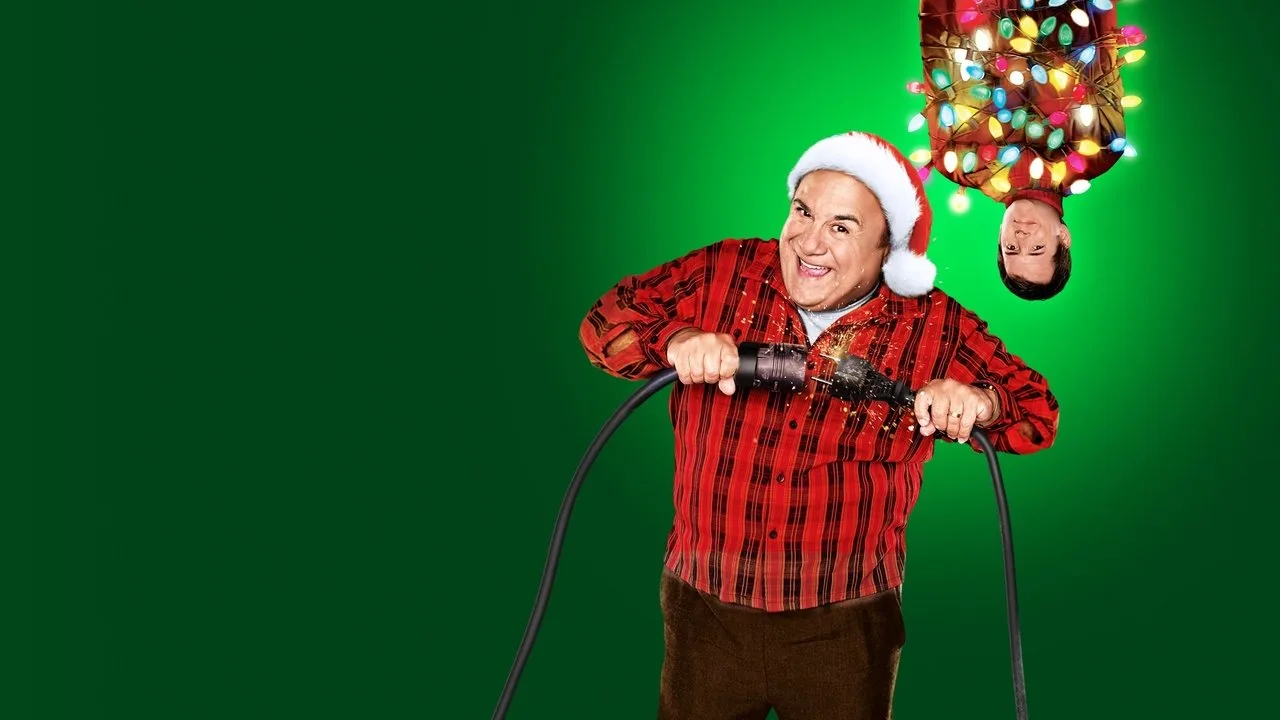
There glows the neighborhood.
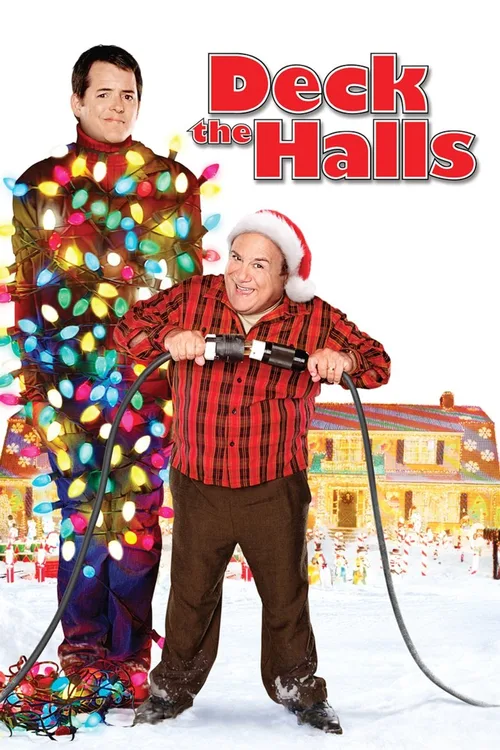
Deck the Halls (2006)
Determined to unseat Steve Finch's reign as the town's holiday season king, Buddy Hall plasters his house with so many decorative lights that it'll be visible from space! When their wives bond, and their kids follow suit, the two men only escalate their rivalry - and their decorating.
 rating 4/10 User rating 788 votes 56%
 ❄ Christmas Connection
A suburban Christmas lights war between neighbors is about as seasonally specific as it gets. The entire plot revolves around holiday decorating, caroling, and a last-minute Christmas Eve reconciliation.
Where to Watch


Our Review
Deck the Halls has one of the best premises in the history of Christmas comedies: a new neighbor decides to cover his house in so many lights that it will be visible from space, and the uptight guy next door loses his mind over it. Danny DeVito and Matthew Broderick star. John Whitesell directs. On paper, this is a slam dunk. In practice, the 2006 film fumbles nearly every opportunity its setup gives it.
The Deck the Halls Cast Deserves Better Material
DeVito plays Buddy Hall, a restless showman who moves to a small Massachusetts town and immediately starts a one-man Christmas arms race. Broderick is Steve Finch, the self-appointed "Christmas Guy" of the neighborhood, a man whose identity is so wrapped up in the holidays that a rival decorator sends him into a genuine crisis. Kristin Chenoweth and Kristin Davis play the wives, both underused in roles that mostly require them to react to their husbands' stupidity.
The casting is genuinely inspired. DeVito's manic energy against Broderick's slow-burn irritation should generate comedy on contact. There are moments, mostly in the first act, where you can see the movie this could have been. DeVito mugging at Broderick across a property line. Broderick silently cataloging every new inflatable Santa with growing horror. The dynamic works.
Then the script takes over.
A Christmas Comedy That Forgets the Comedy
The problem with Deck the Halls is not the concept. It's the execution. Writers Matt Corman, Chris Ord, and Don Rhymer built a screenplay that abandons character-driven humor in favor of slapstick set pieces that feel imported from a different, worse movie. Broderick ends up in a speeding sled. There's a scene involving camel spit. The neighbors' feud escalates not through wit but through property destruction that would realistically end in lawsuits.
The film also can't decide what kind of story it wants to tell. Is Buddy Hall a lovable rogue or a genuine menace? Is Steve Finch a sympathetic control freak or just a killjoy? The movie flips between these readings scene by scene, which makes the inevitable Christmas Eve reconciliation feel unearned. We're told these two men have learned something, but it's hard to say what.
At 93 minutes, Deck the Halls still feels padded. Several subplots go nowhere. The teenage daughters' storyline exists purely to fill time. A running gag about one of the wives being attracted to the other husband lands with a thud every single time it appears.
Christmas Lights and Wasted Potential
The Christmas decorating angle is the film's strongest asset, and it doesn't lean into it nearly enough. The idea of a house visible from space is a brilliant comedic target. Imagine the escalation: the power grid complaints, the HOA meetings, the local news coverage, the FAA getting involved. The movie touches on some of this but never commits.
What the film does get right is the visual spectacle of the lights themselves. The fully decorated Hall house, glowing like a small sun in a quiet New England neighborhood, is a genuinely fun image. It captures something real about the absurd competitive energy that holiday decorating can bring out in people. Anyone who's driven through a neighborhood where one house clearly has a generator budget has seen a version of Buddy Hall.
The movie was shot in various locations around British Columbia, standing in for a fictional Massachusetts town. The production design sells the New England Christmas well enough, with snow-dusted colonials and wreaths on every door. It looks like a Christmas movie, even when it doesn't feel like one.
Is Deck the Halls Worth Watching?
Deck the Halls pulled in about $35 million domestically on a $40 million budget. Critics were unkind. It holds a 6% on Rotten Tomatoes, which is harsh but not entirely undeserved. The film's reputation has not improved much with time, unlike some other mid-2000s holiday comedies that found second lives on cable.
Still, there's an audience for this kind of movie. If you want something playing in the background while wrapping presents, something with recognizable faces and bright colors and zero demands on your attention, Deck the Halls fills that role. DeVito is always watchable. Broderick does his best with material that keeps pulling him toward broad physical comedy he's not built for.
The movie's legacy is mostly as a cautionary tale about squandering a great premise. Two terrific comic actors, a perfect setup, a holiday season hungry for new classics. All the ingredients were there. The recipe just didn't come together. Somewhere in a parallel universe, there's a version of Deck the Halls that's as sharp and quotable as Christmas Vacation. This is not that version, but the DeVito-Broderick property line staredowns are almost worth the ticket alone.
Fun Facts
The film was shot primarily in Vancouver and Cloverdale, British Columbia, not in Massachusetts where the story is set.
Danny DeVito and Matthew Broderick had never worked together before this film, despite both being prominent in New York theater and Hollywood since the 1980s.
Kristin Chenoweth, who plays Tia Hall, won a Tony Award for You're a Good Man, Charlie Brown in 1999 and was already well known from Wicked when she took this role.
The film opened on November 22, 2006, the same weekend as Happy Feet and Casino Royale, both of which dominated the box office.
Director John Whitesell previously directed Malibu's Most Wanted and later went on to direct Big Mommas: Like Father, Like Son.
The "visible from space" concept has a real-world parallel: NASA has confirmed that large clusters of holiday lights in cities can be detected by satellites, though individual houses remain too small.
Deck the Halls was one of three Christmas comedies released in theaters during the 2006 holiday season, alongside The Santa Clause 3: The Escape Clause and Unaccompanied Minors.
Cast