
In 1978, the US government waged a war against organized crime. One man was left behind the lines.
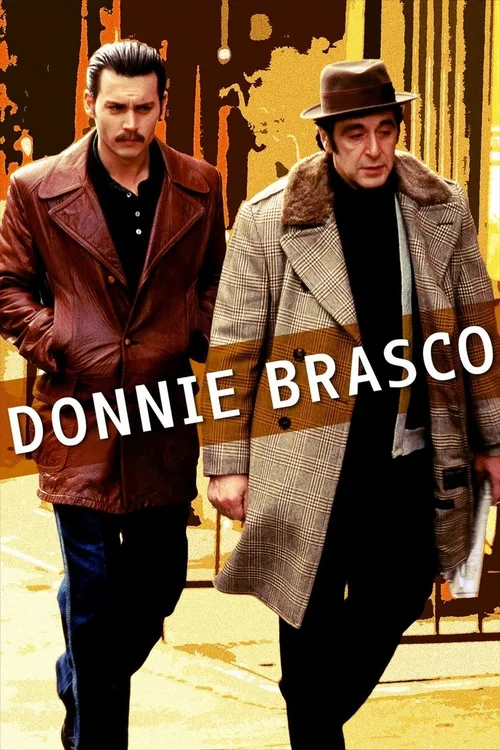
Donnie Brasco (1997)
An FBI undercover agent infiltrates the mob and identifies more with the mafia life at the expense of his regular one.
 rating 8/10 User rating 4,765 votes 75%
 ❄ Christmas Connection
Donnie Brasco uses Christmas as a pressure point rather than a backdrop. The holiday sequences force FBI agent Joe Pistone to choose between his real family and his cover, making the cost of his double life concrete and painful. Christmas here isn't decoration; it's the mechanism by which the film measures what undercover work actually costs a man.
Where to Watch


Our Review
The Christmas scenes in Donnie Brasco are not warm. There is no tree-lighting, no eggnog, no slow-motion snowfall. What director Mike Newell gives you instead is a phone call. FBI agent Joe Pistone, deep undercover inside the Bonanno crime family, calls his wife Maggie from a payphone on Christmas Eve. He can't come home. He doesn't explain why. She already knows not to ask. The film came out in 1997, and that scene remains one of the most economical depictions of what sustained deception does to a marriage.
The Real Donnie Brasco Was Worse Than the Movie
Joe Pistone spent six years inside the Bonnano family, from 1976 to 1981. The film compresses and dramatizes, but the core situation is real: an FBI agent got so deep into organized crime that the mob trusted him completely, and that trust nearly destroyed his family. Pistone missed birthdays, anniversaries, and multiple Christmases. His wife and daughters lived under assumed names during and after the operation because the mob placed a contract on his life.
The film's version of events, adapted from Pistone's 1988 memoir, is actually more restrained than the reality. The real Pistone testified that he genuinely liked many of the men he was investigating. That moral complexity is what gives the movie its weight, and it's also what makes the Christmas scenes cut the way they do.
Lefty Ruggiero and Why Pacino's Performance Works
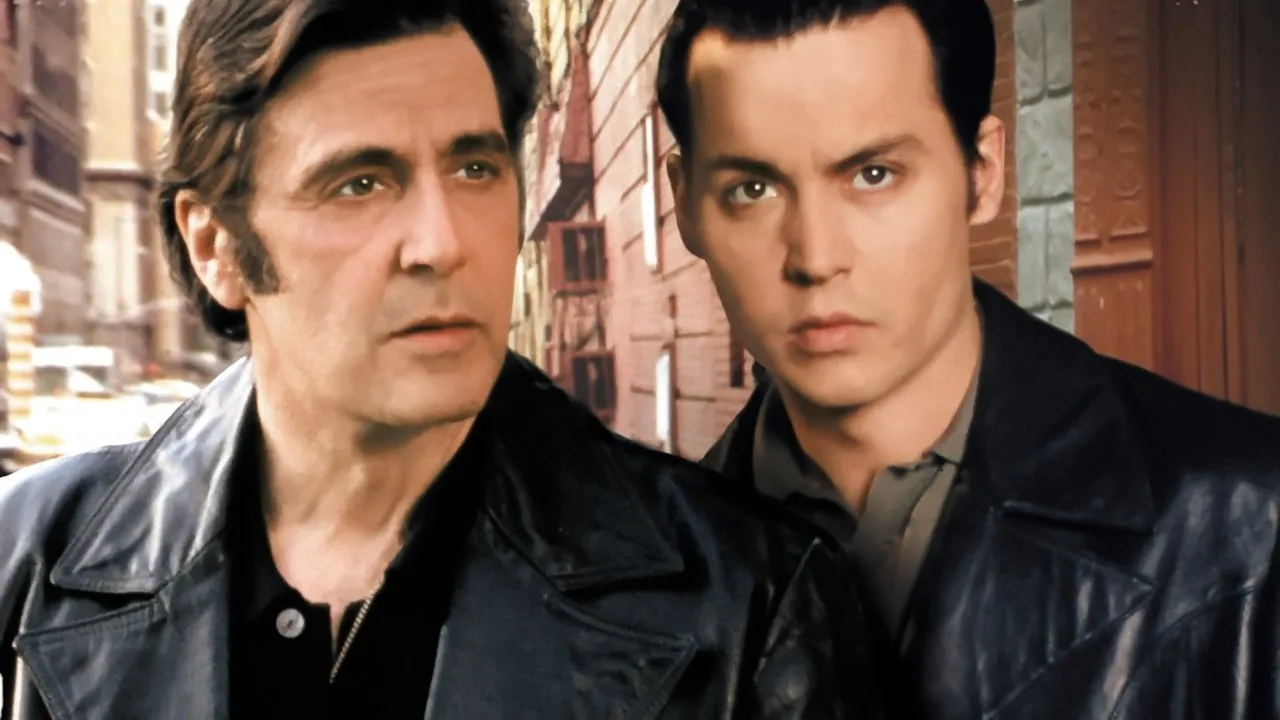
Al Pacino plays Benjamin "Lefty" Ruggiero, a small-time Bonanno soldier who has spent decades doing the family's dirty work without ever making captain. He vouches for Donnie Brasco, which in mob terms means if Donnie turns out to be wrong, Lefty dies. Pacino plays this character without vanity. Lefty is a man who has been chewed up by the system he dedicated his life to, and he knows it.
The relationship between Lefty and "Donnie" is the film's engine. Lefty mentors Donnie, protects him, and treats him with something close to paternal affection. He shows Donnie what it means to be "a friend of ours," which is the mob's phrase for an associate. The irony Pacino carries in every scene is that Lefty is right about Donnie in every way that matters except the one that will get him killed.
Pacino was 57 when the film was released. He had just come off Heat and Carlito's Way in the years prior. Critics at the time noted this as one of his more restrained performances, and they were correct. There are no "Hoo-ah" moments. Lefty is quiet, specific, and genuinely sad.
Christmas as a Measurement Device
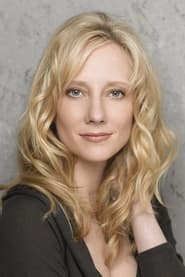
Mike Newell uses the holidays deliberately. Pistone misses Christmas with his family not once but repeatedly throughout the film's timeline. Each time it happens, the gap between his two lives gets wider. Anne Heche plays Maggie Pistone, and the film gives her enough screen time to make clear what's being lost. She's not a prop. She's a woman watching her husband disappear into someone else's life while she raises three daughters alone.
The power of these scenes is that neither Pistone nor Maggie gets to be fully right. He can't explain himself. She can't fully trust him. The FBI keeps extending the operation because it's producing results. Meanwhile, the Bonanno family throws Christmas parties and dinners where Donnie is expected to show up, laugh, and be present in ways he refuses to be for his actual family.
There's a particular brutality in the fact that the mob provides Pistone with more Christmas warmth than his undercover budget allows him to give his wife and daughters. The criminals treat him like family. His family has to pretend they don't have a husband and father.
What the Film Gets Right About Undercover Work
The FBI formally closed Operation Deepscover in 1981 after Pistone's cover was at risk of exposure. His work led to over 200 indictments and more than 100 convictions across multiple families. Lefty Ruggiero was convicted in 1992 and died in federal prison in 1994, three years before the film was released.
Newell doesn't editorialize about whether the operation was worth it. He presents the arithmetic and lets the audience do the math. The FBI got what it wanted. The mob got what it deserved. Pistone got a ruined marriage, a memoir, and a consulting credit on a movie. Lefty got prison.
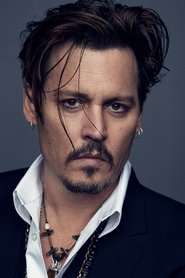
Johnny Depp reportedly spent time with the real Pistone during production and later said the experience informed his understanding of how a person can genuinely lose track of which life is real. That dual consciousness is what the film captures best. By the end, you're not entirely sure Donnie Brasco is the alias.
Fun Facts
The real Joe Pistone received only $500 in bonus pay from the FBI for his six years undercover. He later sued the Bureau for a larger share of the proceeds from his memoir and won an undisclosed settlement.
The Bonanno crime family placed a $500,000 contract on Pistone's life after his identity was revealed. He has lived under some degree of security protection ever since.
Al Pacino and Johnny Depp shot their scenes in rough chronological order to let their on-screen relationship develop naturally. Director Mike Newell said this was a deliberate production choice.
Benjamin "Lefty" Ruggiero, the man Pacino plays, went to his arrest in 1981 fully expecting to be killed by the mob for vouching for an FBI agent. He reportedly said goodbye to his family as if he would not see them again.
Pistone's book, Donnie Brasco: My Undercover Life in the Mafia, was published in 1988 and became an immediate bestseller. It remains one of the most detailed firsthand accounts of mob life ever published.
Mike Newell, a British director best known at the time for Four Weddings and a Funeral (1994), was considered an unusual choice to direct a mob film. Producer Barry Levinson wanted someone who would approach the material without the romanticism that American directors often bring to organized crime stories.
The film was shot primarily in New York City and Montreal, with Montreal standing in for several Manhattan locations due to production costs and city permit logistics.
Johnny Depp was 33 during principal photography. He studied Pistone's mannerisms and speech patterns closely enough that the real Pistone later said Depp captured specific habits he had not mentioned to anyone on the production team.
Cast