
The gift of terror just won't wait!
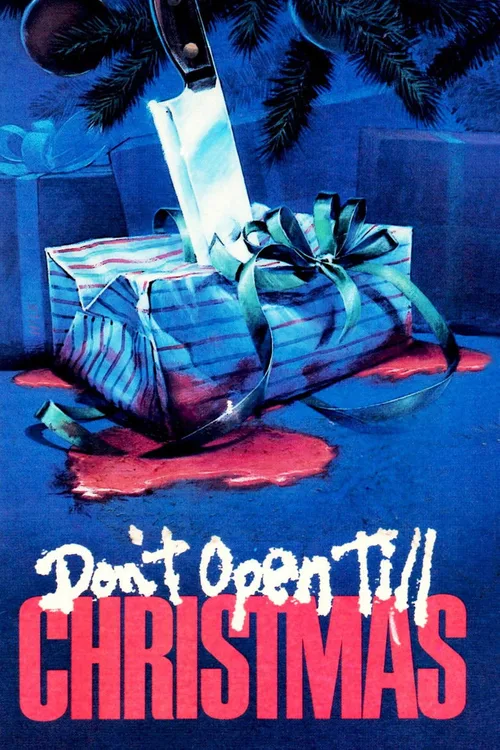
Don't Open Till Christmas (1984)
It's just days before Christmas in London, but not everyone is full of good cheer - as a maniac with a pathological hatred of Santa Claus stalks the streets, butchering any man that’s unlucky enough to be wandering around dressed as Old Saint Nick.
 rating 4/10 User rating 69 votes 49%
 ❄ Christmas Connection
The entire premise of Don't Open till Christmas is a serial killer targeting people dressed as Santa Claus across London in the weeks before Christmas. Every kill is Christmas-coded, the holiday setting is inescapable, and the film was explicitly made to cash in on the Christmas horror wave of the early 1980s. There is no version of this movie without Christmas.
Where to Watch


Our Review
In December 1984, British audiences were invited to consider a seasonal nightmare: what if someone was murdering every Santa Claus in London? Don't Open till Christmas takes this premise and runs with it in the most chaotic, low-budget, stubbornly committed fashion imaginable. It is not a good film in any conventional sense. It is, however, a remarkably honest one. It knows exactly what it is and never pretends otherwise.
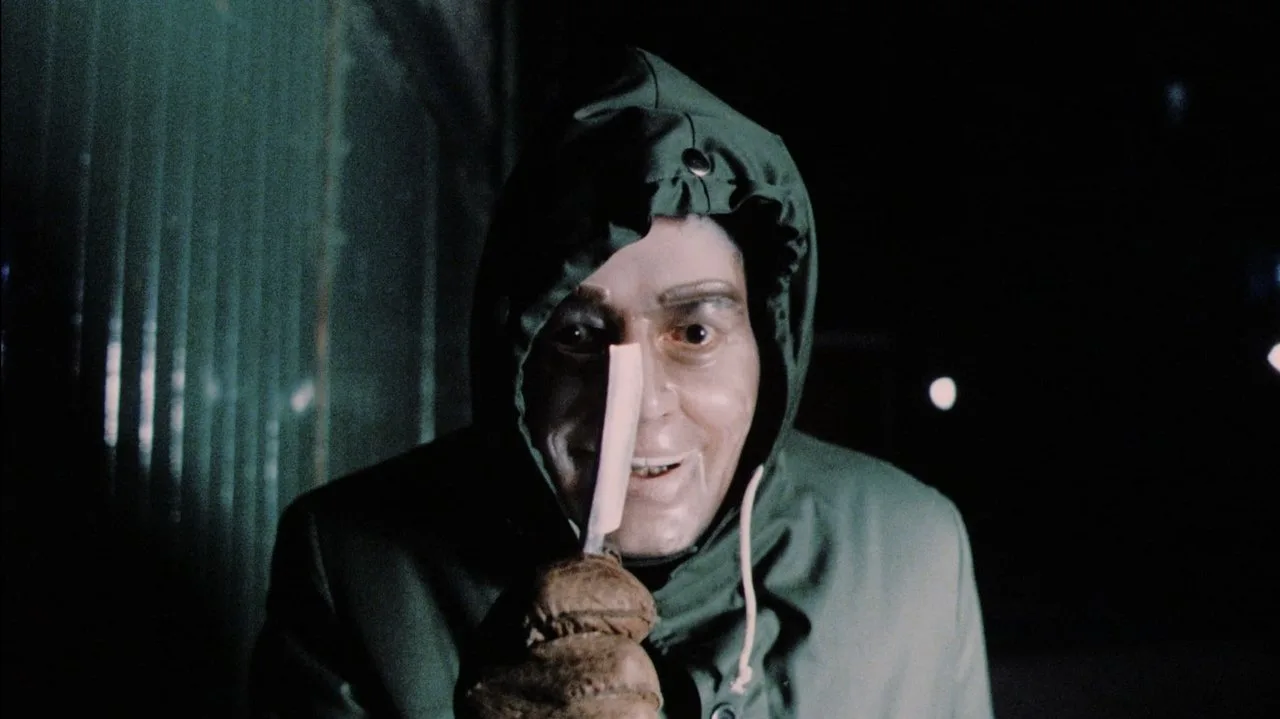
The plot is straightforward enough. A masked killer is targeting men in Father Christmas costumes throughout pre-Christmas London. A detective is on the case. A young woman is looking for her missing father. Red herrings pile up. Bodies mount. The killer's identity, when revealed, is delivered with the grave sincerity of a film that had long since stopped worrying about plausibility.
The Production Was Its Own Horror Story
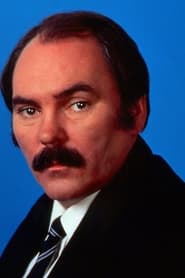
The real story of Don't Open till Christmas is not in the film itself but in the wreckage of its making. Edmund Purdom, who directed the film and cast himself as the investigating police inspector, was fired during production after the project fell apart creatively. A second director, Ray Selfe, was brought in to finish shooting. Purdom later returned to complete the project. The film that reached cinema screens in 1984 represents the product of multiple competing visions, patched together in the editing room.
This should be a disaster. In some ways it is. Scenes don't quite connect. Motivations shift. The film's pacing lurches in directions that suggest different hands were steering at different moments. But this fractured quality also gives Don't Open till Christmas something most low-budget British horror films of the period never managed: it keeps you genuinely uncertain what will happen next, because the film itself seems uncertain.
Purdom was a credible actor with genuine Hollywood credits behind him. He appeared in MGM's 1954 spectacle The Student Prince and had done serious stage and film work across two decades. By 1984 he was directing and starring in a Christmas slasher shot on a shoestring in London. The distance between those two points is, on its own, a kind of story.
The Kills Are the Point
British horror censorship in the early 1980s was severe. The Video Nasties panic was at its height, with the Director of Public Prosecutions actively prosecuting distributors of horror films. Don't Open till Christmas navigated this environment with some scenes cut and others left intact in a way that feels less like editorial judgment and more like survival.
What remains is a collection of murder set pieces that range from genuinely unsettling to unintentionally comic. Santas are killed in pubs, at street corners, at funfairs, in public toilets. The film's willingness to treat the Father Christmas costume as a target rather than a symbol of safety is its one consistent creative choice, and it commits to that choice with admirable persistence.
The London locations give the film texture that money couldn't have bought. The streets, markets, and tube stations of early 1980s London are preserved here with the accidental documentary quality that low-budget location shooting sometimes produces. The city looks cold and real and slightly grim, which suits the material perfectly.
Why People Still Watch It
The cult status of Don't Open till Christmas rests on a specific kind of appreciation. Genre fans who track down every Christmas horror entry from the 1980s find a film that earns its place on the shelf through sheer conviction. It is not trying to be Silent Night, Deadly Night, which came out the same year in the US and generated its own controversy. It is trying to be itself, whatever that turned out to be.
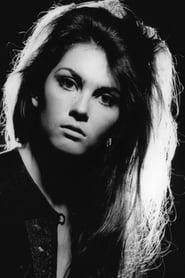
Caroline Munro has a cameo performing in a nightclub, which is either a smart piece of casting or the production stumbling into something it didn't know it had. Munro was a recognizable face from Hammer Horror and Bond films. Her presence, however brief, gives Don't Open till Christmas a moment of genuine genre credibility.
The film was released by 21st Century Film Corporation, which had a brief and memorable run distributing low-budget horror in the mid-1980s before disappearing. Copies circulated on video in degraded condition for years. The version most people saw bore the marks of duplication and censorship and general mishandling. Seeing it in a restored print, as modern home video releases have provided, reveals a film that is marginally more coherent than its reputation suggested. Only marginally.
The final revelation of the killer's identity and motive attempts psychological depth in the last few minutes. It doesn't quite land. But the attempt itself, at that late stage, in that kind of film, says something about the people who made it. They were trying. The production fell apart around them and they kept trying anyway.
Fun Facts
Edmund Purdom had appeared in the 1954 MGM film The Student Prince, dubbing the singing voice for a non-singing lead actor. By 1984, he was directing himself as a police inspector in a London Santa Claus slasher film.
The film had at least two directors during its troubled production: Purdom was replaced mid-shoot by Ray Selfe, then returned to complete the project. Neither director's name appears with much clarity in publicity materials from the time.
Caroline Munro, who had appeared in The Spy Who Loved Me (1977) opposite Roger Moore and in several Hammer Horror productions, appears in the film in a nightclub performance sequence. She is on screen for only a few minutes.
The film was released in 1984, the same year as Silent Night, Deadly Night in the United States. Both films feature killers targeting Santa-costumed figures during the Christmas season, but they were produced independently with no connection to each other.
Britain's "Video Nasties" panic was at its peak during the film's production. The Director of Public Prosecutions had a list of prosecutable films, and distributors of horror titles faced real legal risk. Don't Open till Christmas was produced and released in this environment.
The film's London locations, shot on low budgets in real streets and public spaces, now function as an unintentional record of what central London looked and felt like in the early 1980s, including period-accurate tube stations, market scenes, and street corners that have since changed significantly.
The VHS releases of the film circulated in heavily degraded condition for many years, and a large portion of the film's cult audience first encountered it as a third- or fourth-generation tape copy. Restored versions available in later decades revealed notably more detail in the cinematography.
Cast