
Father Christmas (1991)
Classic animation based on Raymond Briggs' book. What does Father Christmas do with himself for the other 364 days of the year ?
 rating 8/10 User rating 36 votes 64%
 ❄ Christmas Connection
Father Christmas is the story of Santa Claus preparing for and completing his annual Christmas Eve delivery run, making it impossible to place in any other season. The entire plot is structured around December 25th and the labour that precedes it. It's as fundamentally Christmas as Christmas gets.
Our Review
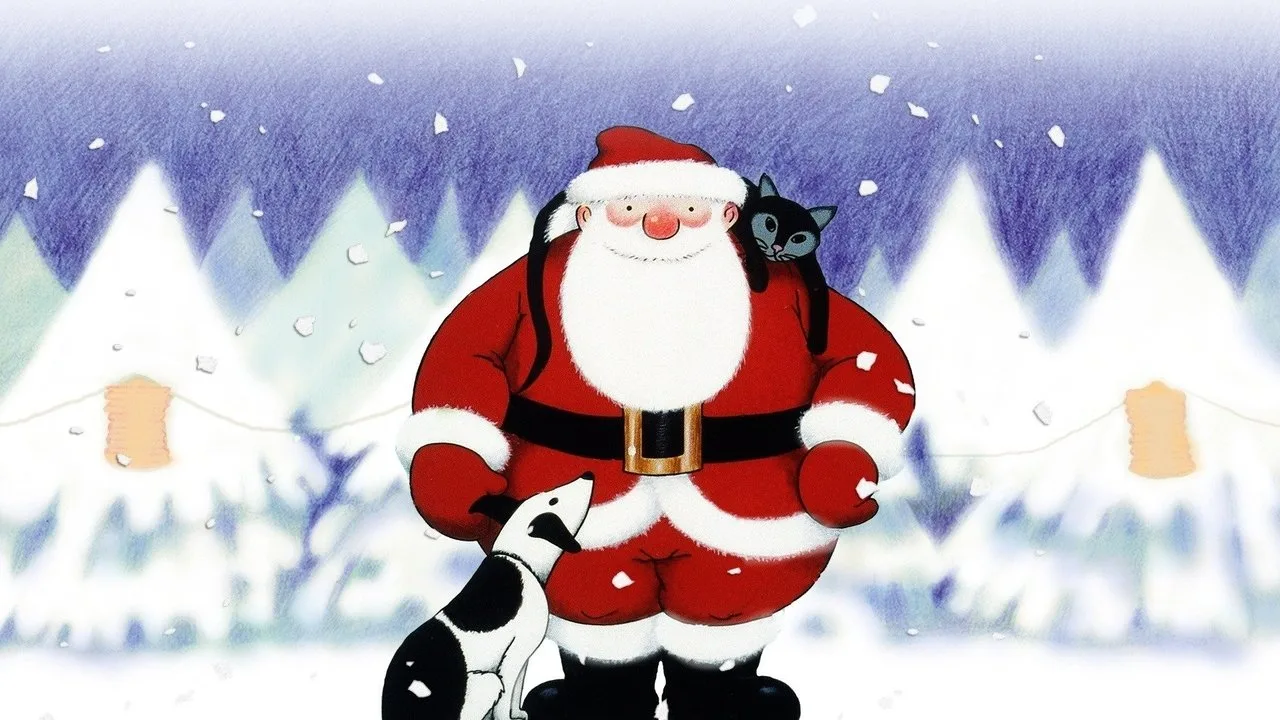
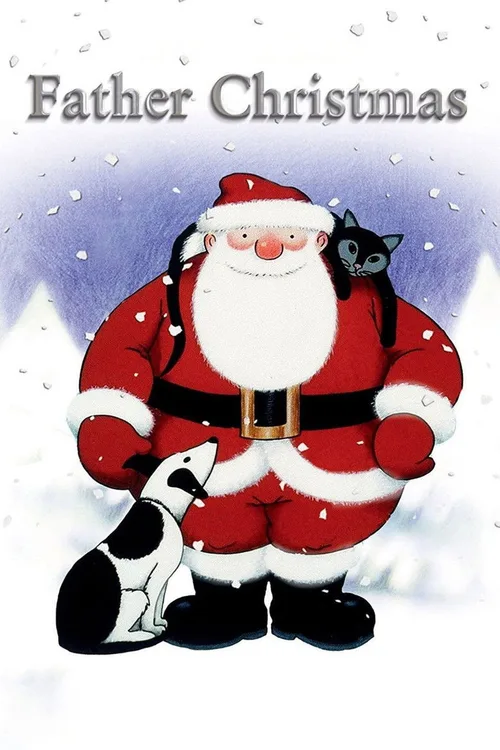
Raymond Briggs drew Father Christmas in 1973 as a deliberate rebuke to the sanitised, jolly Santa Claus of commercial mythology. His Father Christmas is a stocky, red-faced working man who wakes up grumbling on Christmas Eve, feeds his animals in the freezing dark, and gets his deliveries done not out of magic goodwill but out of grim professional obligation. The 1991 animated special produced by TVC London brings that character to life with remarkable fidelity, and Mel Smith voices him in a performance so perfectly pitched that it's difficult to imagine anyone else doing it.
What Father Christmas Actually Is
This is a short film, running just under 25 minutes, and it adapts two Briggs books: the original 1973 "Father Christmas" and the 1975 sequel "Father Christmas Goes on Holiday." The first half covers Christmas Eve, the second covers his post-Christmas holiday, where he visits France, Scotland, and Las Vegas, hating all of them in his particular way. The structure is loose and episodic, which is accurate to the picture books. It doesn't build to anything. That's not a flaw.
The BBC broadcast it on Christmas Eve 1991, and it won the BAFTA for Best Animated Short Film the following year. TVC London was the studio behind "The Snowman" (1982), and the visual approach here is similar: hand-drawn animation, gentle watercolour backgrounds, a pace that allows you to look at things. The two films make an interesting pair. Where "The Snowman" is all hush and wonder, "Father Christmas" is boots-on-the-ground practicality.
Mel Smith's Performance
Mel Smith does not play Father Christmas as broadly comic. The grumpiness is real but it's never mean-spirited. The character complains the way a postman might complain about a particularly brutal December route, with full awareness that the job will get done regardless. Smith finds a weariness in the role that keeps it from being a one-note joke. There are moments, brief ones, where Father Christmas seems genuinely content, and Smith earns those moments because he hasn't been mugging through the rest of it.
The script keeps the word "blooming" as Briggs' characteristic mild profanity throughout. Father Christmas says "blooming" in the books repeatedly, and the film preserves this entirely. It's a small thing that matters enormously to the character. A Santa who says "blooming cold" is a different Santa from one who doesn't.
The Briggs Vision of Santa
Briggs published "Father Christmas" during a period when he was actively interested in the gap between mythologised figures and what they might actually be like as people. His subsequent work, "The Snowman" (1978) and "When the Wind Blows" (1982), shows similar preoccupations: the ordinary texture of life, the weight of routine, the way humans persist through circumstance. Father Christmas fits this pattern. He is not a deity or a symbol. He is a tradesman with a difficult job.
The animals are central to this. Father Christmas keeps a cat, a dog, and two reindeer. He feeds them, talks to them, worries about them. These details appear in the books and the film preserves them. They locate Father Christmas in a domestic reality that makes the flying sleigh feel less like magic and more like a specialised vehicle operated by someone who knows what he's doing.
The holiday section is where the special earns its second Briggs source. Father Christmas in France complains about the food being foreign. In Scotland he drinks whisky and gets briefly cheerful before getting rained on. In Las Vegas he wins at the slots and is unimpressed. None of these places suit him and he returns home satisfied that nowhere is as good as his own house. It is the most British conclusion imaginable.
How It Holds Up
The animation is hand-drawn and shows its age in the best way, which is that it looks like something made by people who were drawing, not compositing. The colour palette is muted and wintry for the Christmas Eve sequences and garish for Las Vegas, which is exactly the right contrast. Nothing in this film has been cleaned up or digitally restored to within an inch of its life. It still looks like a television special from 1991.
It runs 25 minutes and doesn't waste any of them. There is no subplot, no love interest, no villain, no crisis. A man does his job, goes on holiday, and comes home. This is genuinely unusual in a children's Christmas special. Most of them can't resist a lesson or a danger. Briggs and the film trust that the character is interesting enough to watch without manufacturing stakes around him. They're right.
The best moment in the film is very early: Father Christmas sitting at his kitchen table eating a full English breakfast at some brutal pre-dawn hour, steam rising from the mug, the reindeer visible through the window. It's a completely mundane image that nobody had put in a Santa Claus story before Briggs drew it in 1973. The film reproduces it faithfully, and it still feels like a small corrective act against thirty years of department store mythology.
Fun Facts
Raymond Briggs' original "Father Christmas" (1973) won the Kate Greenaway Medal, the UK's most prestigious award for children's book illustration. It was his second time winning the medal, after "The Mother Goose Treasury" in 1966.
TVC London (Television Cartoons Ltd) produced both "The Snowman" (1982) and "Father Christmas" (1991). The studio was founded in 1957 and has produced animation for the BBC and Channel 4 across several decades.
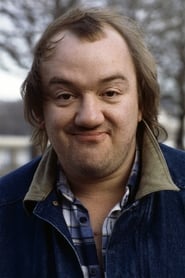
Mel Smith, who voiced Father Christmas, was best known as a comedian and film director. He co-wrote and starred in "Not the Nine O'Clock News" (1979-1982) and directed "The Tall Guy" (1989). He died in 2013.
The special won the BAFTA for Best Animated Short Film at the 1993 awards ceremony, beating out several other short productions that year. It was broadcast on BBC One on Christmas Eve 1991.
Briggs drew Father Christmas as a working-class man partly as a response to the American commercialisation of Santa Claus, which he felt had made the figure implausibly jolly and detached from physical reality. The 1973 book includes Father Christmas using an outdoor toilet in the snow.
A sequel special, "Father Christmas Goes on Holiday," was adapted alongside the first book in the same 25-minute film rather than as a separate production. The two Briggs books cover roughly equal time in the special.
The voice casting of Mel Smith gave the character a specific regional flavour. Smith's accent, while not strongly marked, placed Father Christmas in a recognisably working-class British register that reinforced Briggs' original conception of him as a tradesman rather than a mythological figure.
Cast