
Cute. Clever. Mischievous. Intelligent. Dangerous.
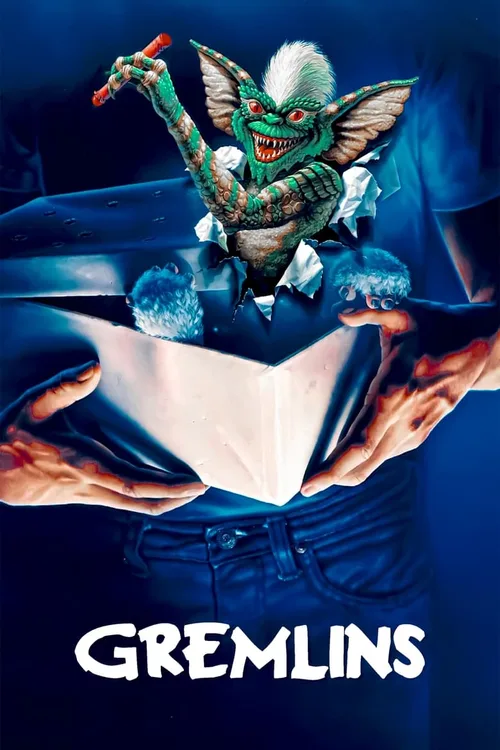
Gremlins (1984)
After receiving an exotic small animal as a Christmas gift, a young man inadvertently breaks three important rules concerning his new pet, which unleashes a horde of malevolently mischievous creatures on a small town.
 rating 8/10 User rating 6,865 votes 71%
 ❄ Christmas Connection
Gremlins is set entirely during the Christmas season in the fictional town of Kingston Falls. The plot is driven by a Christmas gift gone wrong, and nearly every scene features holiday decorations, carolers, or snow. Christmas isn't just backdrop here; it's the engine of the story.
Where to Watch


Our Review
In 1984, a movie about a cute, furry creature and its monstrous offspring nearly destroyed the concept of the PG rating. Gremlins, directed by Joe Dante and produced by Steven Spielberg, opened on June 8 and promptly traumatized an entire generation of children who thought they were going to see a family film about a pet. It earned over $153 million at the box office. And yes, it is absolutely a Christmas movie.
Is Gremlins a Christmas Movie?
This question comes up every December alongside its perennial companion, "Is Die Hard a Christmas movie?" The answer for Gremlins is actually less debatable. The entire plot is set in motion by a Christmas gift: inventor Randall Peltzer buys a strange creature called a Mogwai from a Chinatown shop as a present for his son Billy. Christmas isn't incidental to the story. It's the reason everything happens.
Kingston Falls is blanketed in snow and draped in lights throughout the film. Carolers sing on street corners. A department store Santa stumbles through the chaos. The gremlins themselves cause havoc at a Christmas party and wreck a bar decked out in tinsel. Dante shot every frame as a Christmas movie, and the script by Chris Columbus treats the holiday setting as essential, not decorative.
Then there's the speech. You know the one.
Phoebe Cates and the Darkest Christmas Monologue in Film History
Phoebe Cates plays Kate Beringer, Billy's coworker and love interest at the local bank. Midway through the gremlin attack, she delivers a monologue about why she doesn't celebrate Christmas. Her father, she explains, tried to surprise the family by climbing down the chimney dressed as Santa Claus. He slipped, broke his neck, and died. The family didn't find him until days later, when they noticed the smell.
It's played completely straight in a movie where green monsters are doing the can-can at a bar.
Joe Dante has said this speech was almost cut. The studio thought it was too dark. But Spielberg, as executive producer, fought to keep it in. The tonal whiplash is the point. Gremlins isn't interested in being one thing. It's a Christmas movie, a horror movie, a comedy, and a satire of small-town American life, all at the same time.
The Gremlins Cast and the Making of a Classic
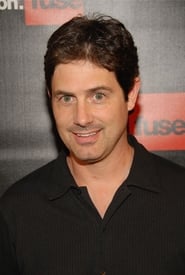
Zach Galligan stars as Billy Peltzer, a young bank teller and aspiring cartoonist. He was 19 when he got the part and had almost no film experience. Galligan has said in interviews that he auditioned for the role by reading scenes opposite a tennis ball on a stick, since Gizmo didn't exist yet as a puppet.
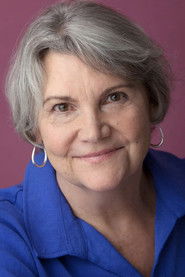
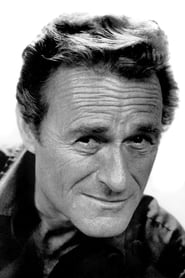
Hoyt Axton plays his father Randall, a hapless inventor whose gadgets never work. Polly Holliday plays the villain you love to hate, Mrs. Deagle, a cruel landlady who threatens to kill Billy's dog. Dick Miller shows up as Murray Futterman, the conspiracy-minded neighbor, in what became one of his most beloved roles across a career of over 100 films.
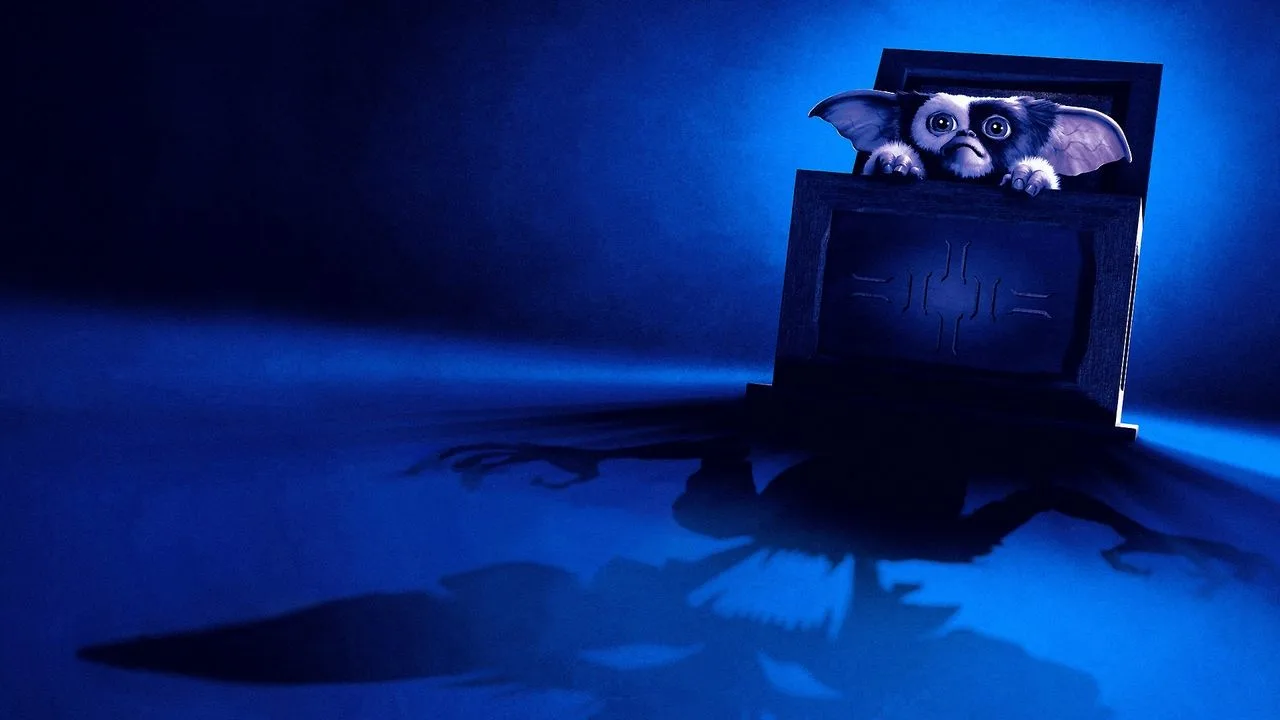
The real star, of course, is Gizmo. Chris Walas and his team built the Mogwai puppet with intricate mechanical controls. Operating Gizmo required multiple puppeteers working simultaneously. Howie Mandel provided the voice, combining baby-talk sounds with occasional English words. The design was so appealing that Spielberg reportedly told Dante during production: "Don't kill Gizmo." The original script had Gizmo transforming into Stripe, the lead gremlin. Spielberg overruled this, sensing the character's merchandising potential and emotional value.
Why Gremlins Still Works
The movie operates on a simple structural principle: the first half is Capra, the second half is chaos. Kingston Falls is introduced as a Norman Rockwell painting of small-town America, complete with a town square, a friendly cop, and Christmas decorations on every lamppost. Joe Dante builds this warmth deliberately so that tearing it apart feels more shocking.
The gremlins themselves are creatures of pure id. They drink, smoke, gamble, and watch Snow White and the Seven Dwarfs in a movie theater while heckling the screen. They're destructive not because they're evil in some grand sense but because they have no impulse control. Dante has cited the Warner Bros. Looney Tunes as a key influence, and the gremlins do behave like cartoon characters who wandered into a live-action horror film.
The rules add to the fun. Don't feed them after midnight. Don't get them wet. Don't expose them to bright light. These arbitrary restrictions give the film a fairy-tale logic that kids understand instinctively. You know someone is going to break every rule. The pleasure is in watching it happen.
The Movie That Changed Film Ratings
Gremlins and Indiana Jones and the Temple of Doom both released in 1984, both produced by Spielberg, and both generated significant parental complaints. The violence in Gremlins, including a mother dispatching gremlins with a kitchen blender and a microwave, was considered too intense for PG but not quite enough for R. The MPAA created the PG-13 rating on July 1, 1984, largely in response to both films. Red Dawn became the first movie released with the new rating, but Gremlins was one of the primary reasons it exists.
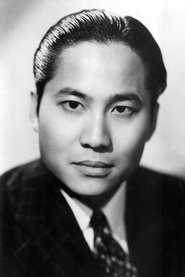
Forty years later, Gremlins endures as one of the most original Christmas films ever made. Not because it's heartwarming. Because it takes a Christmas present, adds water, and lets everything go horribly wrong. The last shot of the film is the old Chinese shopkeeper retrieving Gizmo and warning: "You do with Mogwai what your society has done with all of nature's gifts. You are not ready."
Fun Facts
Steven Spielberg overruled the original script, which had Gizmo transforming into Stripe the lead gremlin. Spielberg insisted Gizmo remain cute and separate throughout the film.
The movie was shot primarily at Universal Studios' backlot on the same town square set used in Back to the Future, which filmed there the following year.
Howie Mandel provided Gizmo's voice by improvising baby-like sounds and gibberish into a microphone. He was not credited in some early prints of the film.
Each Gizmo puppet cost roughly $40,000 to build in 1984, and multiple versions were needed for different types of movements and close-ups.
Gremlins and Indiana Jones and the Temple of Doom together prompted the creation of the PG-13 rating by the MPAA in July 1984.
Chris Columbus wrote the Gremlins screenplay while still a student at NYU. Steven Spielberg read the script and hired Columbus, who went on to write The Goonies and later direct Home Alone and Harry Potter.
Polly Holliday, who played the villainous Mrs. Deagle, was best known at the time for playing the cheerful waitress Flo on the sitcom Alice, making the casting a deliberate contrast.
Jerry Goldsmith composed the score, including Gizmo's theme, which he based on a simple lullaby structure to contrast with the horror elements of the gremlin scenes.
Cast