

You better watch out!
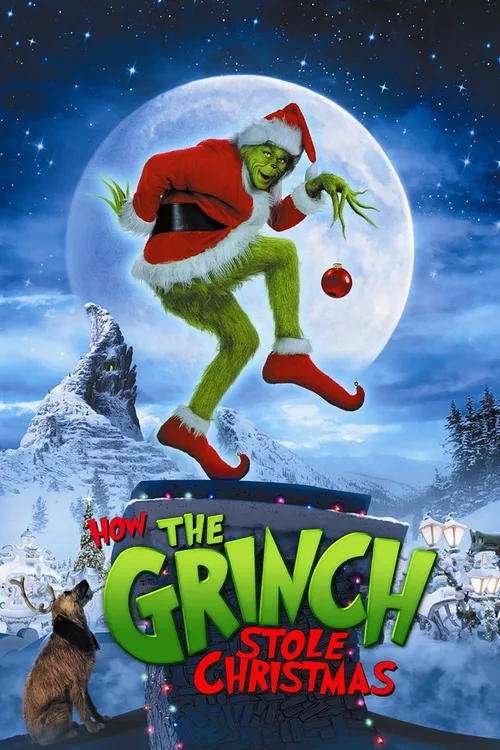
How the Grinch Stole Christmas (2000)
The Grinch decides to rob Whoville of Christmas - but a dash of kindness from little Cindy Lou Who and her family may be enough to melt his heart...
 rating 7/10 User rating 8,165 votes 68%
 ❄ Christmas Connection
The entire film is about Christmas. The Grinch's plot to steal every physical trace of the holiday from Whoville, and his ultimate discovery that Christmas exists beyond decorations and gifts, makes this one of the most Christmas-saturated movies ever produced.
Where to Watch


Our Review
Ron Howard's How the Grinch Stole Christmas (2000) turned Dr. Seuss's slim 1957 picture book into a 104-minute live-action spectacle, and the results are exactly as overstuffed as that sounds. Jim Carrey spends the entire film buried under prosthetic makeup that took three hours to apply each morning. The movie grossed $345 million worldwide. Whether it deserved to is a different conversation.
Jim Carrey Under the Prosthetics
Carrey reportedly hated wearing the Grinch suit so much that the production hired a consultant who trained people to endure extreme conditions. That is not a joke. The consultant taught Carrey mental techniques for coping with the claustrophobic full-body makeup. Carrey has described the experience as being "buried alive" every single day of the shoot.
The performance that came out of that misery is genuinely impressive. Carrey brings his full physical comedy toolkit to the role, contorting his body and voice into something that feels both alien and deeply human. His Grinch is manic, wounded, petty, and occasionally terrifying. There are moments where the rubbery green face conveys real loneliness, which is no small feat considering the actor's eyes are the only visible feature that's actually his.
The makeup, designed by Rick Baker, won the Academy Award for Best Makeup. Baker's team created individual prosthetic pieces that covered Carrey from head to toe, including contact lenses that limited his vision and yak-hair-covered foam latex that trapped body heat. Carrey earned $20 million for the role. He earned every cent.
Whoville and the Production Design
The film was shot almost entirely on soundstages at Universal Studios, where production designer Michael Corenblith built a full-scale Whoville that remains one of the most elaborate Christmas movie sets ever constructed. The town square alone took up an entire soundstage. Every building curves and leans like a Seuss illustration pulled into three dimensions.
The set design is where the movie succeeds most consistently. Whoville feels genuinely lived-in, packed with details that reward repeat viewings. The Grinch's cave on Mount Crumpit, filled with decades of stolen garbage, is both disgusting and oddly cozy. It's the visual design that keeps children glued to the screen even when the plot sags under its own padding.
Cindy Lou Who and the Story That Got Stretched
The original Seuss story is about 300 words long. To fill a feature runtime, screenwriters Jeffrey Price and Peter S. Seaman invented an entire backstory for the Grinch (childhood bullying in Whoville) and expanded Cindy Lou Who from a toddler with a single line into the film's moral center. Taylor Momsen, who was seven years old during filming, plays Cindy Lou with a sincerity that grounds the movie's wilder impulses.
The padding is obvious. There are extended sequences of Whoville consumerism, slapstick set pieces, and a subplot about the mayor (Jeffrey Tambor) that feels like it belongs in a different movie. The Grinch's origin story, where he's mocked by classmates for his appearance, adds genuine pathos but also turns a fable about anti-materialism into a more conventional revenge narrative.
Momsen would later become famous as a rock musician fronting The Pretty Reckless. She has spoken openly about how grueling the child acting experience was and how it pushed her away from Hollywood.
Is It Actually Good?
That depends on what you want from a Christmas movie. As a faithful Seuss adaptation, it fails. Seuss's widow, Audrey Geisel, was reportedly unhappy enough with the result that she blocked all future live-action adaptations of her husband's work. (The 2003 Cat in the Hat sealed that deal permanently.)
As a Jim Carrey vehicle, it mostly works. The scenes where Carrey is alone in the cave, riffing and improvising, have a manic energy that's hard to resist. The scenes in Whoville proper are louder and less interesting. The movie's best joke might be the Grinch's schedule, where he pencils in "wallowing in self-pity" followed by "solving world hunger" (crossed out) and then "dinner with me; I can't cancel that again."
As holiday comfort viewing, it has become a staple. The film airs constantly on cable during December, and its intensely Christmassy production design makes it function almost as seasonal ambient decor with a plot attached. You can stream it on Peacock, rent it on most major platforms, or find it buried somewhere in your family's DVD collection.
The Grinch's Christmas Tree and Seuss's Real Message
The film's climax, where the Grinch's heart grows three sizes and he saves the sleigh of stolen Christmas presents, is taken directly from the source material. What the movie adds is spectacle: a teetering sleigh on a cliff edge, Cindy Lou in danger, the Grinch performing a feat of superhuman strength. Seuss told the same story with a simple line drawing of the Grinch smiling.
The original book was partly a critique of Christmas commercialism, which makes the movie's existence a bit ironic. Universal built an entire Whoville attraction at their theme parks, sold millions in Grinch merchandise, and turned a story about the emptiness of material excess into a $345 million franchise. The Grinch would have something to say about that, probably from his cave, with a sardonic Jim Carrey delivery that would make the whole thing worth watching again.
Fun Facts
Jim Carrey's Grinch makeup took 8,000 hours total across the production, with each daily application requiring about 2.5 to 3 hours and another hour to remove.
The production went through over 500 pounds of yak hair to create the Grinch's fur during filming.
Taylor Momsen was cast as Cindy Lou Who at age six after a nationwide casting search. She later said in interviews that she barely remembers making the film.
Rick Baker's makeup effects team won the Academy Award for Best Makeup, beating The Cell and Shadow of the Vampire in 2001.
Audrey Geisel, Dr. Seuss's widow, had approval rights over the screenplay and insisted on certain changes to keep the story closer to her husband's intent.
The Whoville set at Universal Studios was so elaborate that it was kept standing after production and eventually became a seasonal attraction at Universal Studios Hollywood.
Jim Carrey improvised many of his solo scenes in the Grinch's cave. Director Ron Howard often let the cameras roll while Carrey riffed, then selected the best takes.
Anthony Hopkins narrates the film, replacing the original TV special's narrator Boris Karloff, who had died in 1969.
Cast