
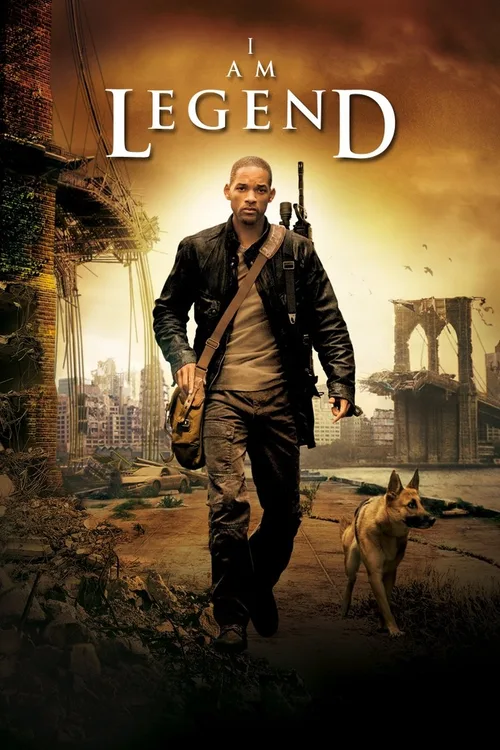
The last man on Earth is not alone.
I Am Legend (2007)
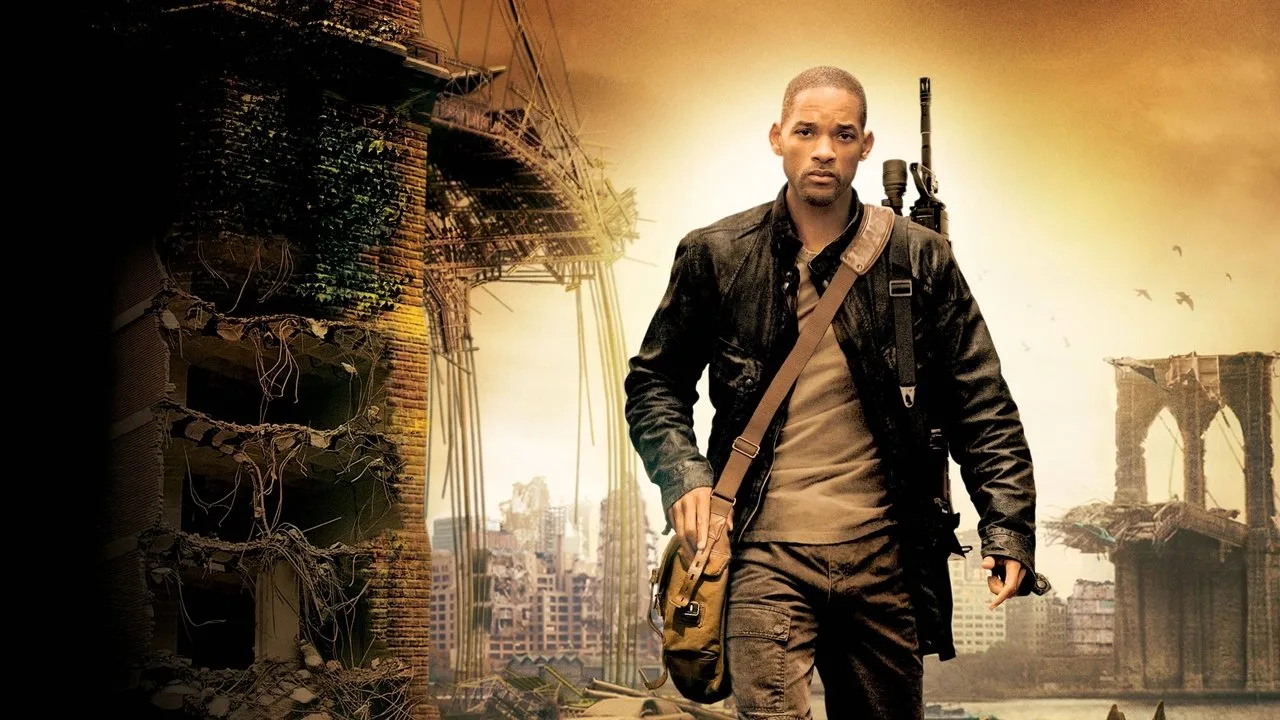
Robert Neville is a scientist who was unable to stop the spread of the terrible virus that was incurable and man-made. Immune, Neville is now the last human survivor in what is left of New York City and perhaps the world. For three years, Neville has faithfully sent out daily radio messages, desperate to find any other survivors who might be out there. But he is not alone.
 rating 8/10 User rating 16,588 votes 72%
 ❄ Christmas Connection
The viral outbreak that destroys civilization begins on Christmas Eve 2009, and the main action takes place three years later against a backdrop of rotting Christmas decorations still strung across a deserted Manhattan. The holiday trappings aren't incidental -- they're the film's emotional spine, marking what was lost and when it was lost.
Where to Watch


Our Review
Most Christmas movies announce themselves with sleigh bells and snow globes. I Am Legend announces itself with a dead city, rotting tinsel, and Will Smith talking to store mannequins. That's a different kind of holiday film. It's also, weirdly, one of the most honest ones.
The premise is brutal in its simplicity. A engineered virus, originally designed to cure cancer, mutated and wiped out most of humanity. Dr. Robert Neville (Smith) is immune. He's also alone -- completely, devastatingly alone -- in a New York City where deer graze on Fifth Avenue and lions sleep in the Lincoln Tunnel. The film is set in September 2012, three years after civilization ended. The outbreak began on Christmas Eve 2009.
That detail is not accidental. Director Francis Lawrence and screenwriters Akiva Goldsman and Mark Protosevich embedded the holiday into the film's DNA deliberately. The decorations that were going up when the world ended are still there, three years later. Faded, weather-beaten, draped over empty storefronts and dark traffic lights. Nobody took them down because nobody was left to take them down.
What Makes I Am Legend a Christmas Movie
The film doesn't dwell on Christmas. It doesn't need to. The decorations appear in the background of shots, in the abandoned apartments Neville searches for supplies, in the silent streets where he jogs each morning with his dog Sam. They function the way all good visual storytelling does -- they tell you something without saying anything.
Neville has preserved his own sense of time through obsessive routine. He broadcasts a radio message every day at noon, still hoping survivors will hear it. He marks the date on a calendar. He rents videos from a store where he's propped mannequins in place of the customers he used to see there. The Christmas backdrop underscores exactly what he's mourning: not just people, but the rituals that tied people together. Shopping trips. Holiday crowds. The version of New York that was impossible to imagine as anything but overcrowded and loud.
There's a scene early in the film where he drives through Times Square and you see the New Year's ball still in place, motionless, over an intersection thick with weeds. Two holidays, frozen at the moment everything stopped. It's one of the more quietly devastating images in the movie.
Will Smith Carries Everything
This is, fundamentally, a one-man film. Smith is on screen for roughly ninety percent of it, often alone or talking to a dog. That's a brutal performance challenge, and he handles it without ever making it feel like a showcase. Neville's mental state deteriorates slowly and plausibly. The scene where he breaks down talking to the mannequins -- after weeks of treating them as social surrogates -- is genuinely uncomfortable to watch.
Smith lost around 20 pounds for the role to suggest a man surviving on military rations and obsessive exercise. The physical specificity sells the performance. This isn't a hero staying in perfect action-movie shape. This is a person grinding through days because stopping is not an option.
His German Shepherd, Sam, is played by a dog named Abbey. The scenes between Smith and Abbey carry real warmth, which makes the film's gut-punch middle section land harder than almost any equivalent moment in mainstream cinema that year.
The Empty City Cost $40 Million
The production spent $40 million of its $150 million budget on converting Manhattan into a wasteland, using a combination of digital effects and practical street closures. Getting permission to shut down major midtown thoroughfares required sign-off from 14 separate government agencies. The Brooklyn Bridge evacuation flashback sequence alone cost $5 million and was filmed over six consecutive nights with 1,000 extras, including 160 National Guard members.
The result holds up. The empty city still looks real rather than rendered, because much of it was real. The production physically cleared streets, removed signage, and planted wild grass in the pavement gaps. The deer running through Manhattan were real deer (trained), not CGI. The lions were digital, but by the time you see them you've already accepted the world.
The Darkseekers, the infected humans who own the night, aged less well. The decision to render them entirely in CGI has not been kind. Their movement reads as artificial in a way that practical effects might have avoided. This is the film's most obvious technical liability, and it undercuts the horror sequences in ways that a theatrical release in 2007 didn't expose as clearly as home viewing does now.
The Alternate Ending Is the Better Movie
The theatrical ending has Neville sacrifice himself to destroy the Darkseekers and save two survivors. He hands off a vial of the cure. The war is won. Roll credits.
The alternate ending, released on the DVD and now widely available, is substantially more interesting. Neville realizes that the Darkseeker leader who has been hunting him isn't acting out of predatory aggression -- he's trying to recover a female Darkseeker that Neville captured for experimentation. Neville, in other words, is the monster. He's been torturing and killing sentient creatures in the name of science, without ever considering that they might have organized societies, emotional bonds, or a perspective on the situation.
That version of the film honors Richard Matheson's 1954 source novel. In the book, Neville's final revelation is that he has become the legend -- the terrifying creature that stalks and kills during the day, the one the survivors fear and build myths about. It's a sharp inversion that the theatrical cut discards entirely. Director Francis Lawrence has since said he preferred the alternate ending and regrets not fighting harder for it.
The theatrical version made $585 million worldwide. The alternate ending made for better conversation.
Fun Facts
The film's opening Brooklyn Bridge scene, where New York evacuates during the outbreak, cost $5 million to shoot and required approval from 14 government agencies. It was filmed over six consecutive nights in January 2007 with 1,000 extras and 160 National Guard members, and was reportedly the most expensive single scene ever filmed in New York City at that time.
Will Smith's German Shepherd in the film is named Sam, short for Samantha. The dog was played by a female dog named Abbey, who was trained specifically for the role. Smith has said the scene where Sam dies was one of the most emotionally difficult he has ever filmed.
The production closed sections of Fifth Avenue, Broadway, and other major Manhattan streets for filming, which required New York residents to accept significant disruption. Smith reported receiving "the most middle fingers I've ever gotten in my career" from locals who were unhappy about the closures.
The virus in the film was originally engineered by Dr. Alice Krippin (Emma Thompson in a brief cameo) to cure cancer. The story of the Krippin Virus spread reaching 100 percent of the global population takes less than three years from first announcement to total catastrophe.
The film earned $256 million domestically, making it the highest-grossing December release in U.S. history at the time for a film that did not open on Christmas Day itself. It finished as the seventh-highest-grossing film of 2007 globally, earning $585 million total.
Richard Matheson's 1954 novel "I Am Legend" has been adapted for film three times: as "The Last Man on Earth" (1964) with Vincent Price, as "The Omega Man" (1971) with Charlton Heston, and as this 2007 version. Matheson's novel is widely credited with inventing the modern zombie genre, predating George Romero's "Night of the Living Dead" by 14 years.
The Darkseekers were designed to be neither vampires nor zombies but infected living humans. Despite their sensitivity to UV light and attraction to blood, the production deliberately avoided vampire terminology. The creatures were rendered entirely in CGI, a choice director Francis Lawrence later acknowledged created some of the film's weakest visual moments.
The film's alternate ending, in which Neville realizes the Darkseeker leader is trying to rescue a companion Neville has been experimenting on, was screened for test audiences who reacted poorly. Warner Bros. ordered a new ending. The alternate version was included on the DVD release and has since been widely regarded as the version that more faithfully captures the moral inversion at the heart of Matheson's novel.
Cast