
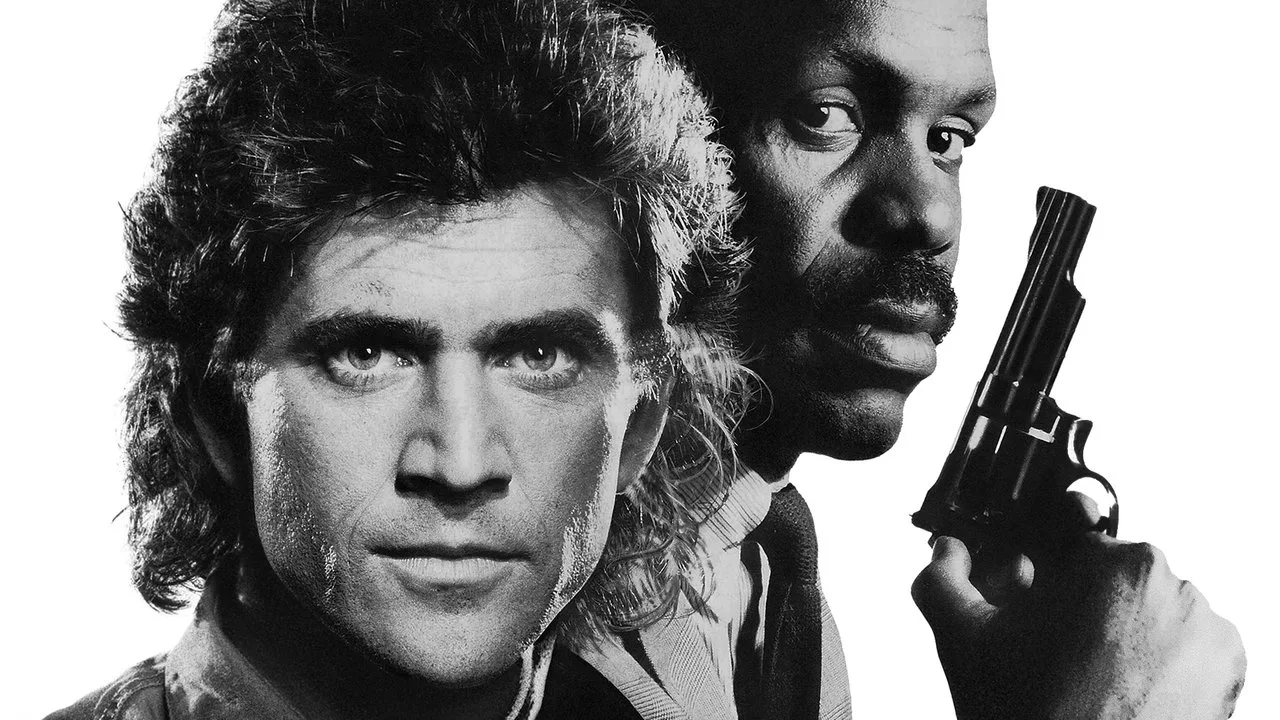
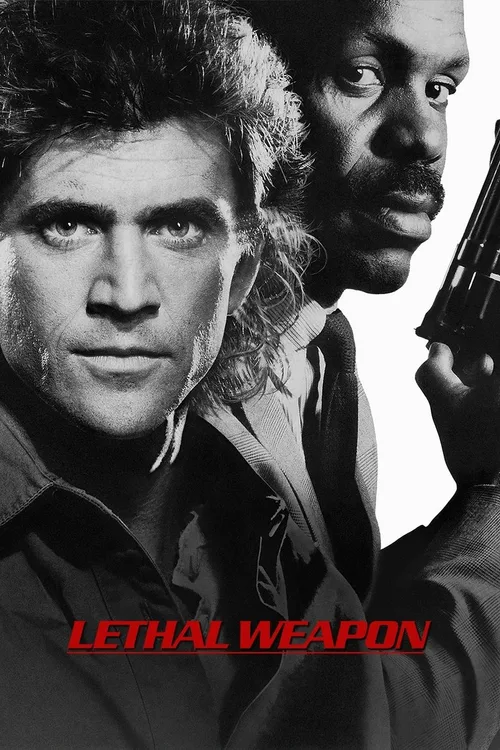
If these two can learn to stand each other... the bad guys don't stand a chance.
Lethal Weapon (1987)
A veteran cop and an unstable detective become partners who must put their differences aside in order to bring down a heroin-smuggling ring run by ex-Special Forces.
 rating 8/10 User rating 4,927 votes 73%
 ❄ Christmas Connection
Christmas is not just set dressing in Lethal Weapon. Martin Riggs' suicidal grief hits hardest against the forced cheer of the holidays, and his emotional recovery tracks from Christmas as a reminder of loss to Christmas as a reason to keep living. The finale literally takes place on Christmas night.
Where to Watch


Our Review
A year before Bruce Willis crawled through the Nakatomi Plaza air ducts, Mel Gibson was already settling the "is it a Christmas movie?" debate with a .38 Special pressed against his own temple. Lethal Weapon opened in March 1987, but the entire story unfolds during the Christmas season in Los Angeles. And unlike plenty of movies that use Christmas as wallpaper, this one weaves the holiday into the emotional spine of its story.
Is Lethal Weapon a Christmas Movie?
Yes. Full stop. The film opens with "Jingle Bell Rock" playing over a shot of the Hollywood Hills lit up for the holidays, then immediately cuts to a woman jumping off a balcony. That tonal whiplash is the whole movie in miniature.
Christmas runs through every major beat. Riggs buys a tiny tree for his trailer. Murtaugh's family gathers around theirs. The final showdown happens on Murtaugh's front lawn while Christmas lights twinkle in the background. Most importantly, Christmas amplifies the central contrast between the two leads: Murtaugh has everything the holiday represents (family, warmth, home), and Riggs has lost it all.
The holidays don't just set the calendar. They set the stakes.
Riggs, Murtaugh, and the Buddy Cop Formula
Shane Black's screenplay did something nobody expected from an action movie in 1987: it opened with a genuinely suicidal protagonist. Martin Riggs isn't performing recklessness for cool points. He's a man whose wife has recently died, and the scene where he puts a gun in his mouth while watching a Bugs Bunny Christmas special is raw in a way the genre rarely attempts.
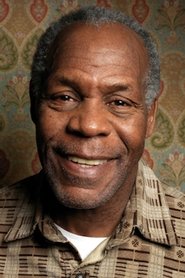
Danny Glover's Roger Murtaugh is the anchor. He turns 50 in the film's opening scene, groans about it in the bathtub, and spends the rest of the movie trying to survive his new partner's death wish. Glover gives Murtaugh a weariness that feels lived-in rather than performed. His delivery of "I'm too old for this" landed so well that it became one of the most quoted lines in action movie history.
The chemistry between Gibson and Glover is the engine. Director Richard Donner let the two actors improvise and riff off each other, and it shows. The dinner scene at the Murtaugh house, where Riggs slowly lets his guard down over a home-cooked meal, is the emotional turning point. No gunfire, no explosions. Just a lonely man accepting an invitation to Christmas dinner.
Shane Black's Christmas Obsession
Lethal Weapon was Shane Black's first produced screenplay. He sold it for $250,000, a record-breaking sum for a spec script at the time. He was 23 years old.
Black would go on to set nearly every one of his films during Christmas: The Long Kiss Goodnight, Kiss Kiss Bang Bang, Iron Man 3, The Nice Guys. It became his signature. But Lethal Weapon is where the pattern started, and it's still the purest expression of his idea that Christmas is the perfect backdrop for stories about lonely people finding connection.
His dialogue crackles with the rhythm of someone who grew up watching screwball comedies. The banter between Riggs and Murtaugh isn't just funny; it reveals character. When Riggs tells Murtaugh he's not going to jump off a building and Murtaugh asks "Why not?", Riggs' answer ("The fall would probably kill me") tells you everything about where his head is at.
The Action Still Holds Up
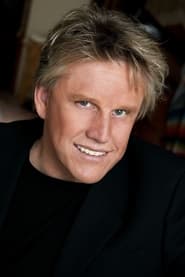
Gary Busey as Mr. Joshua is one of the great underrated action villains. He doesn't chew scenery. He operates with a calm, professional menace that makes him genuinely threatening. The scene where he holds his arm over a flame without flinching establishes more about his character than a page of dialogue could.
The final fight on the front lawn, with Riggs and Joshua going hand-to-hand while the sprinklers run and the Christmas lights glow, remains a perfectly staged action sequence. Donner shot it like a boxing match, not a typical Hollywood brawl. Both men are exhausted, muddy, and fighting on instinct. It feels earned in a way that most action climaxes don't.
Eric Clapton and Michael Kamen's guitar-driven score adds a melancholy edge that separates the film from its imitators. The saxophone theme for Riggs' grief has become almost iconic in its own right.
Why It Matters at Christmas
Lethal Weapon understands something about the holidays that greeting cards don't: Christmas can be the hardest time of the year for people carrying grief. The movie doesn't flinch from that. It also doesn't wallow. It suggests that showing up, accepting a plate of food from a stranger's family, and letting someone in can be enough.
Riggs arrives at the Murtaugh house at the end of the film carrying a gift. It's a bullet, the one he'd been saving to kill himself. He doesn't need it anymore. That's not subtle symbolism, but it hits because the movie earned it over two hours of genuinely watching this man decide he wants to live.
Fun Facts
Shane Black sold the Lethal Weapon screenplay for $250,000 in 1986, one of the highest prices ever paid for a spec script at that time. He was just 23 years old.
The original script was significantly darker. Riggs was written as more unhinged and violent, and the studio asked for rewrites to make him more sympathetic.
Bruce Willis auditioned for the role of Riggs before Mel Gibson was cast. Willis would get his own Christmas action movie the following year with Die Hard.
Danny Glover's famous line "I'm getting too old for this" was originally just a throwaway bit of dialogue. It became the franchise's unofficial tagline across four films.
The opening scene where a woman jumps from a balcony was originally more graphic. The MPAA required cuts before granting an R rating.
Richard Donner encouraged Gibson and Glover to ad-lib during their scenes together. The natural, overlapping style of their dialogue was largely improvised.
Gary Busey actually held his arm over a real flame during the lighter scene, though it was carefully controlled. He insisted on doing it for real to sell the moment.
Cast