What's forgotten is not always gone.
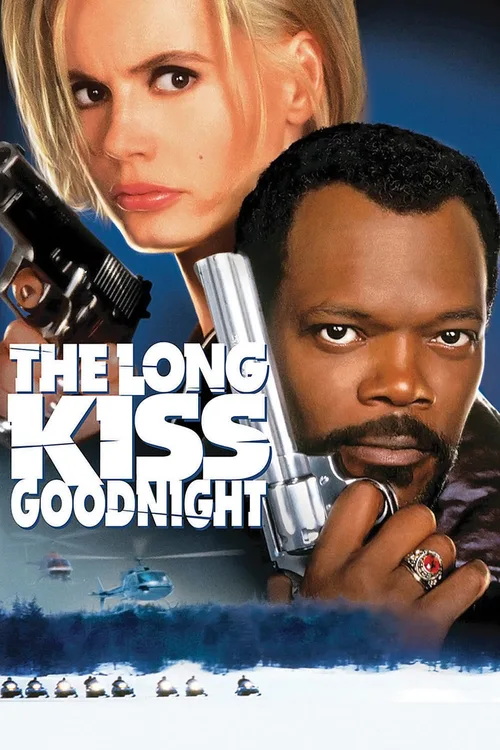
The Long Kiss Goodnight (1996)
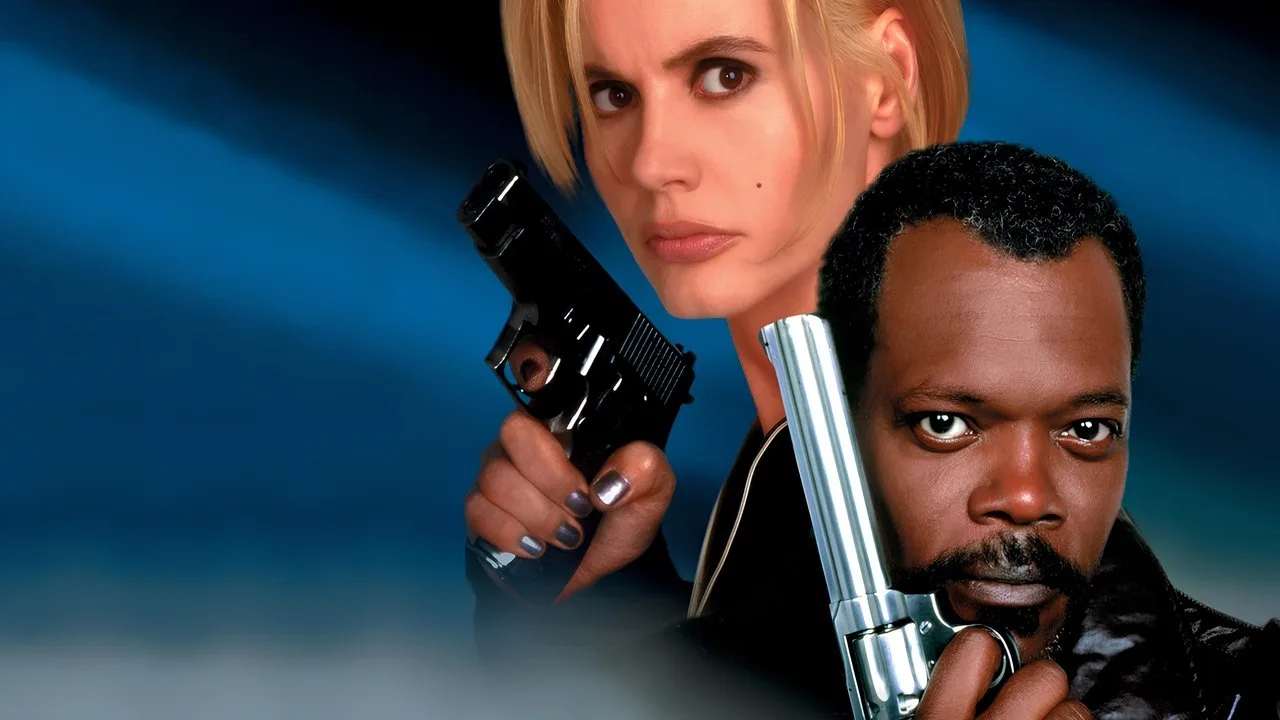
Samantha Caine is a small-town schoolteacher and mom with no memory of her life before washing up on a beach eight years ago. After a car accident and a violent home invasion trigger flashes of her past, she discovers she used to be a deadly CIA assassin. Teaming up with a wisecracking private investigator, Samantha must return to her old ways to take down the people who tried to erase her.
 rating 8/10 User rating 1,314 votes 66%
 ❄ Christmas Connection
The Long Kiss Goodnight is set almost entirely around the Christmas holiday season, with snow, Christmas lights, and festive decorations serving as backdrop to its action sequences. Shane Black, who wrote the script, is famous for setting his films at Christmas as a deliberate aesthetic choice, using the holiday's warmth and domesticity to contrast with violence. The film's central plot kicks off when Samantha's past catches up with her just before Christmas, turning the season into a countdown to survival rather than celebration.
Where to Watch


Our Review
The Long Kiss Goodnight (1996) opens on a postcard-perfect Christmas Eve in small-town Pennsylvania. Snow on the ground, lights strung along the eaves, a cheerful schoolteacher baking cookies while her daughter watches. Then someone tries to kill her, and everything gets interesting.
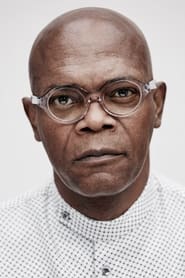
Samantha Caine, played by Geena Davis, has lived a quiet life for eight years with one unsettling detail: she has no memory of anything before she washed up on a beach, pregnant, in 1988. She's hired private detectives to find her past. None of them got very far. Mitch Henessey, the cut-rate detective played by Samuel L. Jackson, is about to have more luck than he bargained for.
Shane Black's Christmas Habit
Shane Black wrote Lethal Weapon, The Last Boy Scout, Kiss Kiss Bang Bang, and Iron Man 3. Every single one is set at Christmas. He has said in interviews that the holiday gives action films a built-in emotional stakes raiser: when the world feels warm and safe, violence feels more violent. He's not wrong.
In The Long Kiss Goodnight, Christmas isn't decoration. It's a ticking clock. Samantha's domestic holiday life, the one she built from scratch with no past, is exactly what she stands to lose. The cookies, the school pageant, the loving boyfriend, the daughter she adores. Black understood that the best thing you can destroy in an action movie is a life that actually looks worth living.
The script cost New Line Cinema $4 million, the most ever paid for a spec screenplay at that point. You can see where the money went on the page. The dialogue has the crackle Black is known for, though this film runs hotter and stranger than his other work, closer to pulp fever dream than buddy-cop riff.
Geena Davis Doing the Work
The transformation from Samantha to Charly Baltimore, her assassin alter ego, is the film's central pleasure. Davis played the shift as a genuine physical change: posture, voice, eye contact, the way she handles a knife. She trained extensively with weapons and movement coaches and performed most of her own stunts, including a sequence where she is dragged behind a moving truck on an icy road.
It's a genuinely difficult dual performance that gets undersold because the film is loud and fast. Davis won a Golden Globe for Thelma and Louise five years earlier. Here she's doing something technically harder, and doing it in the middle of explosions.
Jackson, for his part, plays Henessey as a man who is clearly out of his depth and knows it. He's not a sidekick. He's a civilian who stumbled into something he cannot exit. His fear is played straight, which makes the comedy land. His line delivery in this film has the timing of someone who understood exactly what kind of movie he was in.
A Box Office Disaster That Found Its Audience
The Long Kiss Goodnight cost approximately $65 million to produce and grossed around $33 million worldwide in theaters. By any commercial measure, it failed. The studio had expected an A-list action hit with a female lead, which was a genuinely unusual bet in 1996, and the gamble did not pay off.
The critical reception was mixed. Some reviewers found it too noisy, too violent, too willing to blow things up for spectacle. Which, in retrospect, sounds like a description of roughly half of the decade's successful action films. The difference was Samantha Caine, not John McClane, was at the center.
The reassessment has been slow but steady. The film has a 72% on Rotten Tomatoes now, significantly up from its original reception. People who watched it on cable or VHS in the late 1990s tend to remember it with real affection. It came up regularly in discussions around female-led action cinema as conversations about representation in blockbusters became more mainstream. Davis herself has become an outspoken advocate for gender equity in Hollywood through the Geena Davis Institute on Gender in Media, and the irony that one of her most physically demanding action performances tanked commercially has not been lost on anyone.
The Action Sequences Hold Up
Director Renny Harlin was fresh off Cliffhanger and Die Hard 2 when he took this on. He knows how to build a set piece. The ice-rink confrontation, the truck sequence, the frozen waterfall climax: these are well-constructed action scenes that use physical space and consequence rather than relying entirely on editing speed to create tension.
The finale involves a truck, a bridge, and a fairly substantial explosion. It's not subtle. But it earns the moment because the film has spent time making you care whether Samantha gets to go home to her daughter.
The movie doesn't entirely avoid the pitfalls of mid-90s action excess, but it earns its chaos. There is a scene where Charly Baltimore lights a cigarette off a gas fire while quipping at an adversary, and it is deeply silly, and it works completely.
Fun Facts
Shane Black's script for The Long Kiss Goodnight sold for $4 million in 1994, setting a record for a spec screenplay at the time and generating significant Hollywood buzz before filming even began.
Geena Davis is 6 feet tall and had trained as an Olympic-caliber archer (she competed in the U.S. archery trials for the 2000 Sydney Olympics). Her physical presence and genuine athletic ability made the action role substantially more convincing than it might have been with many other actresses of the era.
Renny Harlin and Geena Davis were married during the making of the film. They divorced in 1998, two years after its release.
The film's production designer went through several thousand Christmas lights for the small-town Pennsylvania sequences, most of which were destroyed during filming.
Samuel L. Jackson and Geena Davis shot several scenes in genuinely freezing conditions in Ontario, Canada during winter. The cold breath visible in outdoor scenes is real, not a production effect.
The film was a co-production between New Line Cinema and Forge, the production company run by Geena Davis and Renny Harlin. Their personal stake in the project is one reason it got made with a female lead in a genre that rarely supported them at that budget level in 1996.
Craig Bierko, who plays the villain Timothy, was reportedly considered for the lead role in Men in Black, which would have gone to Samuel L. Jackson as well. Both ended up in very different 1997 films.
The phrase "chefs do that" became a minor cult reference among fans, spawning its own corner of online appreciation decades after release. It's the kind of throwaway line that sticks precisely because it's delivered with total conviction.
Cast