


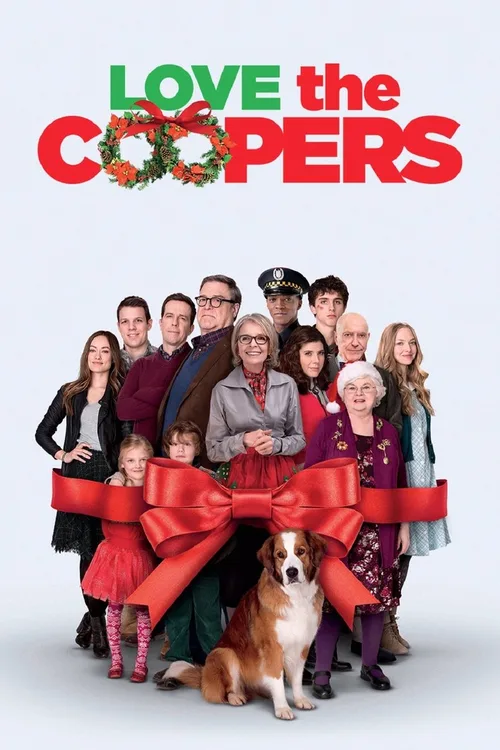
Christmas means comfort, joy and chaos.
Love the Coopers (2015)
When four generations of the Cooper clan come together for their annual Christmas Eve celebration, a series of unexpected visitors and unlikely events turn the night upside down, leading them all toward a surprising rediscovery of family bonds and the spirit of the holiday.
 rating 4/10 User rating 857 votes 60%
 ❄ Christmas Connection
Christmas is the entire structural framework of this film. The Cooper family gathers for one last Christmas Eve dinner before the parents announce their divorce, and every subplot hinges on holiday obligations, traditions, and the emotional weight of family gatherings during the season.
Where to Watch


Our Review
Love the Coopers (2015) assembles one of the most overqualified casts in Christmas movie history and then gives them almost nothing to do with it. Diane Keaton, John Goodman, Alan Arkin, Marisa Tomei, Olivia Wilde, Amanda Seyfried, Ed Helms, Anthony Mackie, and a pre-fame Timothee Chalamet all show up for this Christmas Eve ensemble piece. Steve Martin narrates. From the perspective of the family dog. That last detail tells you a lot about where this movie's instincts lie.
The Love the Coopers Cast: Oscar Winners Lost in the Snow
Director Jessie Nelson and screenwriter Steven Rogers (who would go on to write I, Tonya two years later) split the film into parallel storylines following different members of the Cooper family on Christmas Eve. Charlotte (Keaton) and Sam (Goodman) are hosting what they've secretly decided will be their final Christmas dinner before announcing their divorce. Their son Hank (Helms) is a recently unemployed photographer struggling to buy gifts for his kids. Their daughter Eleanor (Wilde) picks up a soldier named Joe (Jake Lacy) at the airport and convinces him to pose as her boyfriend. Charlotte's sister Emma (Tomei) gets arrested for shoplifting a necklace. And patriarch Bucky (Arkin) visits his favorite diner to say goodbye to a young waitress named Ruby (Seyfried) who's leaving town.
That's five major storylines in 107 minutes. The math doesn't work.
The Alan Arkin and Amanda Seyfried scenes are the best thing in the movie by a wide margin. Arkin plays Bucky as a retired man who has found unexpected companionship in daily conversations with a waitress half a century younger. The tenderness between them feels earned. When Bucky realizes Ruby is leaving, Arkin lets his face do the work, and for a few minutes the film becomes something genuinely moving. These two actors find real emotion in a script that mostly settles for greeting card sentiments.
Too Many Subplots, Not Enough Movie
The structural problem with Love the Coopers is the same one that sinks most ensemble holiday films. Every storyline gets enough screen time to introduce its premise but not enough to develop it. Ed Helms is a struggling single dad, and the film gestures at his financial stress without ever making you feel it. Olivia Wilde and Jake Lacy have an airport meet-cute that plays like a short film stretched past its natural length. Marisa Tomei spends most of her screen time in the back of a police car with Anthony Mackie, trading life observations in dialogue that sounds written rather than spoken.
The weakest thread is the central one. Keaton and Goodman are strong actors who can play married tension in their sleep, but their marriage-falling-apart storyline never gets specific enough to land. We're told they've drifted apart after 40 years. We never see what that drift actually looks like in daily life. Their conversations circle around the topic without ever cutting into it.
Then there's the narration. Steve Martin voices the family's dog, Rags, who provides a running commentary on human love and family bonds. The voiceover aims for whimsical wisdom and lands closer to a greeting card read aloud at moderate speed. Martin is a gifted comedic performer. Giving him philosophical observations about the nature of love from a dog's perspective wastes everything that makes him interesting.
The Timothee Chalamet Factor
The most interesting thing about Love the Coopers in 2026 is spotting a 19-year-old Timothee Chalamet in one of his earliest film roles. He plays Charlie, Hank's sullen teenage son, and gets maybe ten minutes of screen time. Two years later, Call Me by Your Name would turn him into one of the biggest actors of his generation. Here, he's a background presence, glowering through family scenes and delivering his few lines with a mumbling naturalism that already set him apart from the rest of the young cast.
Chalamet fans seeking out his early work will find slim pickings here, but there's a certain novelty in watching a future Oscar nominee sulk through a holiday comedy that doesn't know what to do with any of its talent.
A Christmas Movie That Tries Too Hard to Mean Something
Love the Coopers earned $42.4 million worldwide against a $17 million budget, so it turned a modest profit. Critics were not kind. The film holds a 19% approval rating on Rotten Tomatoes, with the consensus noting that the talented cast deserves better material. That tracks. The individual performances range from solid (Arkin, Seyfried) to underused (Goodman, Tomei, Mackie) to miscalculated (Martin's narration).
The Christmas atmosphere, at least, is genuine. Production designer Beth Rubino found a 1920s Dutch Colonial in Sewickley, Pennsylvania, for the Cooper family home, and the interiors feel lived-in rather than art-directed. The Pittsburgh locations give the film a grounded, wintry texture that studio backlots rarely achieve. Rubino's team brought in truckloads of ice blocks and industrial chippers to create the snowscapes, which look more convincing than most CGI alternatives.
The film's real problem is tonal. It wants to be a bittersweet meditation on family and love and the passage of time. But the script keeps undercutting its own ambitions with broad gags, convenient resolutions, and a narrating dog. Screenwriter Steven Rogers wrote Hope Floats and Stepmom, films that handle domestic emotion with reasonable skill. He also wrote I, Tonya, which is sharp and structurally inventive. Love the Coopers splits the difference and lands on neither side.
The final scene gathers the whole family around the dinner table, secrets still half-kept, grievances temporarily shelved. It should feel bittersweet. Instead it feels like the movie ran out of time to resolve anything and decided a group hug would cover it. Somewhere in there, the dog has the last word.
Fun Facts
The film was originally titled "The Most Wonderful Time" and was set up at Relativity Media with Robert Redford cast opposite Diane Keaton. When Relativity filed for bankruptcy in July 2015, CBS Films and Lionsgate picked up the project.
Principal photography began on December 19, 2014, in Pittsburgh, Pennsylvania, using real locations including the PPG Place, U.S. Steel Tower, and Pittsburgh International Airport.
The Cooper family home exterior was a real 1920s Dutch Colonial in Sewickley, Pennsylvania. Production designer Beth Rubino chose it because it looked like a house where a family had lived for 30 years.
Screenwriter Steven Rogers went on to write I, Tonya (2017), which earned him BAFTA and Writers Guild nominations for Best Original Screenplay.
Timothee Chalamet was 19 years old during filming. Two years later, Call Me by Your Name would make him one of the most sought-after actors in Hollywood.
The production team created artificial snow by trucking in 40-pound blocks of ice and feeding them through industrial chippers attached to blowers for the outdoor Sewickley scenes.
Nick Urata, who also composed scores for Paddington and Crazy, Stupid, Love, wrote the original score. The soundtrack features Robert Plant and Alison Krauss performing "The Light of Christmas Day."
Cast