
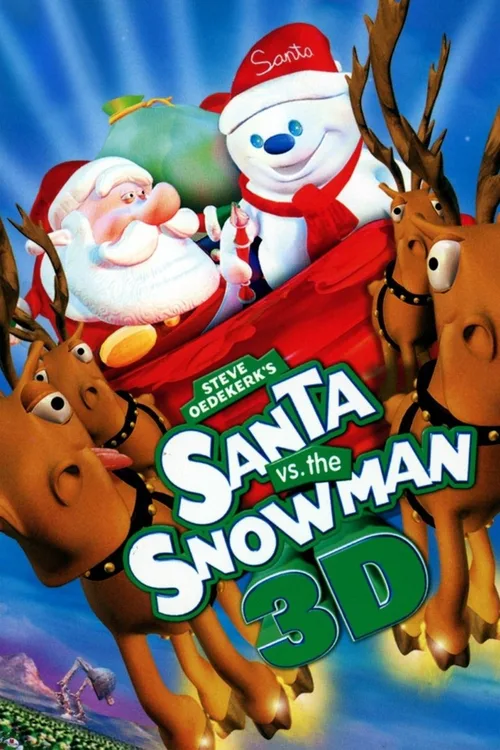
Santa vs. the Snowman (2002)
A lonely snowman finds Santa's workshop. But when he sets off the perimeter alarms and is chased away, he wonders why he couldn't be Santa and get all the love and fun this year. With the aid of "Snow Minions Made Easy", he pits his snow army against Santa's elves and captures Santa. But can he really do Santa's job?
 rating 6/10 User rating 5 votes 72%
 ❄ Christmas Connection
The entire film is set at the North Pole and revolves around Santa Claus, Christmas gift delivery, and a snowman's obsessive desire to take over Christmas. There is no ambiguity here: Santa vs. the Snowman is a Christmas movie by premise, by setting, and by the message it delivers about the spirit of giving.
Our Review
In November 2002, if you walked into an IMAX theater expecting to be dazzled by a nature documentary about the ocean floor or a space shuttle launch, you might have been surprised to find a lonely snowman attacking Santa's workshop with an army of snow minions. Santa vs. the Snowman 3D was the first fully animated film ever screened in IMAX 3D, and it arrived on those eight-story screens courtesy of DNA Productions, the Dallas-based studio that had just come off Jimmy Neutron: Boy Genius the previous year. It's a 35-minute holiday short with an unusual voice cast, no dialogue for its title character, and a surprisingly affecting moral at its center.
From ABC to IMAX: How a TV Special Got Supersized
The story starts in 1997, when the original Santa vs. the Snowman aired on ABC on December 13 as a 22-minute television special. Steve Oedekerk created it through his O Entertainment production company; John A. Davis of DNA Productions directed it. The two men liked what they had made enough to ask a bigger question: what if it played on the largest screens in the world, in stereoscopic 3D?
The IMAX version, released November 1, 2002, runs approximately 35 minutes. New footage was added at the beginning and end, existing battle sequences were expanded to take advantage of 3D depth, and the entire film was rendered at 2K resolution using NewTek LightWave software on PC workstations. This was the same software DNA Productions had used for Jimmy Neutron, which means the studio was not working with exotic technology but with a relatively affordable, off-the-shelf animation pipeline pushed to its limits for a premium format.
The result earned over $22 million worldwide across multiple holiday-season runs from 2002 through 2006. For a 35-minute animated short in a specialized venue, that is a substantial number.
The Snowman Who Cannot Speak
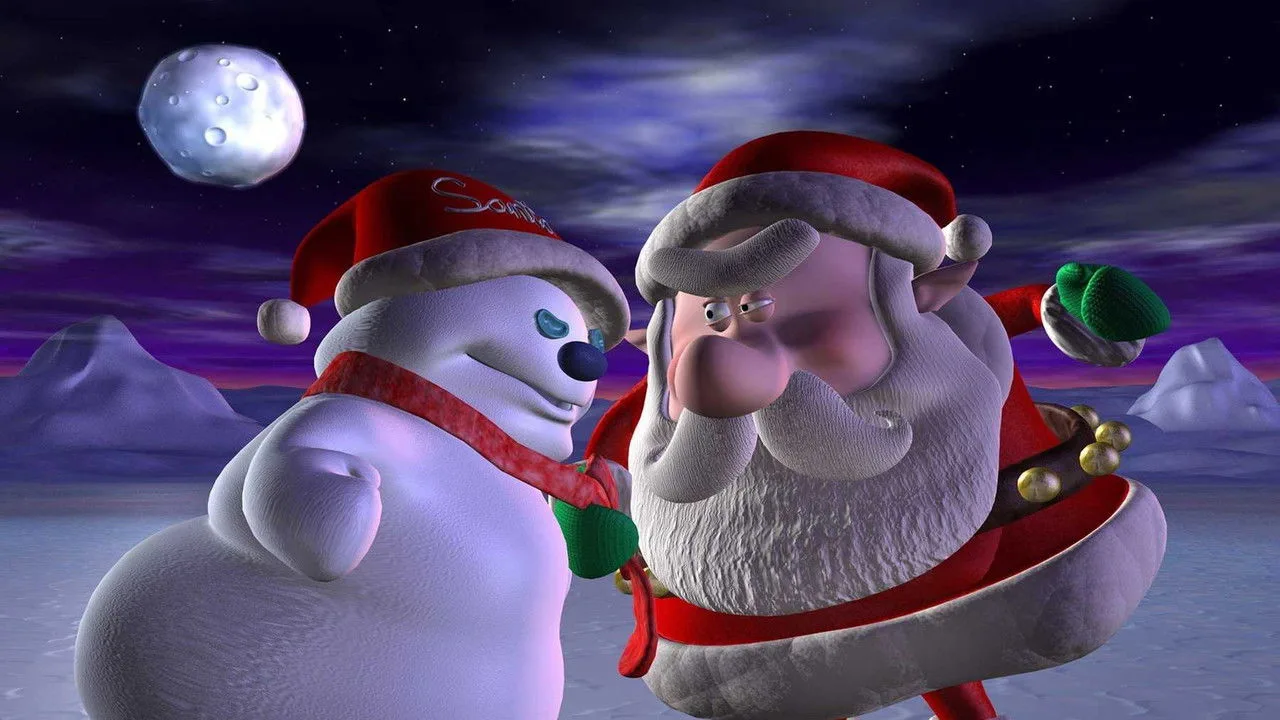
The film's most interesting creative choice is also its most underrated one. The Snowman, the film's antagonist and eventual protagonist, never speaks a single word. He communicates entirely through a small flute, and through whatever emotion the animators could convey via his face and body. He has no legs. He rolls. He watches Santa's glowing workshop from the dark cold outside and wants, very badly, to be part of it.
This is not a villain's origin story. It is a loneliness story. The Snowman's envy is legible and even sympathetic. His escalating plans, which involve impersonating Santa, recruiting a snow army, and deploying igloo fortresses against the workshop's Nutcracker mechs, are played for comedy but rooted in something genuine. He doesn't want to destroy Christmas. He wants to be seen.
The mute character design also posed a real technical challenge. DNA Productions had to engineer character rigging that could carry an entire emotional arc without dialogue, relying on subtle facial deformations and eye movement. Whether they fully succeeded is debatable. Critics at the time noted the Snowman's somewhat "doughy" quality, and the expressiveness is limited compared to what Pixar or DreamWorks could achieve in the same era. But the attempt was serious, and for a small Texas studio on a tight timeline, the result is more than adequate.
The Voice Cast Is Not What You'd Expect
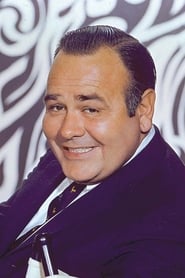
The cast assembled around the mute snowman is a genuinely odd collection of 2002-era talent. Jonathan Winters voices Santa. Winters, born in 1925, was a pioneer of improvisational stand-up comedy and a career-long influence on comedians including Robin Williams. By 2002 he was 77 years old, and the filmmakers specifically chose him because they needed a Santa who could be both commanding and warm without the two qualities fighting each other. Winters could bridge that gap, and he does. His Santa is comfortable, unhurried, and not remotely threatening.
Ben Stein plays Spunky, a deadpan elf tour guide. Ben Stein's flatline monotone, which he had been deploying to comic effect since Ferris Bueller's Day Off in 1986, is put to good use here. A tour guide elf who sounds like he would rather be anywhere else is a reasonable comedic premise, and Stein executes it without effort, which is the point.
Don LaFontaine narrates. LaFontaine was, at the time, the most recognizable voice in Hollywood, the man responsible for "In a world where..." on what felt like every trailer released between 1980 and 2008. His presence gives the film a mock-epic quality that fits the absurd premise well. Using the voice of cinematic gravitas to describe a snowman stealing a magical flute is a joke that works on its own terms.
What Actually Holds Up
The battle sequences are the film's clearest achievement. Chocolate-squirting weapons, gingerbread infantry, and full-scale igloo siege tactics: the production committed to its holiday combat concept with genuine imagination. These scenes were designed specifically to exploit stereoscopic 3D depth on a massive screen, and they deliver the spectacle they promise. For families sitting in an IMAX theater in 2002, this was a genuinely new experience. Nothing like it had been shown in that format before.
The ending also works better than it deserves to. Santa does not punish the Snowman. He gives him the magical flute and makes him part of Christmas. This is not a surprise ending, but the film earns it by keeping the Snowman's loneliness visible throughout. The resolution feels proportionate to what caused the conflict in the first place.
The film was awarded the 2003 Golden Reel Award for Best Sound Editing in Special Venue Film, and the sound design is notably good. Snow has specific textures across the film, whether it is the quiet crunch of a snowman army assembling or the chaotic audio of a full workshop siege.
What Does Not Hold Up
The animation looks its age. The character models carry the slightly plastic, rounded quality common to CGI of the early 2000s, before studios fully solved how to give digital surfaces genuine weight and warmth. Santa's beard is technically impressive for 2002. The elves are less so. The backgrounds in the workshop sequences are more convincing than the character surfaces.
The comedy aimed at adult viewers mostly does not land. The Variety review at the time noted "zippy pace" but found actual laughs "few and far between," and that reading remains fair. Ben Stein is funny in precisely the way he is always funny. Winters is warm but not comedically sharp in this material. The film's strengths are visual and emotional rather than funny, and it would have been better served admitting that earlier.
The film also runs out of ideas before it runs out of runtime. The battle section overstays its welcome by several minutes, cycling through variations on the same joke. A tighter cut at 28 minutes would have been a stronger film.
Fun Facts
Santa vs. the Snowman 3D, released November 1, 2002, was the first fully computer-animated film to be screened in IMAX 3D format, predating major studio animated features in that format by several years.
The original 1997 ABC television special ran 22 minutes; the 2002 IMAX version was extended to approximately 35 minutes with newly animated sequences designed specifically to exploit 3D depth on large screens.
DNA Productions, the Dallas-based studio that animated both versions, built its entire pipeline around off-the-shelf NewTek LightWave 3D software running on standard PC workstations, the same approach they used on Jimmy Neutron: Boy Genius in 2001.
Jonathan Winters, who voiced Santa Claus, was born in 1925, making him 76 years old at the time of the IMAX release. Robin Williams, who idolized Winters as an improv pioneer, once said Winters was "the greatest comedian who ever lived."
Don LaFontaine, who narrated the IMAX version, voiced an estimated 5,000 film trailers during his career. He died in 2008 at age 68.
The film screened in IMAX theaters every holiday season from 2002 through 2006, making it one of the most enduring productions in IMAX's theatrical history for an animated short.
The Snowman character does not speak a single word in either the 1997 or 2002 versions. All his emotion is conveyed through a small flute and facial animation, a deliberate choice by director John A. Davis that required specialized character rigging to carry the film's emotional arc.
The 2002 IMAX version earned over $22 million worldwide in theatrical revenue, a substantial figure for a 35-minute animated short playing exclusively in specialized large-format venues.
Cast