
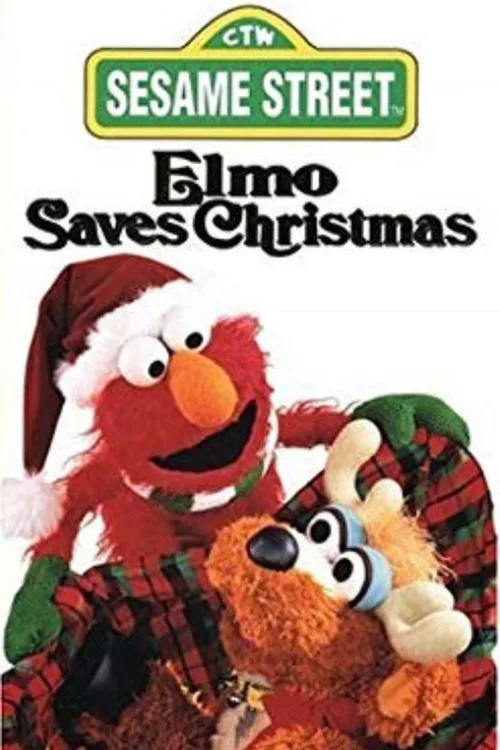
Sesame Street: Elmo Saves Christmas (1996)
Can there be such a thing as too much Christmas? Find out... when a magical Christmas wish is granted and Elmo gets to see what the world would be like if every day were Christmas! You'll enjoy lots of songs and holiday cheer with Elmo and his new friend Lightning, the reindeer, and discover for yourself why Christmas is best kept to one day a year!
 rating 7/10 User rating 11 votes 59%
 ❄ Christmas Connection
The entire special is built around Christmas as its central premise. Elmo saves a reindeer named Lightning, Santa grants him a wish, and Elmo uses it to make Christmas happen every single day. The plot only works because Christmas is finite and precious, and the special spends its runtime proving exactly that.
Where to Watch


Our Review
Elmo Saves Christmas is a 50-minute Sesame Street direct-to-video special from 1996 that contains, buried inside its cheerful puppet chaos, one of the more unsettling premises in Christmas television. A small red monster wishes for Christmas every single day. Santa grants it. And then Sesame Street slowly starts to die.
Not literally. This is still a children's special, complete with songs, furry monsters, and a Santa played by Charles Durning with the warmth of a man who genuinely enjoys the job. But the logic of the story is surprisingly ruthless.
What Actually Happens When Christmas Never Ends
The setup is brisk. Elmo rescues a baby reindeer named Lightning from a frozen pond on Christmas Eve. As a reward, Santa grants Elmo one wish. Elmo, being Elmo, wishes for Christmas every day. Santa warns him, gently but clearly, that this is a bad idea. Elmo doesn't listen.
What follows is a compressed montage of consequences. The mail carriers go on strike because they can't handle the volume. Stores run out of everything by March. Easter Bunny, played by Harvey Fierstein with appropriate exasperation, has nothing to do because his holiday keeps getting pushed out. Kids grow tired of Christmas by summer. Big Bird's birthday, canonically celebrated on his special day, simply vanishes from the calendar.
The special doesn't flinch from any of this. It shows a community ground down by abundance.
Maya Angelou as Narrator
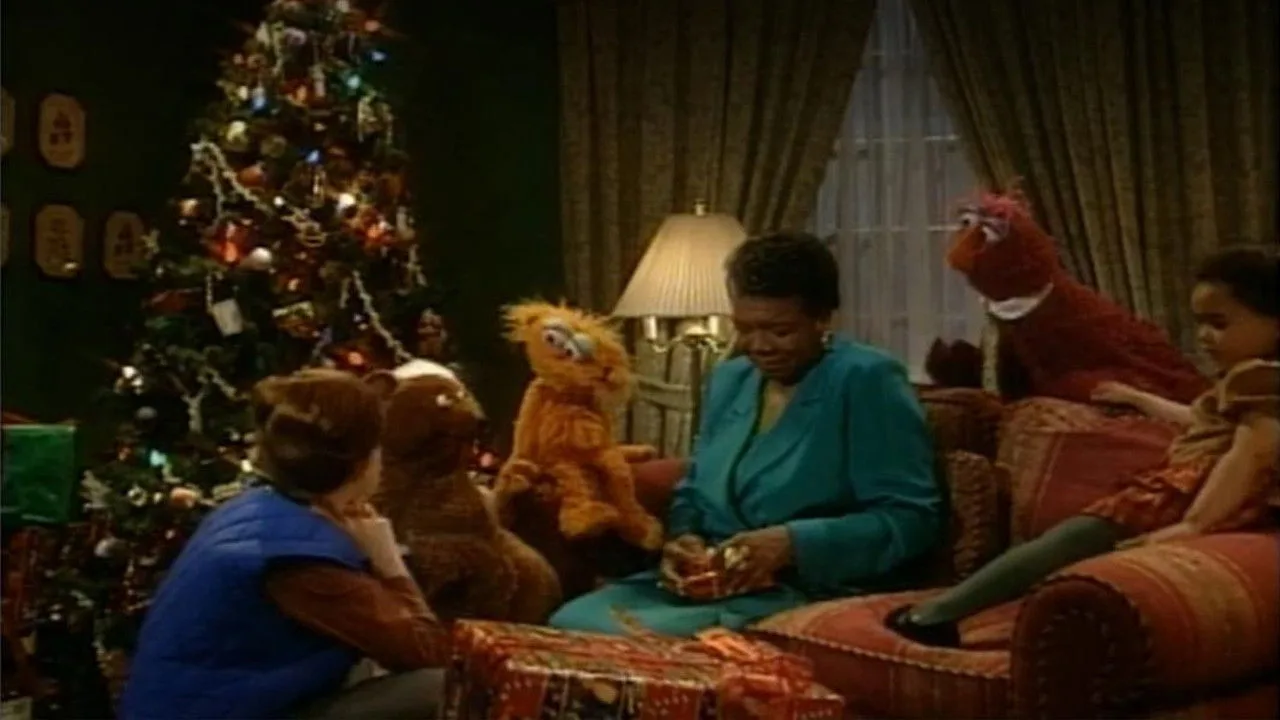
The decision to cast Maya Angelou as the narrator is one of the more quietly bold choices in children's holiday television. Angelou wasn't doing much children's media at the time. She had delivered the inaugural poem at President Clinton's 1993 inauguration three years earlier. Her voice carries authority without condescension, and the special uses it well.
She frames the story with a knowing detachment that suits the "be careful what you wish for" structure. When things go wrong, Angelou's narration doesn't panic or rush. It watches. That tonal steadiness is what keeps the special from tipping into either slapstick or anxiety.
Charles Durning's Santa
Durning was 71 when this was filmed, a veteran character actor with decades of stage and screen work behind him. His Santa is physically warm and vocally gentle, and he plays the one scene where Santa has to tell Elmo the truth, gently but without sugarcoating, with real care. It's a small moment in a children's production, but Durning earns it.
He had played Santa before, in the 1983 television movie A Christmas Story, though in a much smaller capacity. By 1996 he had the role down. Santa should feel inevitable, like he's always been there. Durning managed that.
Harvey Fierstein as Easter Bunny
Fierstein's Easter Bunny is the comedic highlight. He voices the character with his distinctive gravelly rasp, which should not work for a pastel holiday rabbit and absolutely does. The Easter Bunny functions as a kind of Greek chorus for what's wrong with Elmo's wish: if every day is Christmas, every other holiday disappears, and the Easter Bunny has nowhere to be.
It's a sharp bit of writing. The special could have illustrated the problem with generic "Christmas fatigue" but instead gives it a face, and that face is Harvey Fierstein complaining about unemployment.
The Lesson, Stated and Earned
The "be careful what you wish for" lesson is stated explicitly multiple times, which is correct for a production aimed at four-year-olds. But the special also earns it through the plot rather than just asserting it. Elmo has to see the consequences play out over what feels like an entire year before he understands what he's done.
The ending requires Elmo to use a second wish to undo the first, which raises a metaphysical question the special wisely ignores: if Santa could grant an unlimited-Christmas wish and then take it back, why did any of this have to happen. Don't ask that question. The children watching don't, and they're the ones the movie is for.
What the special gets right is that Christmas is good partly because it's rare. The specialness depends on the waiting. When you remove the waiting, you don't get more joy. You get depletion. For a 1996 Sesame Street video aimed at preschoolers, that's a sophisticated point, and it lands.
Fun Facts
Maya Angelou, who narrates the special, had recited her poem "On the Pulse of Morning" at President Bill Clinton's inauguration in January 1993, making her one of the most prominent literary figures in America when she was cast for this production three years later.
Harvey Fierstein, who voices the Easter Bunny, won two Tony Awards in 1983 for both writing and starring in "Torch Song Trilogy" on Broadway. His casting as a holiday mascot voicing complaints about unemployment is one of the more unexpected moves in Sesame Street history.
Charles Durning, who plays Santa Claus, received two Academy Award nominations in his career: Best Supporting Actor for "The Best Little Whorehouse in Texas" (1982) and "To Be or Not to Be" (1983). He did not win either but remained one of the most respected character actors of his generation.
The special was produced by Jim Henson Productions and Sony Wonder, released direct-to-video in 1996. It was not broadcast as a television special initially, which made it something of a cult find for families who discovered it at video rental stores.
The baby reindeer Lightning, whose rescue by Elmo sets the entire plot in motion, is one of the few new characters introduced into the Sesame Street Christmas universe who interacts directly with Santa's established mythology.
The premise of "Christmas every day" has precedent in literature: the 1892 short story "Christmas Every Day" by William Dean Howells covers nearly identical thematic territory, suggesting the idea was already well-worn when Sesame Street revisited it over a century later.
Elmo's transition from a minor background character to the star of his own specials accelerated significantly in the mid-1990s after "Elmo's World" segments became a dominant part of Sesame Street. This special was part of that broader shift in the show's center of gravity toward Elmo.
Cast