
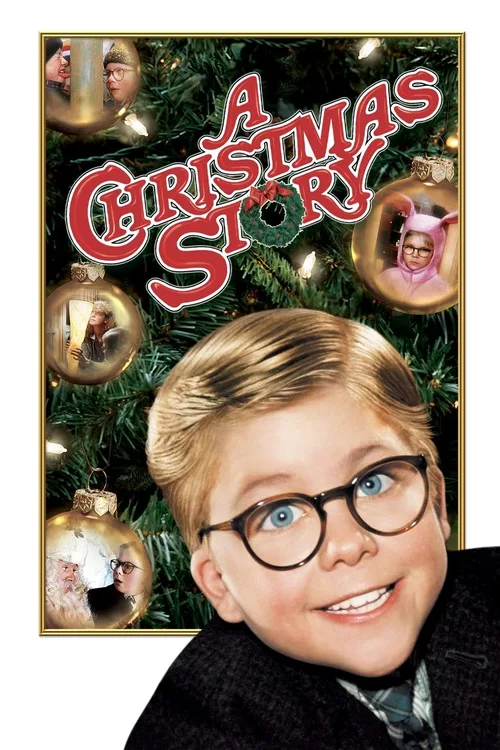
A tribute to the original, traditional, one-hundred-percent, red-blooded, two-fisted, all-American Christmas.
A Christmas Story (1983)
The comic mishaps and adventures of a young boy named Ralph, trying to convince his parents, teachers, and Santa that a Red Ryder B.B. gun really is the perfect Christmas gift for the 1940s.
 rating 8/10 User rating 1,388 votes 72%
 ❄ Christmas Connection
A Christmas Story is set entirely during the Christmas season in 1940s Indiana, centering on a boy's quest for the perfect Christmas gift. Every scene revolves around holiday anticipation, family traditions, and the raw excitement of Christmas morning.
Where to Watch


Our Review
A Christmas Story opened in November 1983 to modest box office returns and mixed reviews. It earned $20 million against its $4 million budget, respectable but unremarkable. Then something unusual happened. Through cable television reruns, the film burrowed into American culture so deeply that by the 2000s, TBS was running a 24-hour marathon of it every Christmas, and the leg lamp had become a decorating staple in homes that had never seen the movie.
Directed by Bob Clark and based on Jean Shepherd's semi-autobiographical stories, the film follows nine-year-old Ralphie Parker through the agonizing weeks before Christmas in 1940s Hammond, Indiana. Ralphie wants one thing: a Red Ryder Carbine Action 200-shot Range Model air rifle. Every adult in his life tells him the same thing. "You'll shoot your eye out, kid."
Shepherd's Narration Makes It Work
Jean Shepherd narrates the film as the adult Ralphie, looking back on his childhood with a voice that's warm without being sentimental. Shepherd was a radio raconteur who had spent decades telling these stories on WOR in New York, and his delivery has the practiced ease of a man who has been refining these anecdotes for years. The narration doesn't explain what's on screen. It adds a layer of adult perspective that makes the childhood experiences funnier.
"My old man's derby hat was gone, and the kid was still alive." That line, delivered over the image of a shattered lamp, tells you everything about this family without a single scene of exposition. Shepherd understood that humor lives in specificity, and every detail in his narration, from the pink bunny suit to the Bumpus hounds, lands because it's exact.
The Leg Lamp and Other Icons
The "major award" leg lamp has transcended the film entirely. You can buy full-size replicas, ornament versions, cookie cutters, and string lights shaped like the fishnet-stockinged leg. It has become a Christmas decoration in its own right, displayed by people who find it genuinely funny and those who display it ironically. The film's production designer found the original lamp at a prop house and modified it. No one expected it to become iconic.
A Christmas Story is built from moments, not a plot. The triple-dog dare tongue-on-flagpole scene. The department store Santa with the boot. The Chinese restaurant dinner ("Fra-gee-lay"). Each one functions as a standalone sketch, connected by Ralphie's obsessive campaign for the BB gun. The structure mirrors how people actually remember childhood: not as a continuous narrative, but as vivid, disconnected episodes.
Why 1940s Nostalgia Landed in 1983
Bob Clark set the film in the early 1940s, and the production design is meticulous. The Parker house, the Higbee's department store, the schoolyard, all of it feels lived in rather than art-directed. Cleveland stood in for Hammond, Indiana, and the actual house at 3159 W. 11th Street has since been converted into a museum that draws over 100,000 visitors annually.
The film taps into a specific flavor of Christmas nostalgia that isn't about wealth or perfection. The Parker family is solidly working class. The furnace fights back. The turkey gets eaten by the neighbor's dogs. Christmas morning brings genuine joy not because everything goes right, but because the kid gets the gift despite every obstacle. That's a more honest version of the holiday than most Christmas films are willing to offer.
The Marathon Phenomenon
Since 1997, TBS (later TNT) has aired the "24 Hours of A Christmas Story" marathon beginning on Christmas Eve. The marathon consistently ranks among the highest-rated cable broadcasts of the season, drawing tens of millions of combined viewers. The film's episodic structure makes it ideal for drop-in viewing. You can catch any 15-minute stretch and be entertained, which is exactly how most people watch it during the marathon.
Peter Billingsley, who played Ralphie at age twelve, went on to become a film producer, working alongside Vince Vaughn and Jon Favreau. He appeared briefly in Iron Man as a Stark Industries engineer, a cameo that delighted exactly the kind of people who watch A Christmas Story every year.
Fun Facts
The film's house at 3159 W. 11th Street in Cleveland, Ohio was purchased by a fan in 2004 for $150,000 and converted into a museum. It now draws over 100,000 visitors per year.
Jean Shepherd, who narrates the film as the adult Ralphie, makes a cameo in the department store Santa line scene as the man who tells Ralphie the line starts further back.
The tongue-on-flagpole scene used a hidden suction tube to create the effect. The child actor, Scott Schwartz, was never in danger, but the scene required multiple takes in freezing temperatures.
Director Bob Clark also directed Black Christmas (1974), widely considered one of the first slasher films. He bookended his career with Christmas at both ends of the genre spectrum.
The leg lamp prop was custom-built for the film. After the movie's success, replica lamps became a multi-million dollar industry, with the official version selling hundreds of thousands of units.
TBS paid $500,000 for the broadcast rights in 1997. The 24-hour marathon format was born when the network needed to fill programming on a low-viewership holiday and the film's episodic structure proved perfect for all-day viewing.
Cast