
The Christmas Box (1995)
A ski-shop owner reluctantly moves himself, his wife, and his daughter in to an estate as live-in help for an elderly widow. While struggling to balance his career and family life, he has recurring dreams about an angel.
 rating 7/10 User rating 12 votes 52%
 ❄ Christmas Connection
The Christmas Box is set entirely during the Christmas season and uses the holiday as its central dramatic engine. The mysterious gift box, the angel statue, and the snow-draped Utah setting are not decorative details but load-bearing story elements. The film argues, at full length, that Christmas is about grief acknowledged, time reclaimed, and the kind of love that doesn't require a bow on it.
Our Review
The Christmas Box aired on CBS on December 17, 1995, and drew 18 million viewers. That number is worth sitting with. In the peak era of the TV movie, a 90-minute holiday drama based on a self-published novella that Richard Paul Evans photocopied and gave to friends became the most-watched television event of that December. The book had sold over 4 million copies that year. People weren't stumbling onto this. They came looking for it.
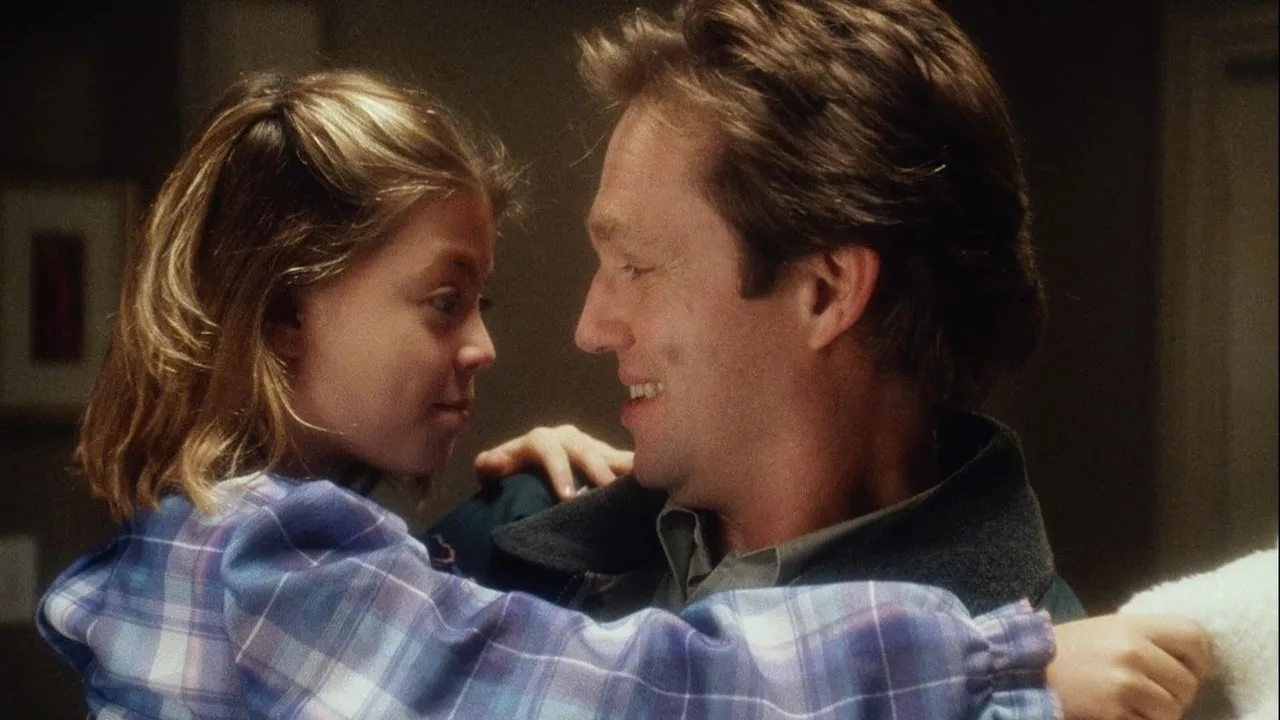
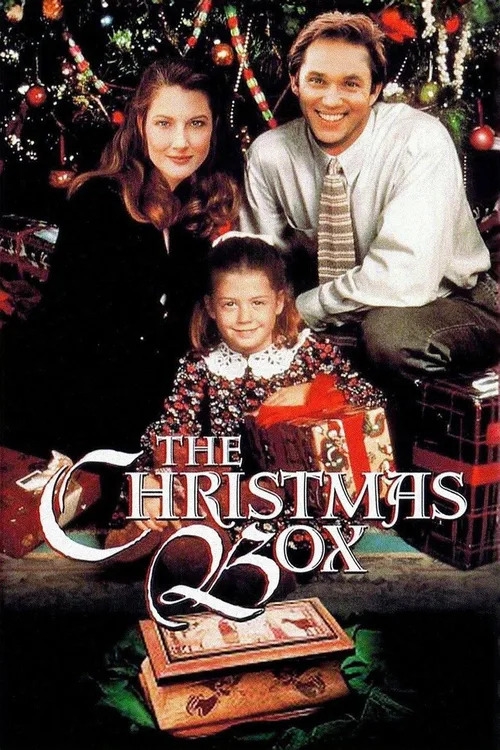
The setup is domestic and deliberately unhurried. Rick (Richard Thomas) and Keri Stanton (Annette O'Toole) move their young daughter Jenna into the spacious Victorian home of Mary Parkin, a wealthy widow played by Maureen O'Hara. The arrangement is practical: the Stantons get affordable housing, Mary gets company. What follows is less a Christmas movie in the commercial sense and more a quiet examination of what happens when a man too focused on his career finally hears what his family is trying to tell him.
What The Christmas Box Is Actually About
The surface story is Rick learning to be present. The deeper story belongs to Mary. In the attic, Rick discovers an old wooden box containing love letters written to a child who died. The angel statue in the garden, Mary's grief, and the letters combine to confront Rick with a question he hasn't thought to ask: what would he regret, looking back?
Evans wrote the novella as a gift to his own family in 1992 after his daughter was diagnosed with a life-threatening illness. That origin shows. The grief in this film isn't decorative. Mary's loss isn't resolved or softened into a Christmas lesson. It sits there, specific and real, and the movie is honest enough not to fix it.
This is where The Christmas Box diverges from most holiday television. The angel statue is never given a tidy supernatural explanation. The box doesn't contain magic. What it contains is evidence that love doesn't always arrive in time, and that Christmas can be the season when that fact becomes impossible to ignore.
Maureen O'Hara's Final Performance
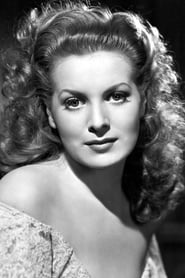
O'Hara had been largely absent from screens since the 1970s. She was 75 when she filmed The Christmas Box, and she brought to Mary Parkin the specific authority of someone who doesn't need to perform emotion because she has lived through enough of it. Her scenes with Richard Thomas are the film's best work. He's warm and capable throughout, but she anchors every scene she's in with a stillness that the material requires.
The connection to Miracle on 34th Street (1947) was not lost on audiences. O'Hara played the skeptical mother in that film, the one who had to be persuaded that Santa Claus was real. Here she plays a woman whose faith is not in question but whose grief is still unresolved decades after her loss. It's a fitting bookend, even if it wasn't planned as one.
O'Hara returned to acting one more time, in 2000's The Last Dance, but The Christmas Box is the role most people point to as her farewell. She said in interviews that the script moved her immediately, and that shows.
The Pacing Question
The Christmas Box is slow. Not slow the way prestige drama is slow, building toward something, but slow in the way of a film that trusts its audience to sit still. Some scenes exist mainly to establish the house, the snow, the family rhythms. If you come expecting the emotional velocity of a Hallmark production, you'll feel the 90 minutes.
That slowness is also its integrity. The film refuses to manufacture urgency. Rick's transformation doesn't arrive on cue. Mary's grief doesn't resolve cleanly. The story earns its ending by not rushing toward it.
Director Marcus Cole keeps the visual approach simple: the Victorian house lit with warm practical lighting, the Utah winter providing the white exterior world against which the interior drama plays out. There's nothing showy in the cinematography because showy would be dishonest to the material.
Richard Paul Evans and the Book Phenomenon
Evans wrote The Christmas Box in 1992 and initially self-published it, distributing copies to family and friends. By 1994, local bookstores were stocking it by popular request. Simon and Schuster acquired it in 1995, and it immediately became a phenomenon: 4.2 million copies sold in a single year, making it the #1 bestselling hardcover novel of 1995 in the United States.
That kind of word-of-mouth acceleration, before social media, before algorithmic recommendation, is genuinely remarkable. People bought it, gave it to someone, and that person bought ten more copies. The TV adaptation was essentially inevitable, and the production moved quickly to capitalize on the book's momentum while it was still in the public conversation.
Evans went on to write a sequel, Timepiece, in 1996, which was also adapted for CBS television. But The Christmas Box is the one that started it, and the one that still circulates on streaming services each December to find people who missed it the first time.
Fun Facts
Richard Paul Evans originally wrote The Christmas Box in 1992 as a personal gift for his two daughters. He had it photocopied at a local print shop and distributed fewer than 20 copies to family and close friends before it spread by word of mouth.
The book became the first self-published title to reach #1 on both the New York Times Fiction and Nonfiction bestseller lists simultaneously, a classification dispute that arose because retailers and critics disagreed on whether a first-person Christmas story counted as fiction or memoir.
Maureen O'Hara was 75 years old during production and had been living in semi-retirement in Ireland. The Christmas Box was filmed on location in Salt Lake City, Utah, which meant O'Hara traveled specifically for the project.
The angel statue that figures prominently in the plot is based on an actual monument in Salt Lake City's Salt Lake City Cemetery. The grave it marks is for a young child, and Evans visited it while writing the original novella.
CBS paid $1.4 million for the rights to the novella before it had been acquired by a major publisher, a significant sum for a TV movie adaptation of a self-published book in 1995.
The film drew approximately 18 million viewers on its original broadcast date of December 17, 1995, making it the highest-rated television movie of that Christmas season by a wide margin.
Annette O'Toole, who plays Keri Stanton, is best known today for playing Martha Kent in the TV series Smallville (2001-2011), but in 1995 she was perhaps most recognized for playing Lana Lang opposite Christopher Reeve in Superman III (1983).
Richard Thomas, who plays Rick Stanton, has been associated with Christmas nostalgia since his role as John-Boy Walton in the long-running CBS family drama The Waltons (1972-1981), which frequently featured Christmas episodes. His casting in The Christmas Box was not an accident.
Cast