
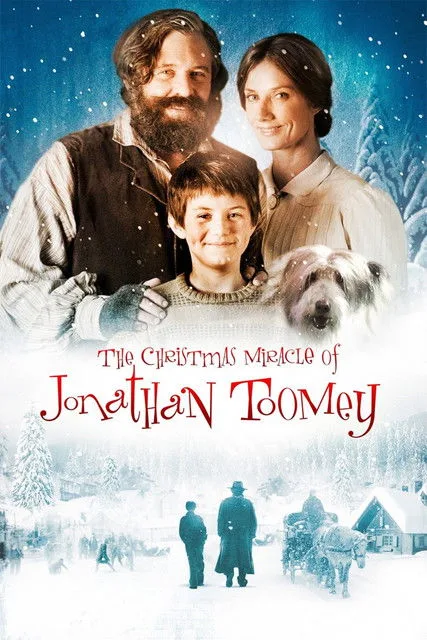
The Christmas Miracle of Jonathan Toomey (2007)
When a broken hearted boy loses the treasured wooden nativity set that links him to his dead father, his worried mother persuades a lonely ill-tempered woodcarver to create a replacement, and to allow her son to watch him work on it.
 rating 7/10 User rating 38 votes 57%
 ❄ Christmas Connection
A woodcarver's grief thaws through the Christmas season as he carves a Nativity set for a widow and her son, with the holiday itself driving both the plot and emotional resolution.
Where to Watch


Our Review
A Quiet Kind of Christmas Magic
The Christmas Miracle of Jonathan Toomey (2007) is the kind of film that arrives without fanfare and leaves you unexpectedly moved. Directed by Bill Clark and based on Susan Wojciechowski's best-selling 1995 illustrated picture book, it is a small, deliberate, and genuinely affecting Christmas story about what happens when grief holds a person hostage and a child refuses to take no for an answer. The film stars Tom Berenger as the title character, and he carries the whole picture on his broad, silent shoulders.
Toomey is a woodcarver living on the edge of a snow-dusted New England village. The children call him Mr. Gloomy, which is apt. He lost his wife and infant child years earlier, and he has not bothered to come back from that loss. He fills his days with precise, joyless work and his evenings with darker thoughts. When a recently widowed woman named Mrs. McDowell, played with warm restraint by Joely Richardson, commissions him to carve a replacement Nativity set, he accepts only because she is paying. What he does not plan on is her young son Thomas, played by Luke Ward-Wilkinson, who turns up each week to watch him work and refuses to be discouraged by silence or scowls.
Grief Carved in Wood
The film's central conceit is elegant and slightly heartbreaking. Each Nativity figure Toomey carves draws something out of him, a memory he has been suppressing, a feeling he has been refusing to name. Bill Clark's script leans into this structure with patience, letting scenes breathe rather than rushing toward resolution.
The pacing is slow by modern family-film standards, which will frustrate some viewers and reward others. This is not a film for people who want their Christmas movies to sparkle and bustle. It is a film for people who have known grief at Christmas and want to see it handled honestly.
Berenger gives arguably one of his more controlled performances here. There is no scenery-chewing, no grand breakdown. He conveys decades of pain through the set of his jaw and the way he holds himself apart from everything warm in the frame. Richardson matches him well, never playing Mrs. McDowell as a sentimental device but as a woman who recognizes suffering because she is living with her own version of it.
The Book Becomes a Film, More or Less
Fans of Wojciechowski's picture book and P.J. Lynch's luminous illustrations will find the film faithful in spirit if not in visual splendor. Lynch's artwork won the prestigious Kate Greenaway Medal in 1995, recognizing the year's finest children's book illustration by a British subject, and the book went on to sell over one million copies in the United States alone. That source material carries real emotional weight, and the film respects it. Clark wisely expands the story to feature length without bloating it, adding context for both Toomey's backstory and the McDowell family's circumstances without making either feel contrived.
Where the adaptation stumbles is in some of its supporting dialogue, which occasionally tips from sincere into corny. A few exchanges between the village characters land with an unintentional thud. Thankfully, the film's core relationship (the silent negotiation between a traumatized man and a persistent child) remains persuasive throughout.
A Career-Making Cameo Before the Oscars
Sharp-eyed viewers will spot a very young Saoirse Ronan in a small supporting role. This was among the Irish actress's earliest theatrical film appearances, made just a year before her breakout role in Atonement (2007) and her first Academy Award nomination. It is a blink-and-miss-it part, but knowing what came next makes it a fascinating footnote. The film also features Ronald Pickup and the late Jenny O'Hara in reliable supporting turns.
The Christmas setting is not merely decorative here. The countdown to Christmas Day creates genuine narrative pressure, and the moment when Toomey finally allows himself to grieve, using the likenesses of his lost wife and child for the figures of Mary and the infant Jesus, is quietly devastating. It is the kind of storytelling decision that earns its emotional payoff rather than stealing it.
Christmas Vibes and Final Verdict
The film was shot at Shepperton Studios in Surrey, England, which gives its American colonial village setting a slightly theatrical quality: all that pristine studio snow and firelit interiors. For a certain type of viewer, this is pure comfort. For others, it may feel slightly artificial. The production design opts for storybook warmth over gritty period realism, which suits the source material just fine.
Guy Farley's score underlines every emotional beat with strings and choir, and it sometimes pushes too hard. The film earns its tears; it does not always need to demand them. Still, this is a minor complaint against a picture that gets the important things right: the central performances, the structural elegance of the Nativity-as-healing-device, and the respect it shows for the difficulty of grief without wallowing in it.
The Christmas Miracle of Jonathan Toomey played at eight film festivals upon release and won Best Film at the Gloria Film Festival in Salt Lake City in 2007. That modest critical reception is about right. This is not a great film, but it is a genuinely good one -- the sort of Christmas movie that trades tinsel for something sturdier. It holds up because it never pretends grief is easy or that healing is instant. It simply argues that sometimes, a child's stubborn affection and the act of making something beautiful is enough to crack a person open.
Worth finding on a cold December evening, ideally with the lights turned low.
Fun Facts
The film is based on Susan Wojciechowski's 1995 picture book of the same name, which Wojciechowski reportedly wrote in under an hour after failing to find a new Christmas story she wanted to read aloud to children at her library.
Illustrator P.J. Lynch won the Kate Greenaway Medal for his artwork in the original book, one of the most prestigious prizes in British children's book illustration, recognizing the year's best illustration by a British subject.
The book sold over one million copies in the United States alone, making it one of the more commercially successful Christmas picture books of the 1990s before it was adapted for the screen.
Saoirse Ronan, who appears in a small supporting role, filmed this the same year as Atonement, the film that earned her her first Oscar nomination for Best Supporting Actress at just 13 years old.
The film was shot at Shepperton Studios in Surrey, England, despite being set in a 19th-century American New England village -- a common transatlantic production arrangement for British period-adjacent films.
The production played at eight separate film festivals before its wider release, an unusually wide festival run for a family Christmas film, and it took home the top prize at the Gloria Film Festival in Salt Lake City.
Director Bill Clark also wrote the screenplay himself, making him responsible for both the adaptation choices and the directorial decisions, a level of creative control that is relatively rare in commercially produced holiday films.
The Nativity set at the center of the story functions as a structural device as well as a plot object: each figure Toomey carves corresponds to a specific emotional memory he is forced to confront, giving the film an unusual architecture for a family Christmas movie.
Cast